Home   /   Tools

Template Creator > Letter Sample

Letter Templates let you store frequently used letters in a single, reusable format. Once created, the same letter template can be used in system to ensure consistent wording and style.
You can use Letter Templates in (Base on the access rights):

  • Case > Print Letters
  • Case > Send Email

Create Letter Template:

  1. Sign in to AgentFront CRM.
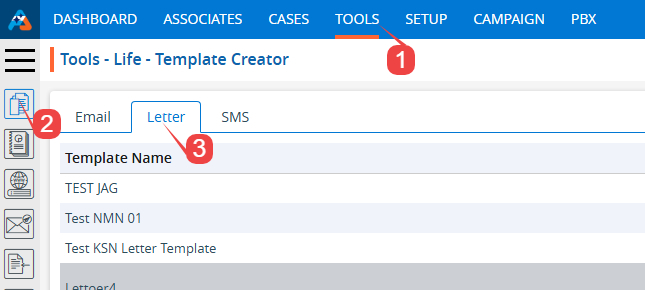
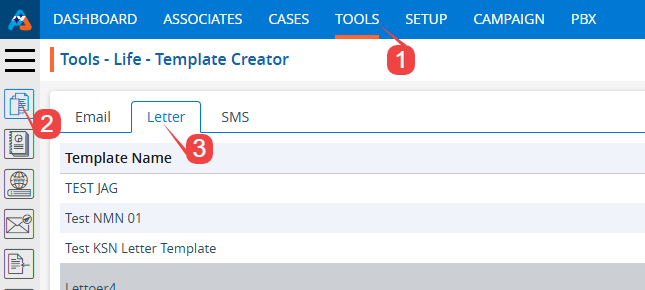
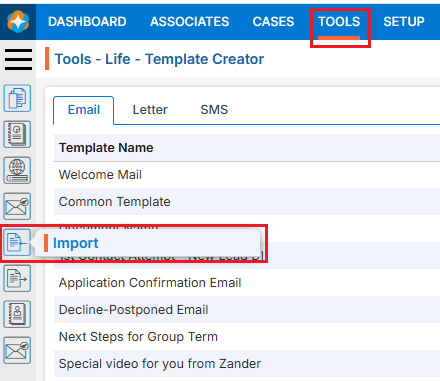
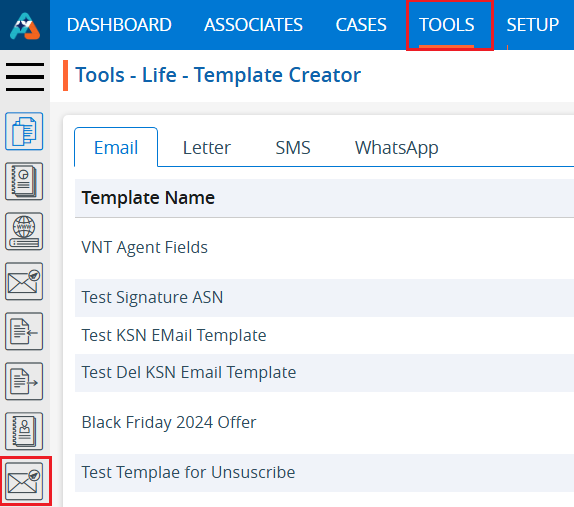
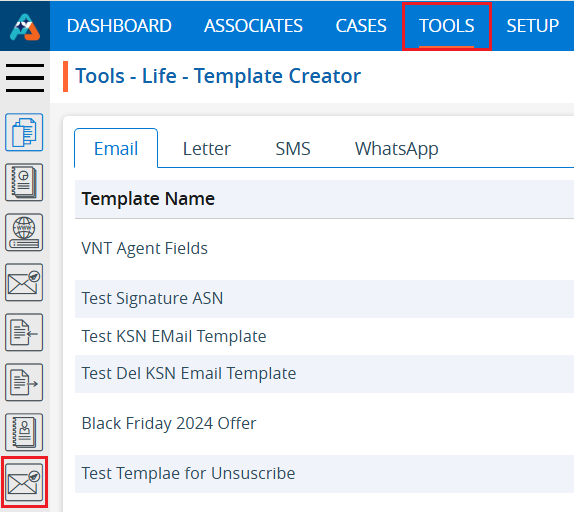
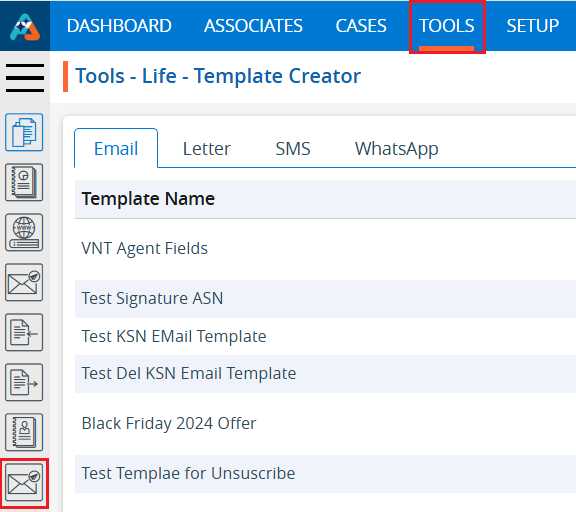
  2. From the top menu, choose Tools.
  3. In the left sidebar, select Template Creator.
  4. It will open Template Creator with multiple tab (Based on the access rights)
  5. Click on Letter tab
  6. It displays the list of available/created Lettes.
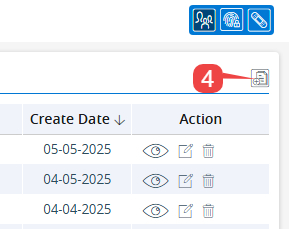
  7. Click on ‘Create Template Creator’ icon from the Top Right side of the list.
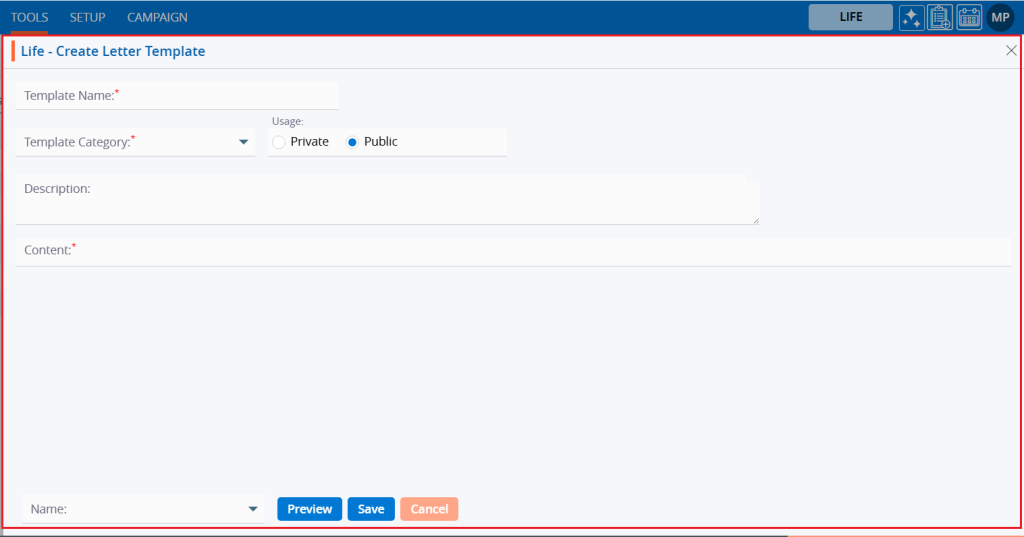
  8. It will open page to create new letter template
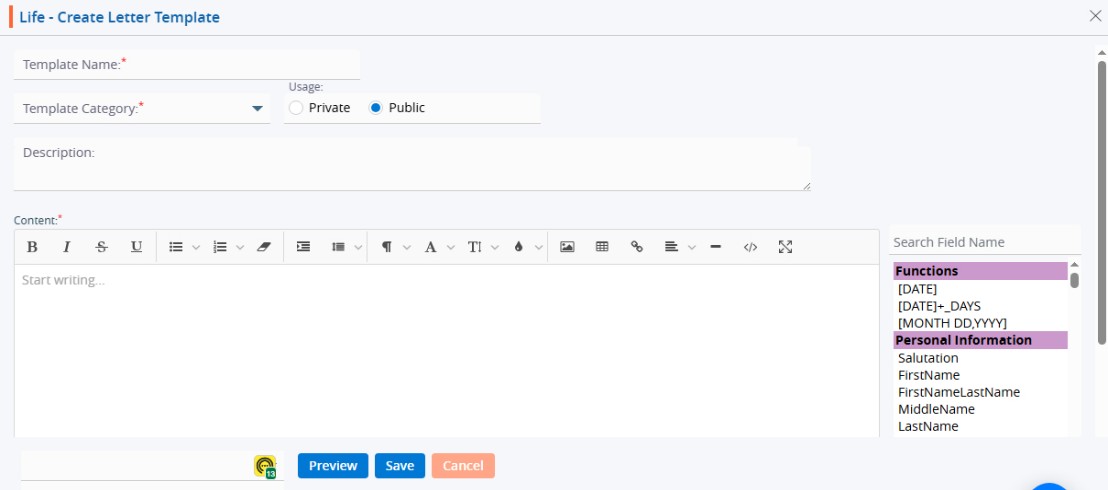
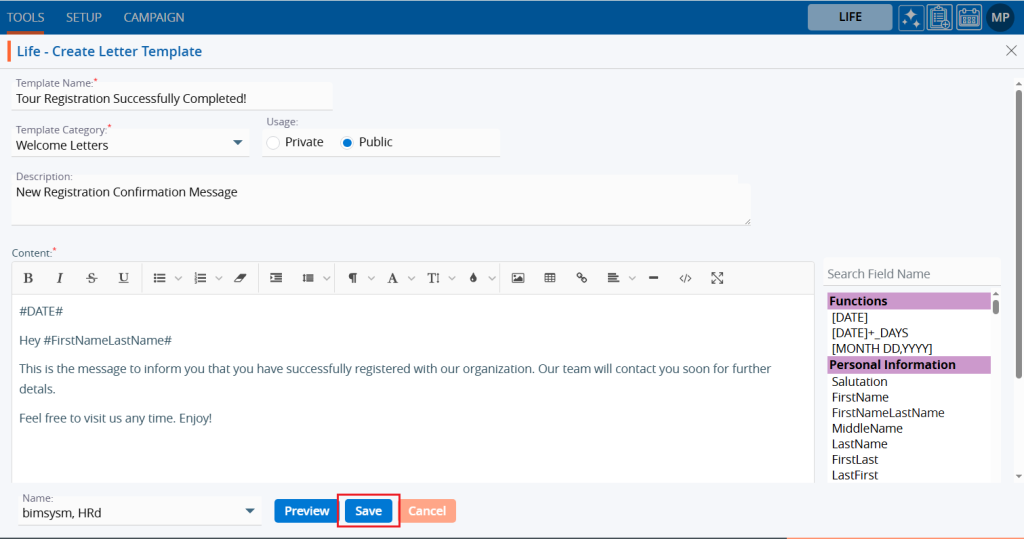
  9. To create new letter template, enter the following details:

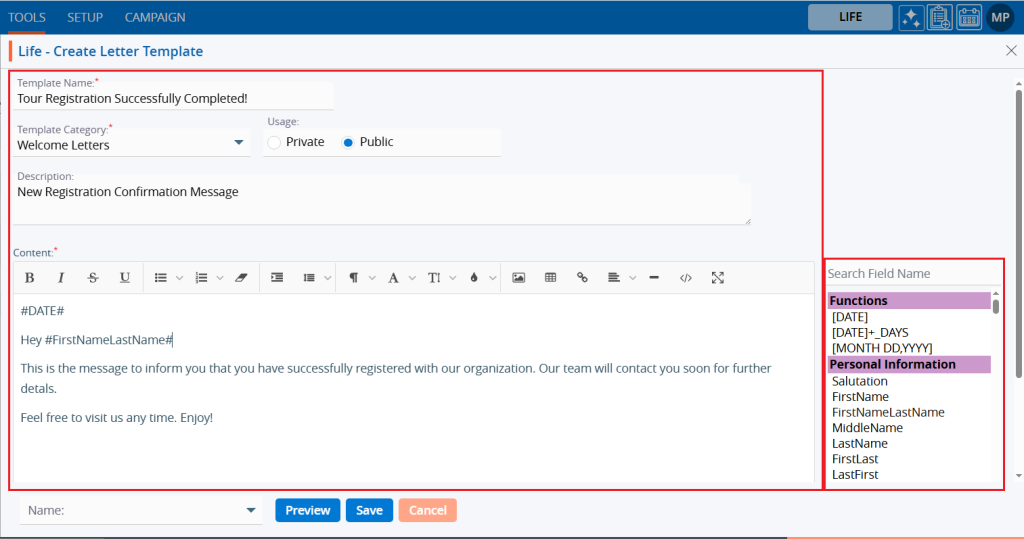
    1. Template Name: Enter clear, descriptive name. This is what users will see when they select a letter template from other places of the application.
    2. Template Category: Choose from the drop-down list. (Categories can be managed in Setup → System Setup → Template Category.)
    3. Usage: Option to select Public/Private. (Default will be Public).
      1. Public: Visible to anyone with access.
      2. Private: Visible only to the creator.
    4. Description: Optional explanation of the template’s purpose.
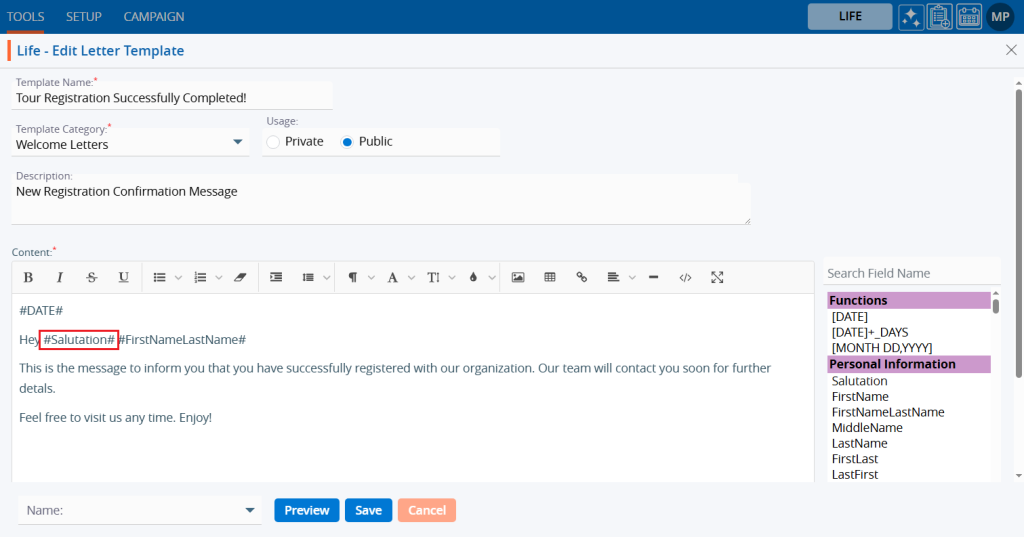
    5. Content: Write or paste the letter text. A rich-text editor appears when you click in the box. Use placeholders from the panel on the right to insert dynamic data—place the cursor where the value should appear, then click the required field.
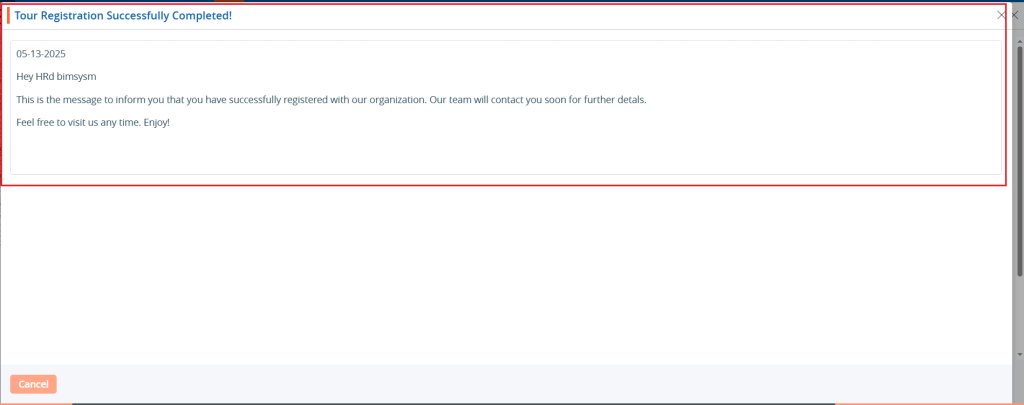
    6. Preview the letter: choose a sample person, then click Preview to verify that letter format and placeholders resolve correctly.
    7. Click Save. The template is now listed and ready for use.

Update Letter Template:

  1. Sign in to AgentFront CRM.
  2. From the top menu, choose Tools.
  3. In the left sidebar, select Template Creator.
  4. It will open Template Creator with multiple tab (Based on the access rights)
  5. Click on Letter tab
  6. It displays the list of available/created Lettes.
  7. From the list click on Edit (
    ) icon from the Action column for the letter you want to edit/change
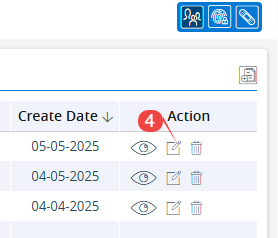
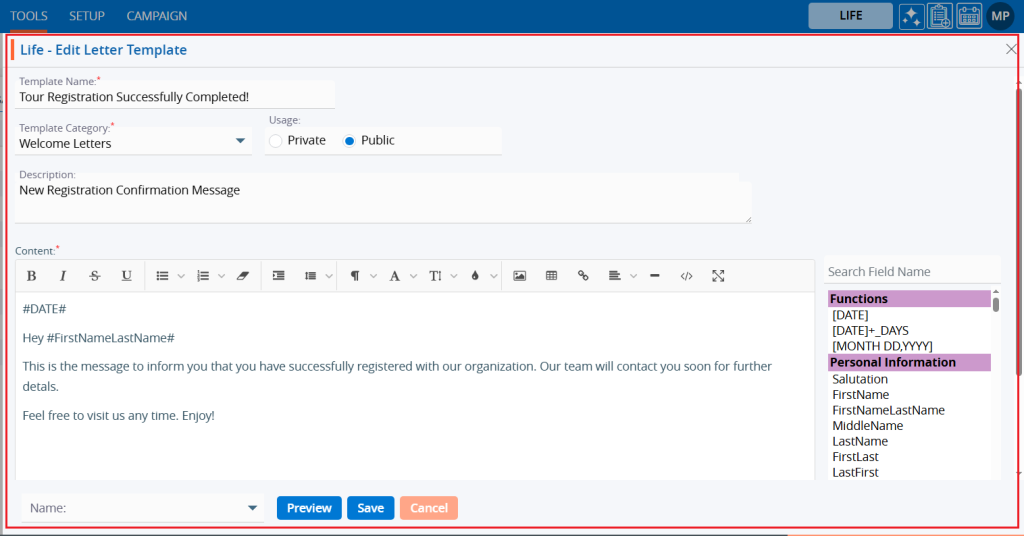
  8. It will open the selected letter in edit mode.
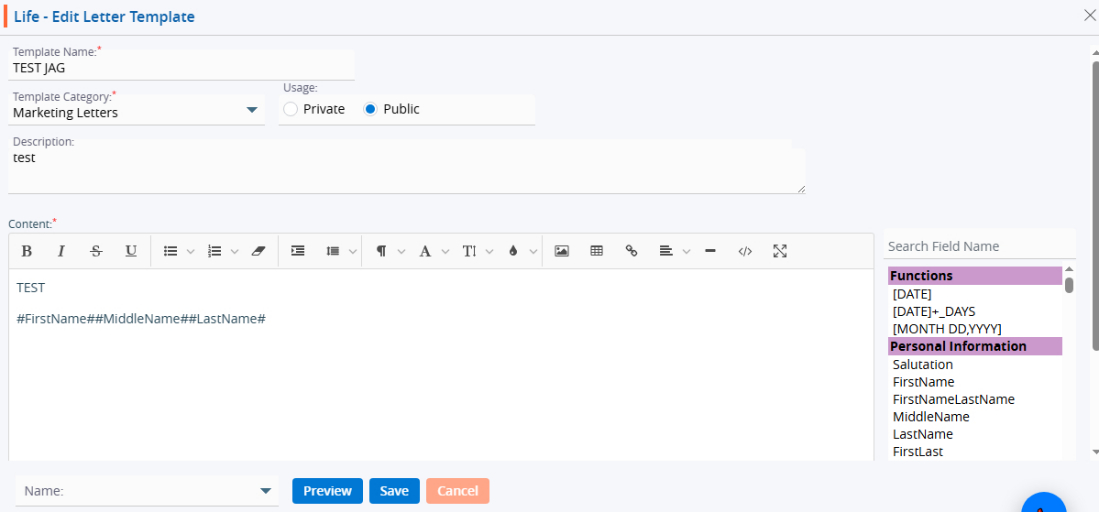
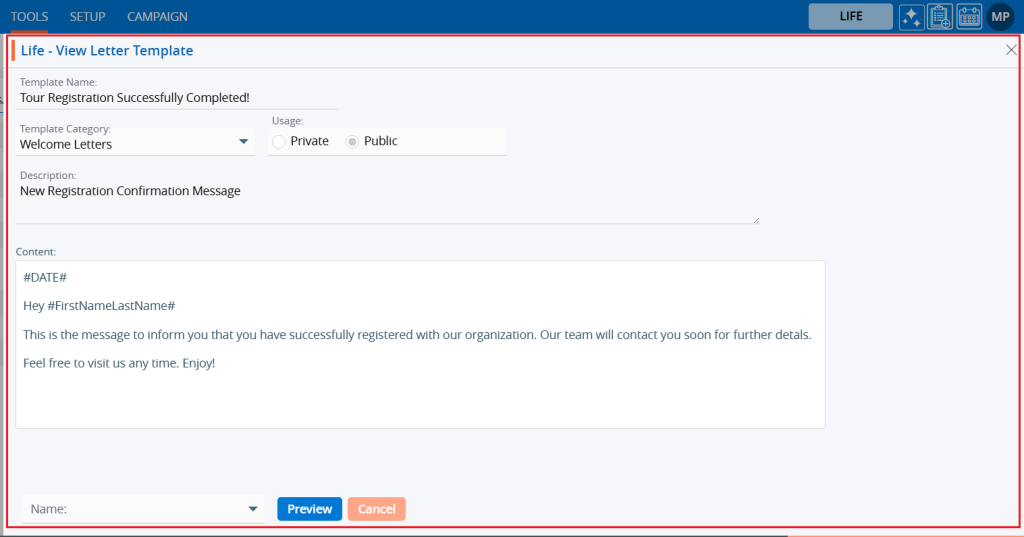
  9. You can make the require edit in the below fields values of the open letter templates
    1. Template Name: Enter clear, descriptive name. This is what users will see when they select a letter template from other places of the application.
    2. Template Category: Choose from the drop-down list. (Categories can be managed in Setup → System Setup → Template Category.)
    3. Usage: Option to select Public/Private. (Default will be Public).
      1. Public: Visible to anyone with access.
      2. Private: Visible only to the creator.
    4. Description: Optional explanation of the template’s purpose.
    5. Content: Write or paste the letter text. A rich-text editor appears when you click in the box. Use placeholders from the panel on the right to insert dynamic data—place the cursor where the value should appear, then click the required field.
    6. Preview the letter: choose a sample person, then click Preview to verify that letter format and placeholders resolve correctly.
    7. Click Save. The template is now updated and ready for use.

Delete Letter Template:

  1. Sign in to AgentFront CRM.
  2. From the top menu, choose Tools.
  3. In the left sidebar, select Template Creator.
  4. It will open Template Creator with multiple tab (Based on the access rights)
  5. Click on Letter tab
  6. It displays the list of available/created Lettes.
  7. From the list click on Delete (
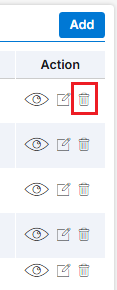
    ) icon from the Action column for the letter you want to delete.
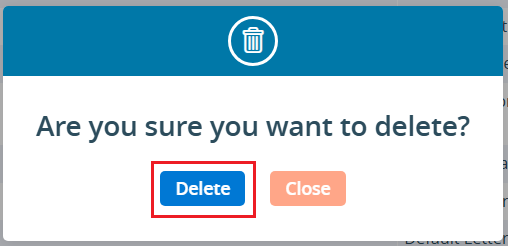
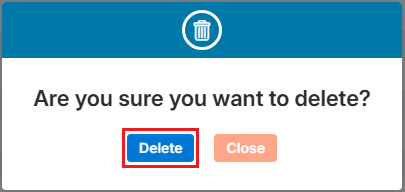
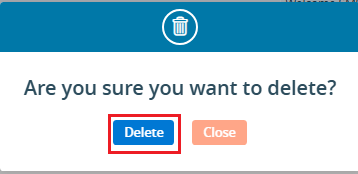
  8. It will ask for confirmation in popup, click on Delete button to delete letter otherwise click on Close button.
  9. Important: If the template is referenced elsewhere (for example, in a Trigger), deletion is blocked until those references are removed.

Multi-product tip

If your login has access to multiple products, be sure to select the correct product from the product icons in the top-right corner before creating, editing, or deleting templates.

3
0

Template Creator > Letter

The Letter Template tool is used to create templates for quick letter sending.

The following are the steps for creating letter templates:

1. Navigate to the ‘TOOLS’ tab. The Tools tab will open with the ‘Template Creator’ tab displayed by default. Click to Expand

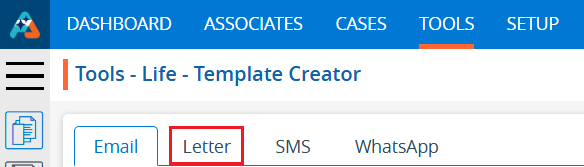
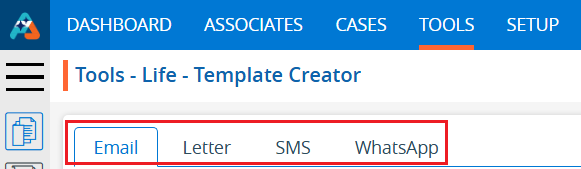
2. The user will see the ‘Tools – Template Creator’ with four different tabs: Email, Letter, SMS, and WhatsApp.

3. The ‘Email’ tab opens by default in the Document Editor, displaying a list of existing email templates along with details.

4. Click on the ‘Letter’ tab. Click to Expand

5. By clicking on the ‘Letter’ tab, a new list will open and display a list of existing letter templates, with details including Template Name, Category, Usage, Created By, Created Date and Action. Click to Expand

6. Click on the ‘Create Letter Template’ icon to create a new letter template. Click to Expand

7. A pop-up window will open with fields for Template Name, Template Category, Subject, Usage (default selected as Public), Description and Content. Click to Expand

8. Fill in the fields to create an Letter template. Also, on the right-hand side, there is a list of fields that will fetch details for the message. Search for field names to use in the templates. Double-clicking on the field will add it to the content area. For example, users can include fields such as FirstNameLastName and Date. Click to Expand

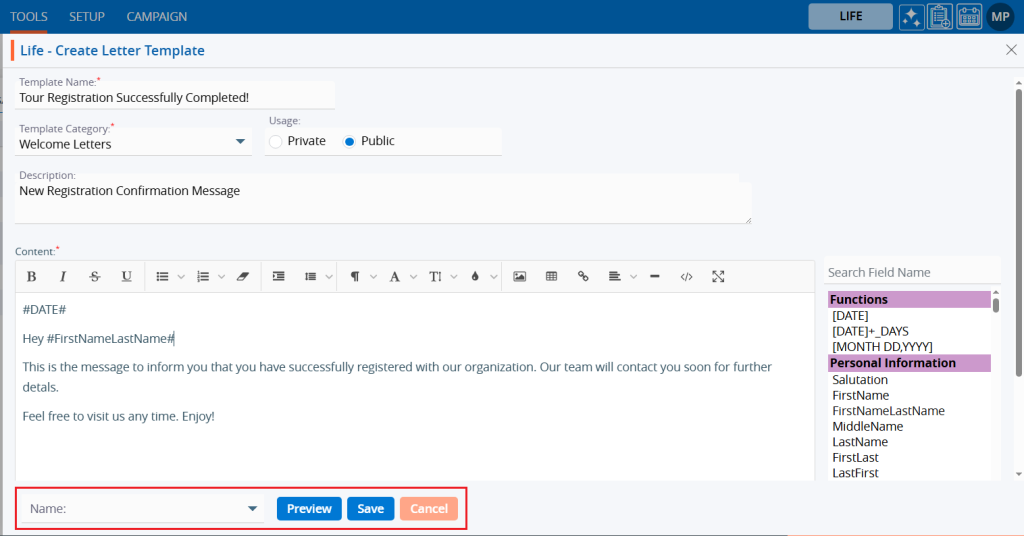
9. At the bottom, there is a dropdown menu with the names of associates and three buttons: Preview, Save, and Cancel. Click to Expand

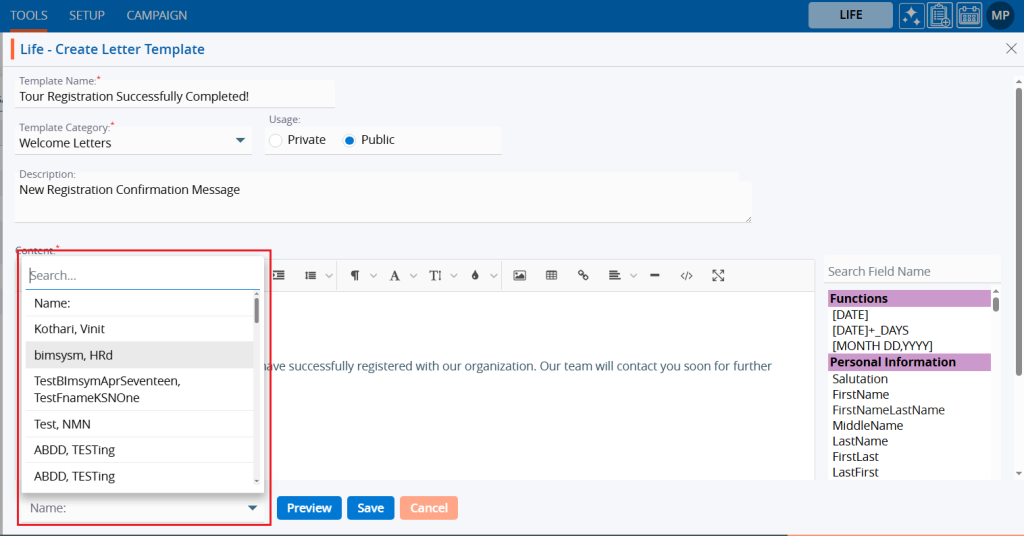
10. Select an associate’s name from the dropdown menu. Click to Expand

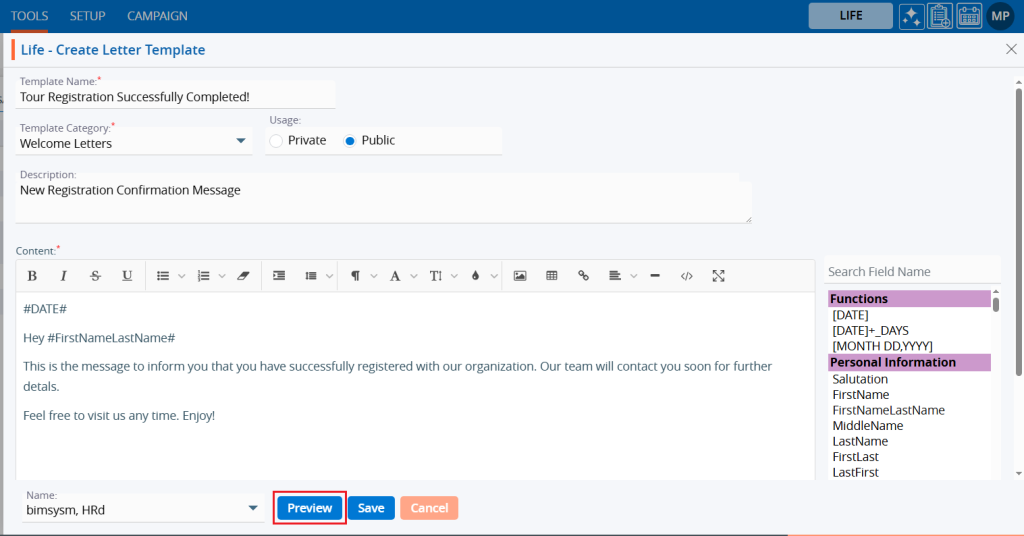
11. Click on the ‘Preview’ button. Click to Expand

12. A pop-up window will open, displaying the template details in preview mode. Click the ‘Cancel’ button to close it. Click to Expand

13. Click the ‘Save’ button. Click to Expand

14. A confirmation message will appear, and the user will find the newly created template in the list. Click to Expand

15. Click the ‘Edit’ option to modify the created template. Click to Expand

16. A pop-up window will open, allowing the user to update details of the template. Click to Expand

17. Click the ‘Edit’ option to modify the created template. Click to Expand

18. A pop-up window will open, allowing the user to update any details related to the template. Click to Expand

19. Update details to edit the template. For example, we have added ‘Salutation’. Click on ‘Save’ button. Click to Expand

20. A confirmation message will appear that the template has been updated, and the list will show the updated ‘Usage’ field value. Click to Expand

21. Select the ‘Delete’ option to remove the template from the list if it is no longer needed. Click to Expand

22. Select the ‘Delete’ option in the confirmation message to proceed with removing the template from the list. Click to Expand

23. After clicking on the Delete button, a confirmation message will appear, indicating that the template has been deleted and is no longer available in the list. Click to Expand

0
0
Import

The Import feature in CRM refers to the ability to upload and integrate external data into the system. This feature allows users to bring customer data into the CRM using spreadsheets, streamlining data management, avoiding manual entry, and ensuring accurate records. Import files must contain specific data in CSV format with delimiters, which will then be displayed in the CASES list.

Steps to Import Multiple Records

  1. Sign in to AgentFront CRM.
  2. From the top menu, choose Tools.
  3. In the left-side panel, select Import.
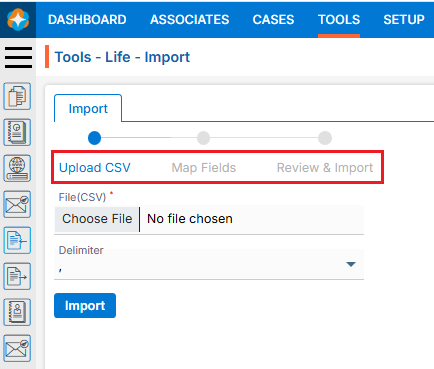
  4. A new page titled ‘Tools – Life – Import‘ will open, featuring the ‘Import’ tab with three steps to complete the process.
  5. There will be 3 steps to Import Data:
    • Upload CSV,
    • Map Fields, and
    • Review & Import
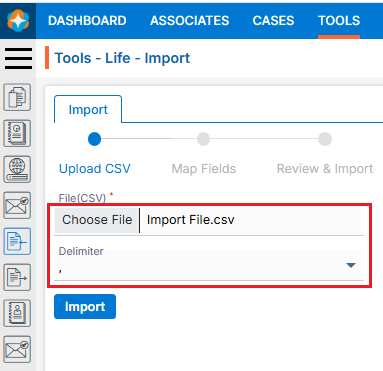
    • Upload CSV:
      1. Select the file containing the data you want to import into the application.
      2. Select Delimiter option from the drop-down. (The selected file format must match the selected delimiter option.)
      3. Click the Import button to proceed to the next step, Map Fields.
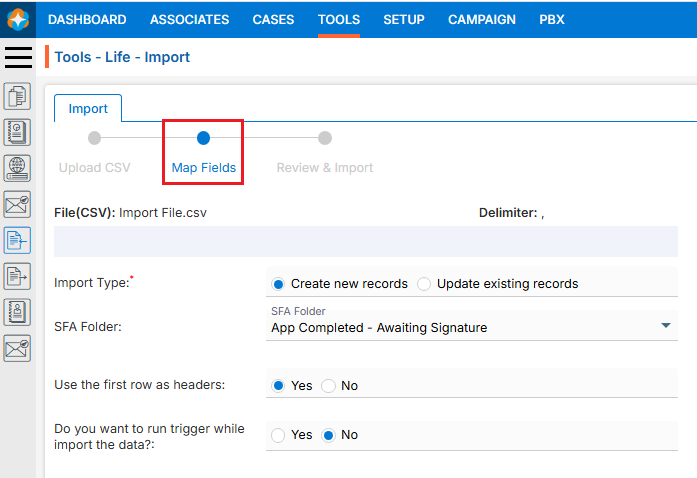
    • Map Fields:
      1. On the same page next step is for Map Fields.
      2. Selected file name and delimiter will be displayed on this page.
      3. There are 2 sections on this step:
        • First section: Selection of the options
        • Second section: Map the fields
      4. First Section: Following options need to be selected on this page:
        • Import Type: There are 2 following options:
          • Create new records: All records will be imported as new records.
          • Update existing records: Existing records will be updated. (A unique Case ID must be included in the file to update existing records)
        • SFA Folder: Select SFA in which you want to import the data.
        • Use the first row as headers: Select Yes/No. If Yes is selected, then first row will be considered as header and if No selected then first row will not be considered as header.
        • Do you want to run trigger while import the data?: Select Yes/No. If Yes is selected, then trigger will be run as per created from Setup > System Setup > Trigger Action and if No selected then no trigger will be run.
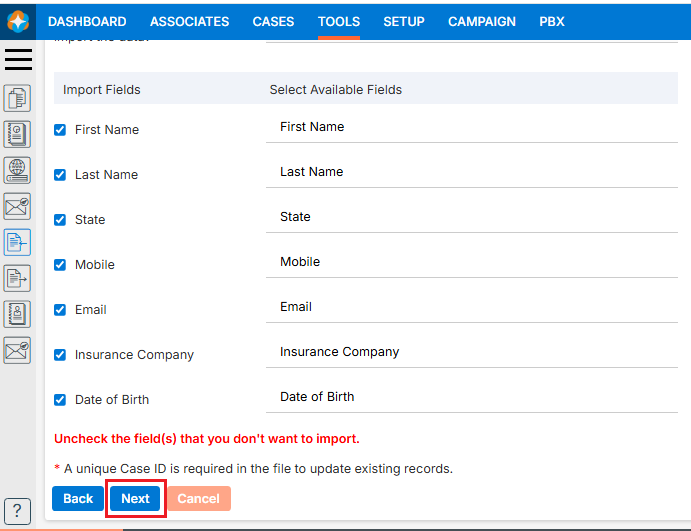
      5. Second Section: Needs to map the fields.
      6. On the left side the system shows the header row from the uploaded CSV file as we have selected Yes for ‘Use the first row as headers’.
      7. The “Available Fields” section displays all fields available in the application. Select the appropriate fields.
      8. Map the appropriate fields for each field from the dropdown. (Unique Case ID field is required if you selected ‘Update existing records’ option for ‘Import Type’).
      9. You can deselect unwanted fields by unchecking the checkbox before field name.
      10. Click Next.
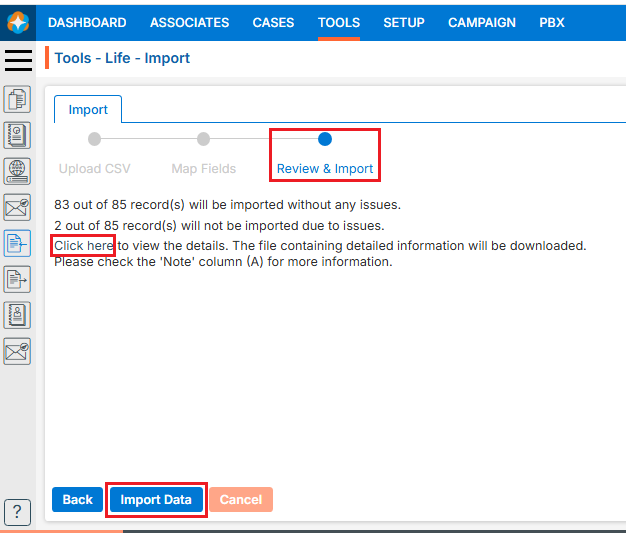
    • Review & Import
      1. On the same page next step is for Review & Import the data.
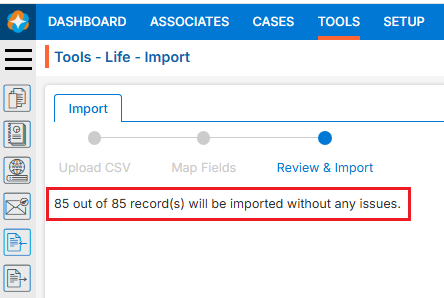
      2. Review page will display the counts of records with issues and without issues.
      3. The system generates a CSV file link containing the records with issues.
      4. Click “Click here” to download and review the file.
      5. Even records can be imported which are shown without any issues.
      6. Click on Import Data if you want to Import records which are shown without issues.
      7. If you want to correct all the records and then import them together, check the records in the downloaded file, correct the information, and then re-import them.
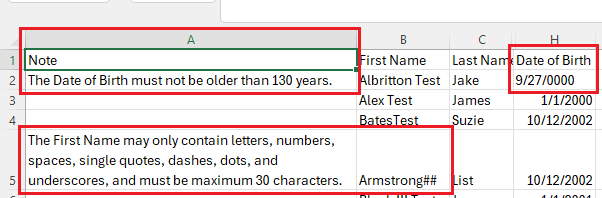
        Note: System will check each field’s validation for all records and display issue message in Column A. Here, DOB is incorrect for record #1, and the first name is incorrect for record #4.
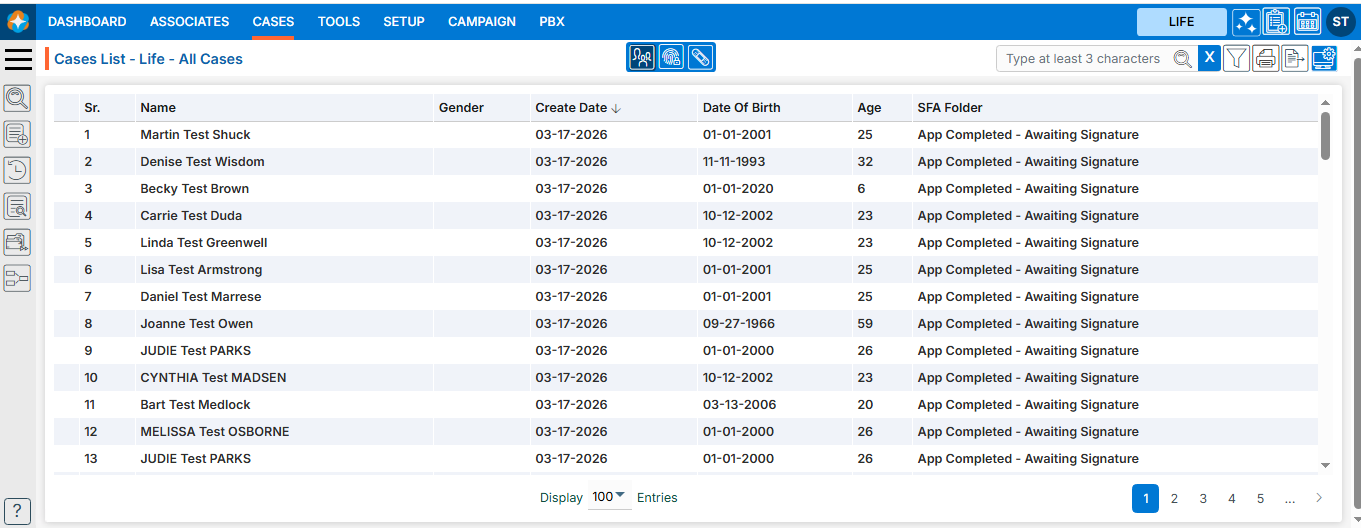
      8. Once all records are corrected click Import Data. Data will be imported and shown in the selected SFA Folder.
      9. All records will be shown under Cases and selected SFA Folder tab.
0
1

Template Creator > Email

Create templates to streamline and expedite email sending. These email templates can be used when sending any email from the system.

The following are the steps for creating email templates:

1. Navigate to the ‘TOOLS’ tab. The Tools tab will open with the Template Creator tab displayed by default.

2. Users will see the ‘Tools – Template Creator’ with four different tabs: Email, Letter, SMS, and WhatsApp.

3. The ‘Email’ tab opens by default in the Template Creator, displaying a list of existing email templates with details including Template Name, Category, Usage, Created By, Create Date and Action.

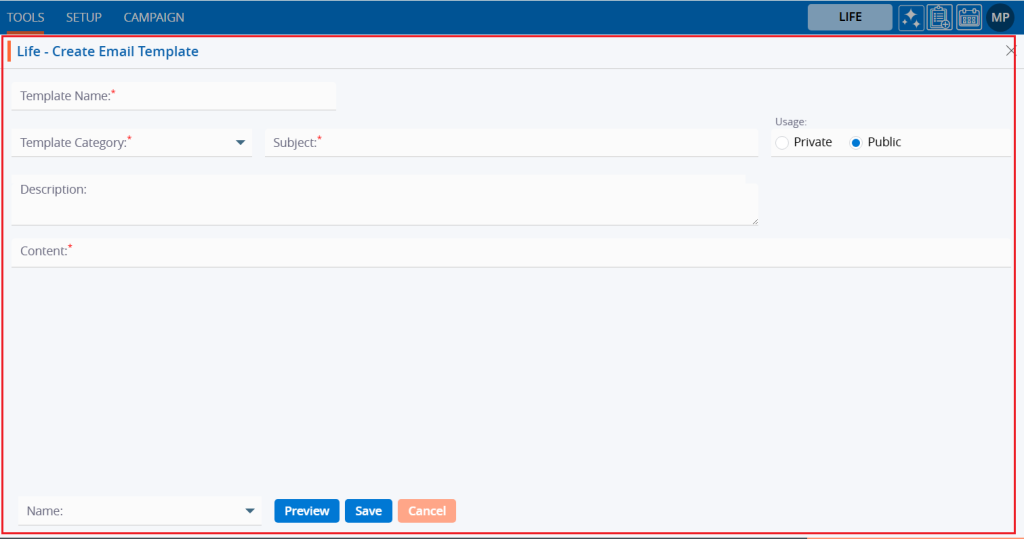
4. Click on the ‘Create Email Template’ icon to begin creating a new email template.

5. Click on the ‘Create Email Template’ icon to begin creating a new email template.

6. Fill in the fields. Fields with an asterisk are mandatory.

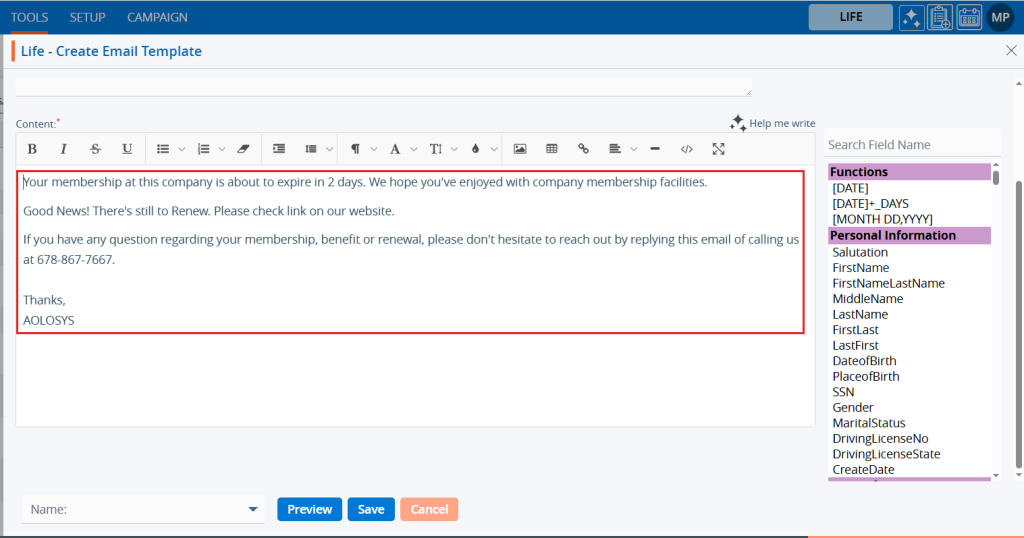
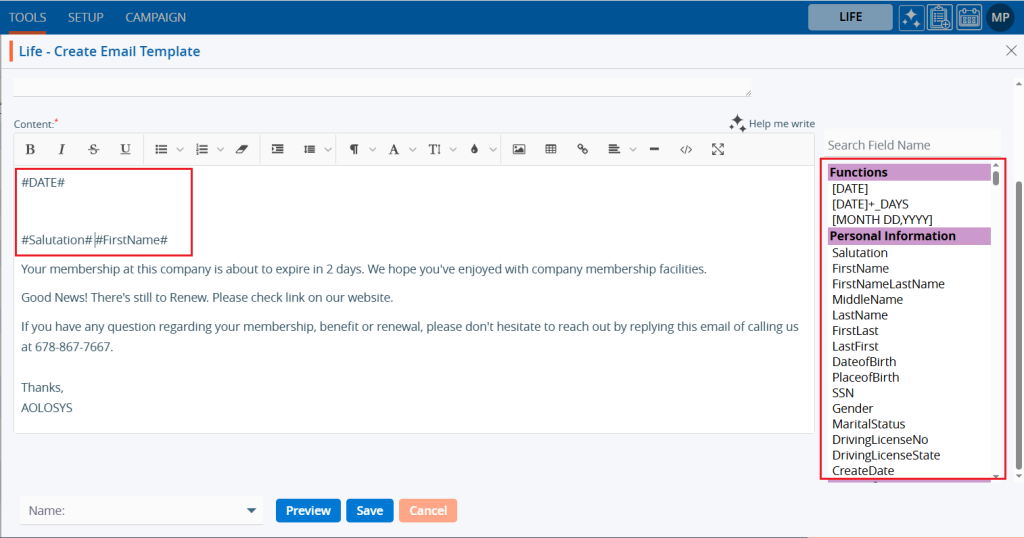
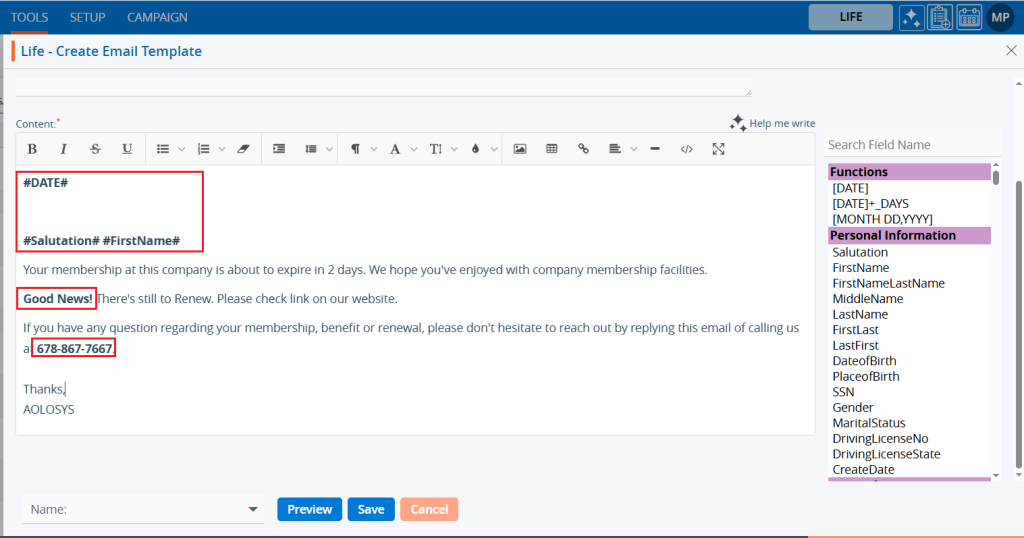
7. On the right-hand side, there is a list of fields that will fetch details for the selected user. Search for field names from the list to use in the templates. Double-clicking on the field will add them to the content. For example, users can include fields such as Date, Salutation, and FirstLast for mapping.

8. Users can apply formatting effects to specific text in the content editor, such as font styles, size, and headings. For example, use Bold for the Date, salutation, name fields, and the text ‘Good News!’ and phone number.

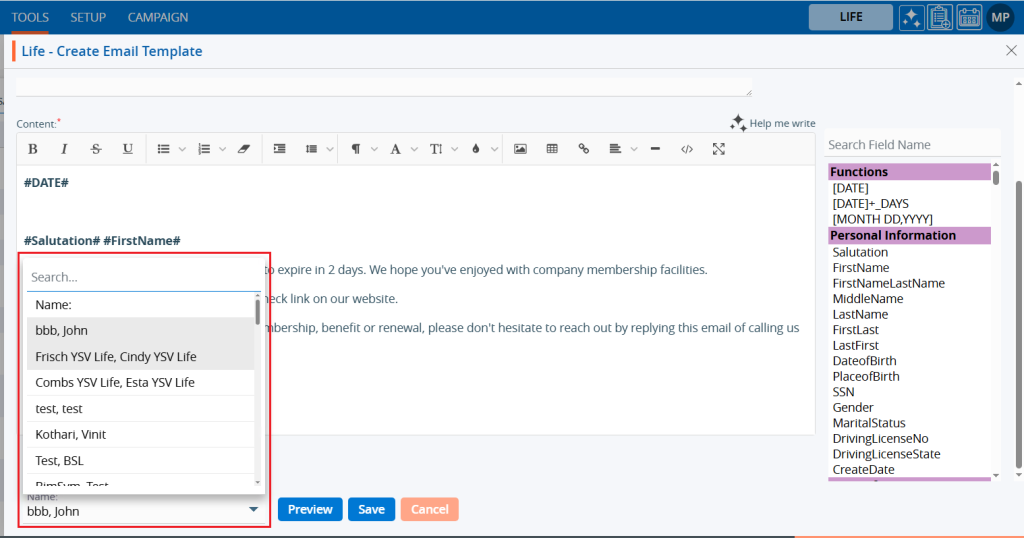
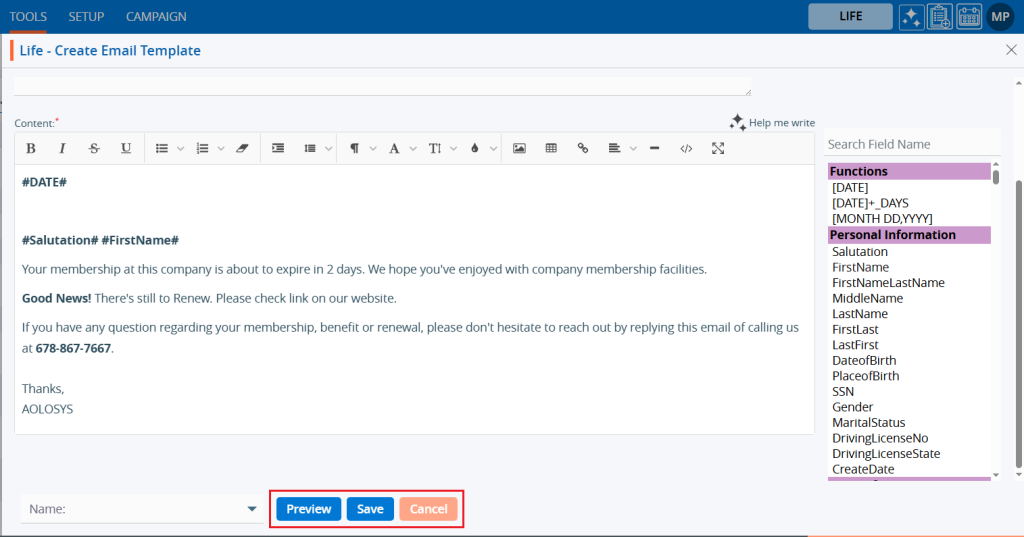
9. At the bottom, there is a dropdown menu with the names of the associates and three available buttons: Preview, Save, and Cancel.

10. Select an associate’s name from the ‘Name’ dropdown menu.

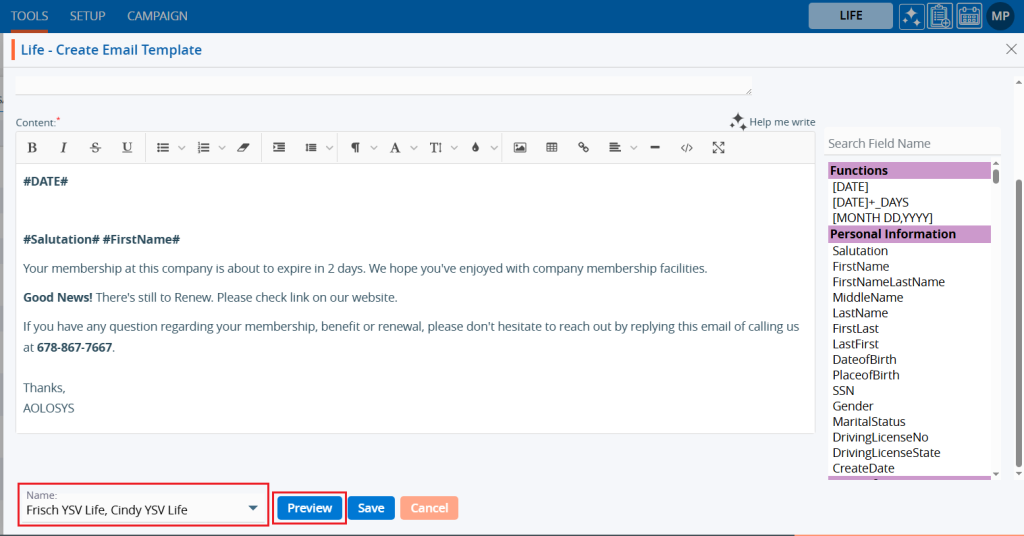
11. Click the ‘Preview’ button.

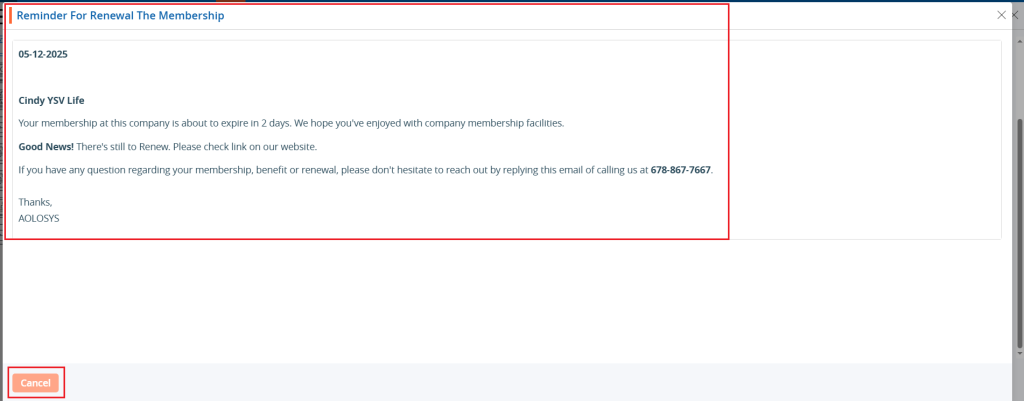
12. A pop-up window will open, showing the template details in preview mode. Click the ‘Cancel’ button to close it.

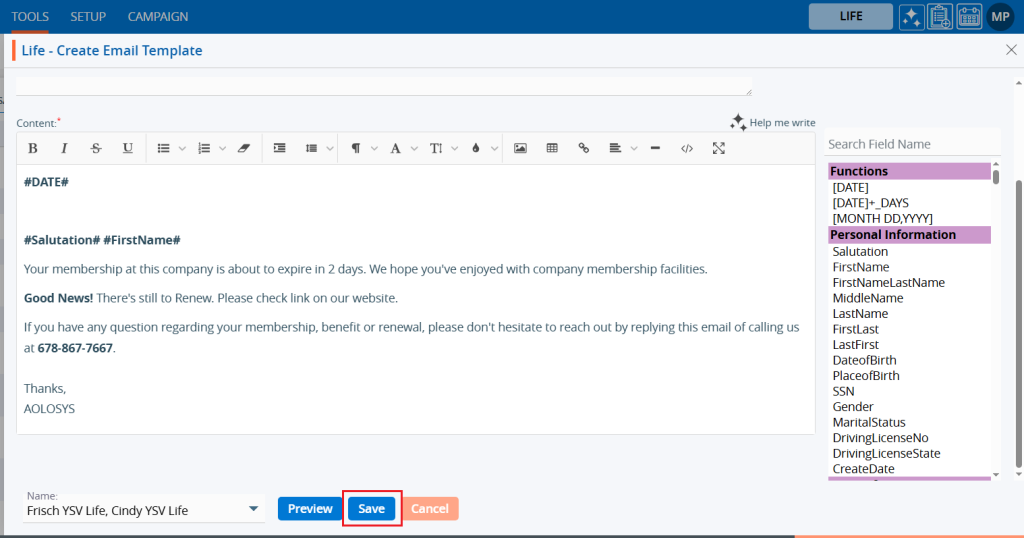
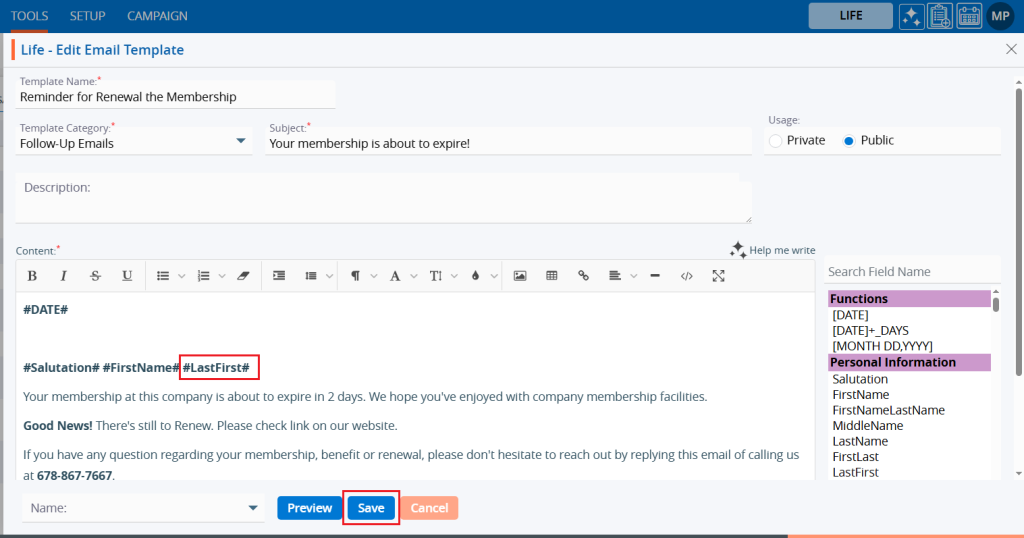
13. Click the ‘Save’ button.

14. A confirmation message will appear that the template is saved, and the user will find the newly created template and its details in the list.

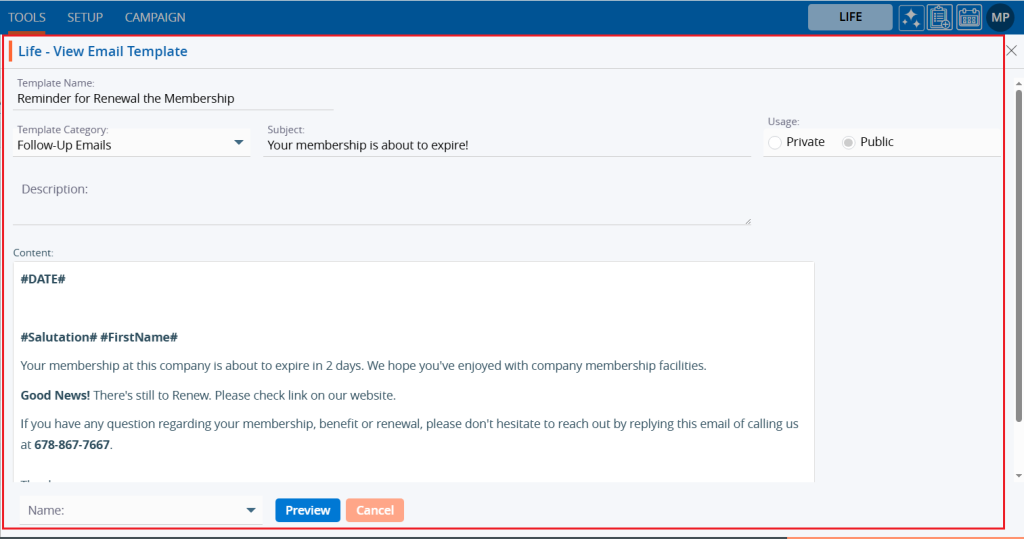
15. Click on the ‘View’ icon to view the existing Template.

16. A pop-up window will open, where the user can view the details of the template in read-only.

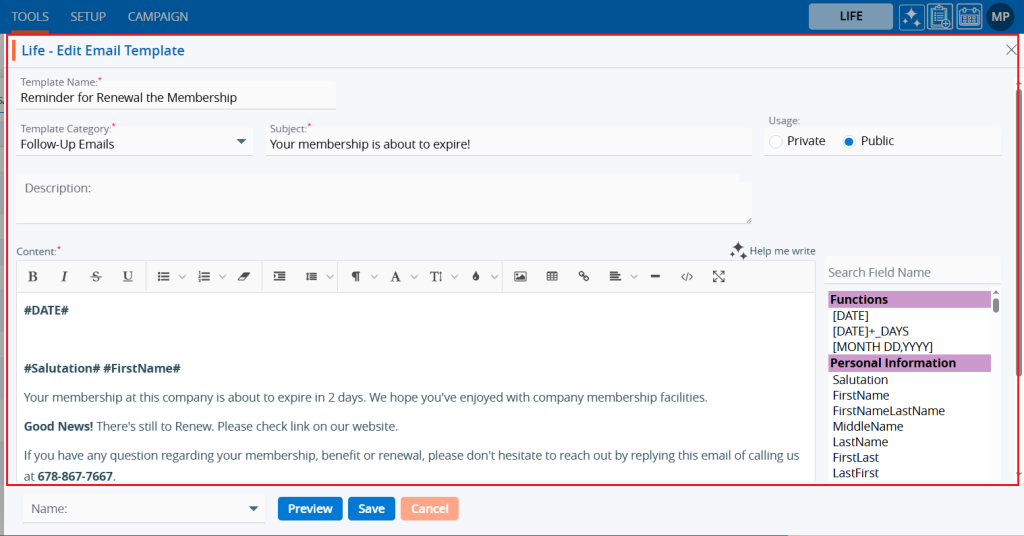
17. Click the ‘Edit’ option to modify the created template.

18. A pop-up window will open, allowing the user to update details of the template.

19. For example, we have added ‘Last Name’. Click on the ‘Save’ button.

20. A confirmation message will appear showing Email Template updated successfully.

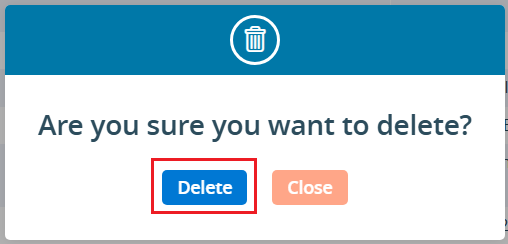
21. Select the ‘Delete’ option to remove the template from the list if it is no longer needed.

22. Select the ‘Delete’ option in the confirmation message to proceed with removing the template from the list.

23. After clicking on the Delete button, a confirmation message will appear, and the template is no longer available in the list.

0
0
Export

The export feature in a CRM system enables users to extract, export and download the data in multiple formats (e.g., CSV, XML, JSON). This data, which may include customer information, can then be utilized for analysis, reporting, or sharing across different purposes.

Steps to Export Multiple Records

  1. Sign in to AgentFront CRM.
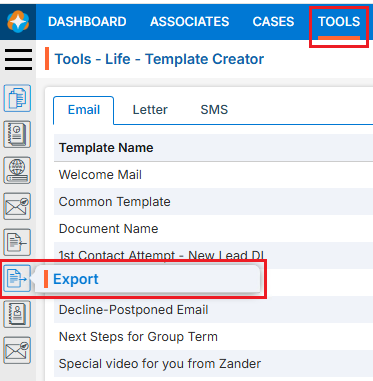
  2. From the top menu, choose Tools.
  3. In the left-side panel, select Export.
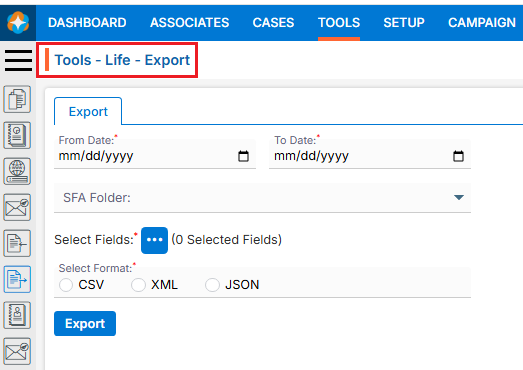
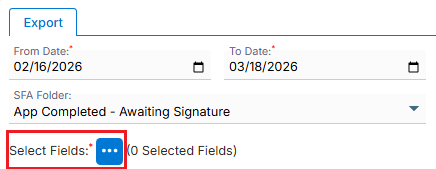
  4. A new page titled ‘Tools – Life – Export’ will open, featuring the ‘Export’ tab with following steps to complete the process:
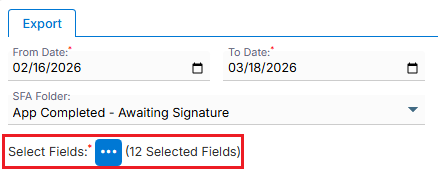
    • Select the date range
    • Select SFA Folder
    • Select the fields
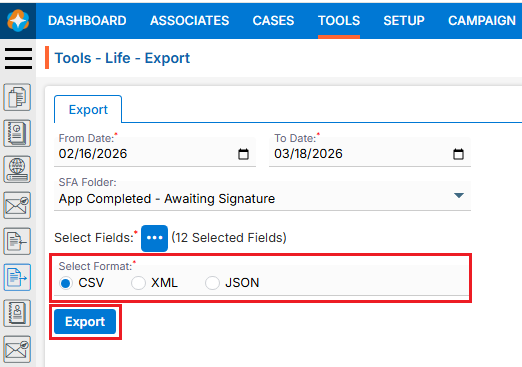
    • Select Format
    • Select the date range:
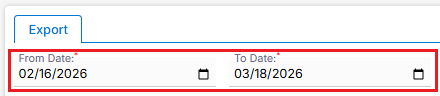
      1. Select the date range for which you want to export data.
        Note: System will allow to select maximum of 31-days date range.
    • Select SFA Folder:
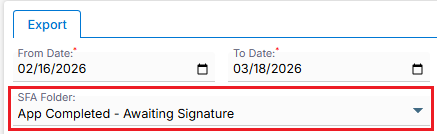
      1. On the same page, the next option is for selecting the SFA folder.
      2. Choose the SFA folder from the dropdown from which you want to export the data.
    • Select Fields:
      1. On the same page, the next option is for selecting Fields.
      2. Click on 3 dots blue color Icon.
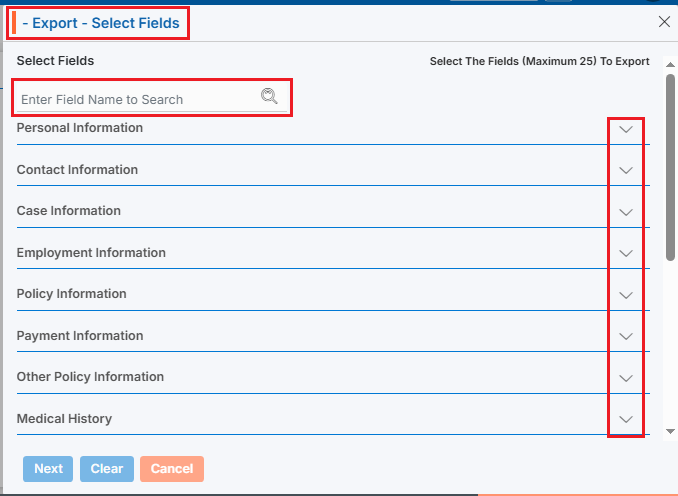
      3. A pop-up window titled ‘Export – Select Fields’ will open.
      4. The fields will be listed in sections as per available in the application.
      5. Click on the down arrow to reveal the fields for selection.
      6. Additionally, the user can search for field names based on their requirements, and the system will display the corresponding results.
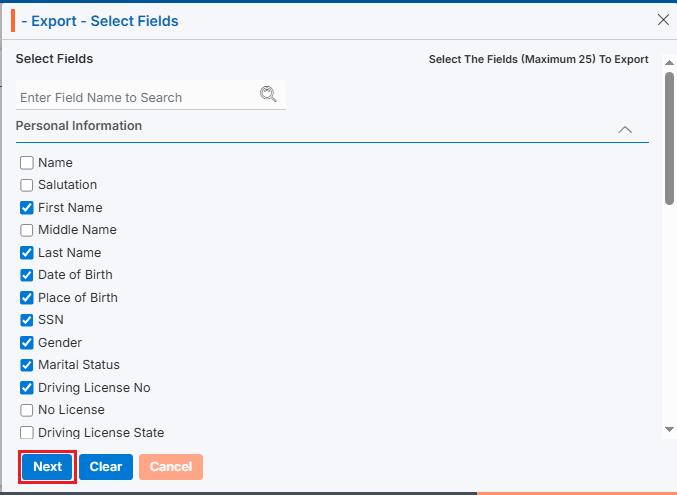
      7. Select the field names whose data needs to be exported in the file.
        Note: Maximum 25 fields can be selected.
      8. Click ‘Next’ to proceed.
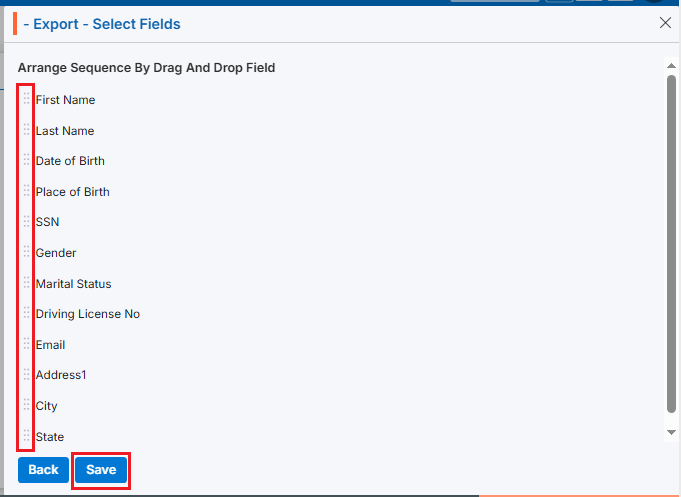
      9. Clicking on ‘Next’ opens a new page listing the selected fields.
      10. The sequence of the field list can be re-arranged using the six-dot () icon.
      11. Hover over the Re-arrange () icon at the beginning of a field name.
      12. Click and drag the Re-arrange () icon to move up or down the fields to the desired position, then drop it to save the new order.
      13. Click on the ‘Save’ button to proceed.
      14. Clicking the ‘Save’ button will display the number of selected fields next to the three-dot icon.
    • Select Format:
      1. On the same page, the next option is for selecting format.
      2. There are three available formats for exporting the file: CSV, XML, and JSON. Select the desired format and click the ‘Export’ button to proceed.
      3. The file will be exported, and user can save in the desired location.
0
0
Address Book

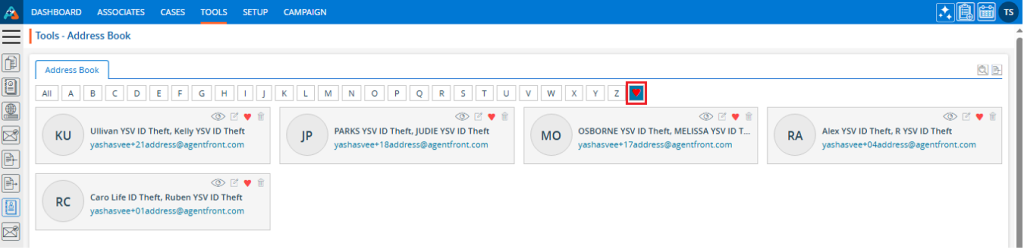
Address Book –The Address Book feature consolidates general, business, and personal details of customers in one place.

The following are the steps to save data in the Address Book:

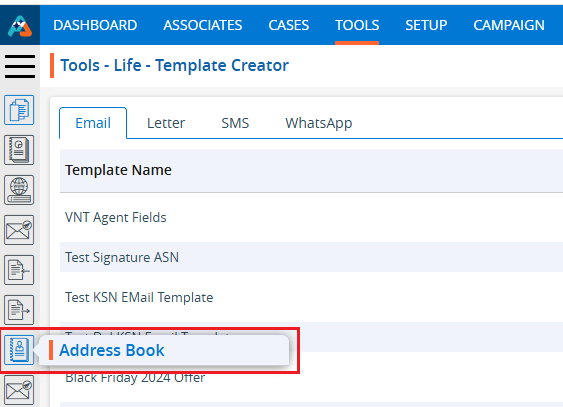
1. Navigate to the ‘Tools’ tab.

2. Click on ‘Address Book’ from the left-side menu.

3. A new page titled ‘Tools – Address Book’ will open, displaying the existing contacts under the ‘Address Book’ tab.

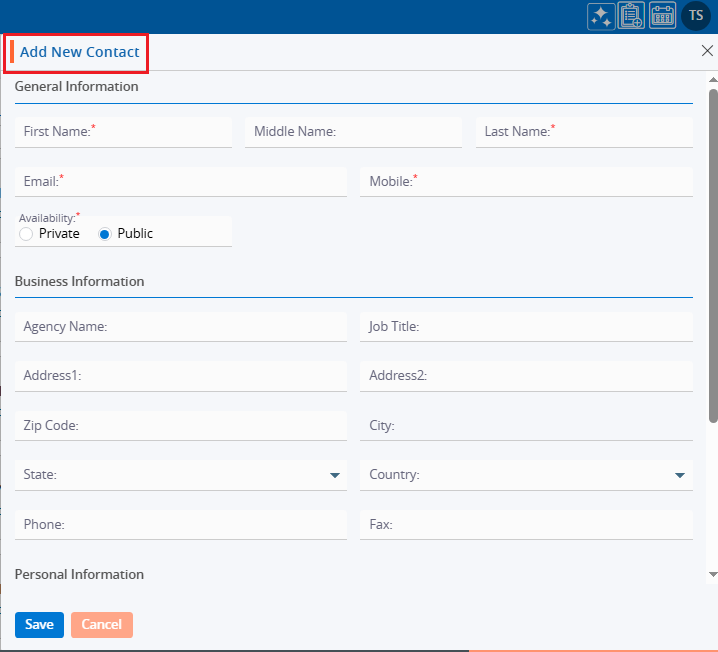
4. Click the ‘Add New Contact’ icon to add a new contact.

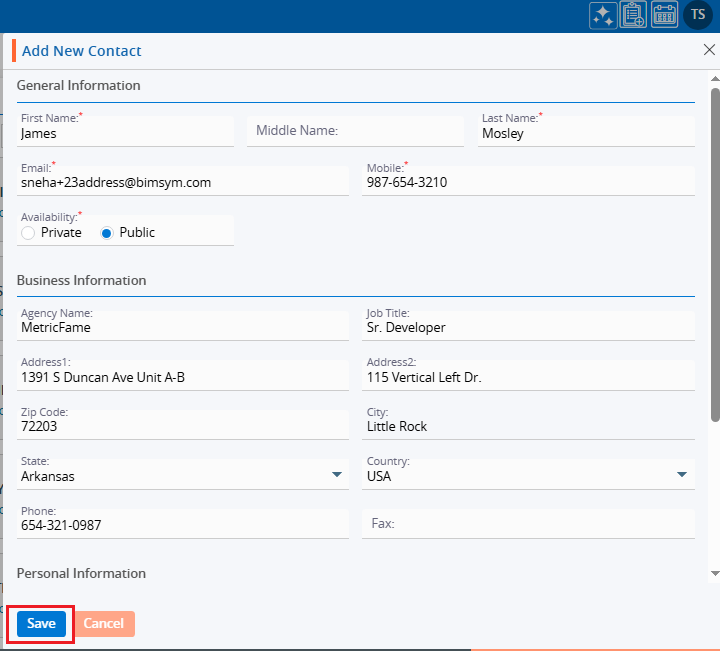
5. A pop-up window titled ‘Add New Contact’ will open, displaying fields including General Information, Business Information, and Personal Information.
6. Fields marked with an asterisk (*) are mandatory.

7. Fill in the details and click the ‘Save’ button to proceed.

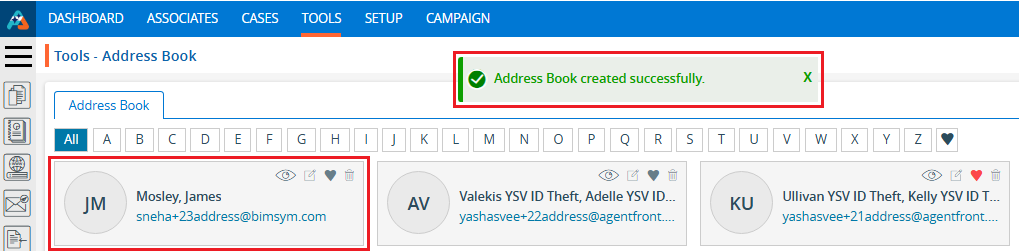
8. A confirmation message will appear, and the newly added contact will be included in the list.

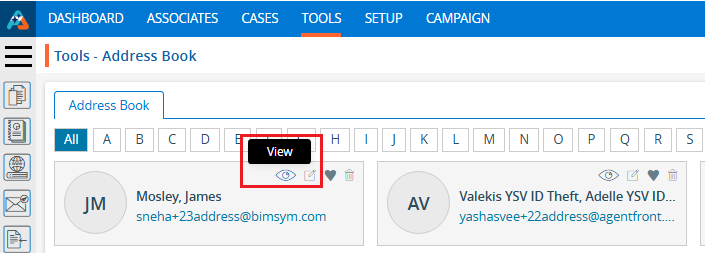
9. Click the ‘View’ icon to open the contact details.

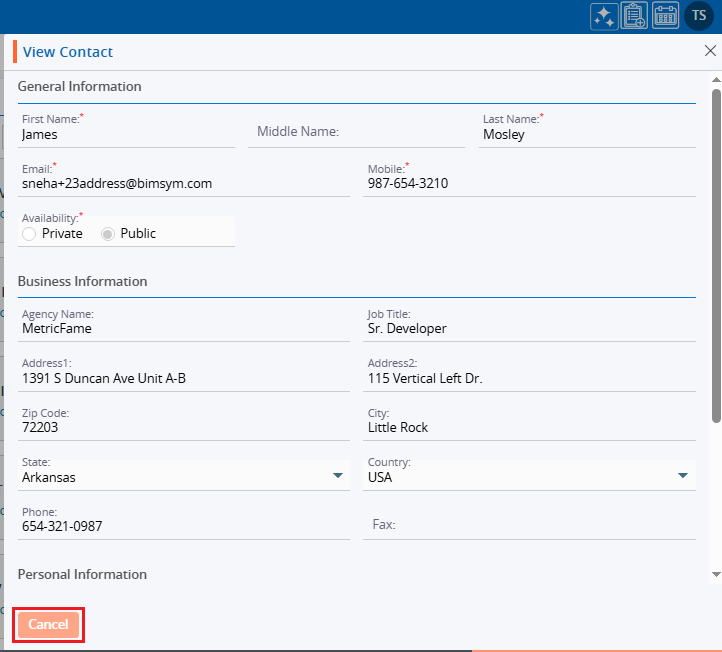
10. A pop-up window will open the contact in view mode, displaying the contact’s General Information, Business Information, and Personal Information. Click the ‘Cancel’ button to close the window.

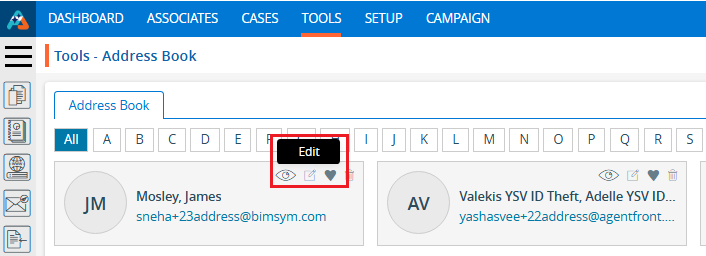
11. Click the ‘Edit’ icon to update the contact details.

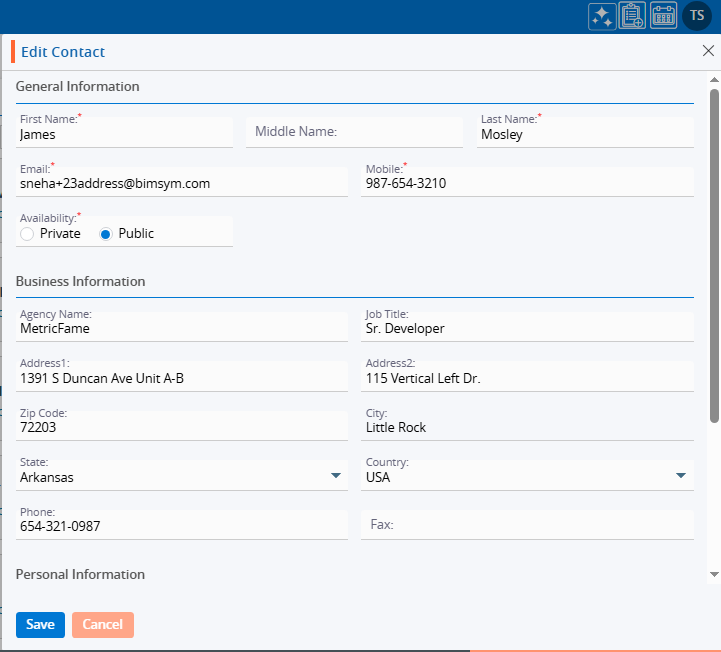
12. A pop-up window will open, allowing you to update the information.

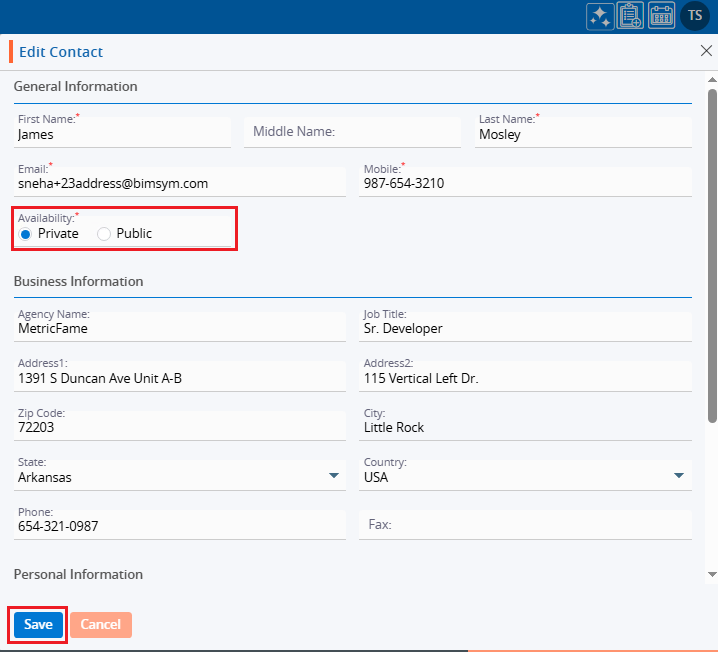
13. Make the necessary updates. For example, change the Availability field from Public to Private. Click the ‘Save’ button to proceed.

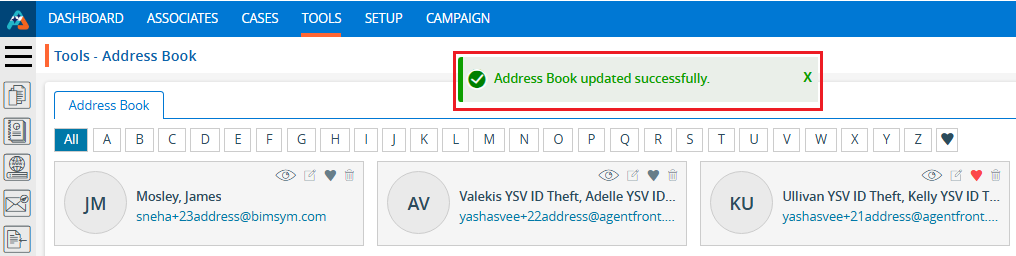
14. A confirmation message will appear, indicating that the Address Book has been updated for the selected contact.

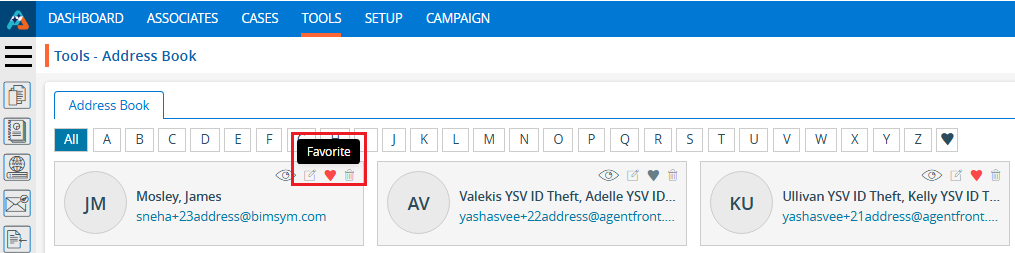
15. Click the ‘Favorite’ icon to add the contact to your Favorites list.

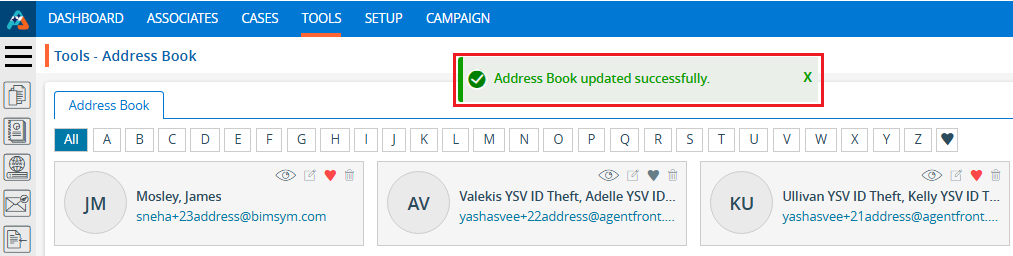
16. A confirmation message will appear indicating that the Address Book has been updated for the selected contact.

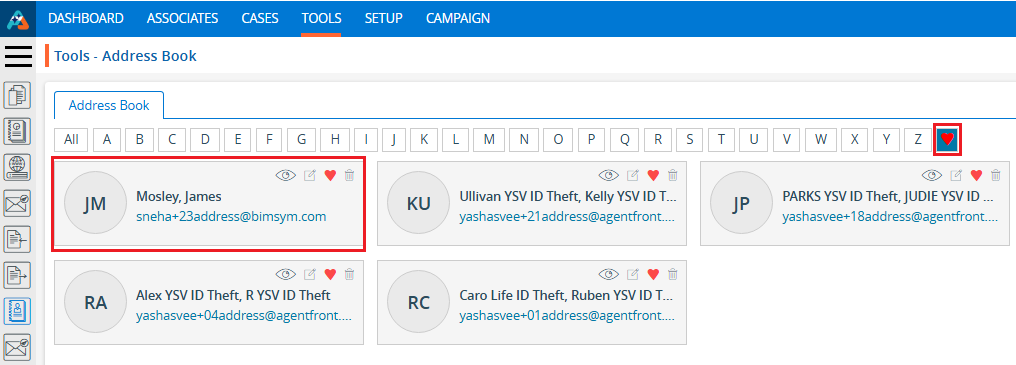
17. The contact that was added to favorites will also appear in the favorites list.

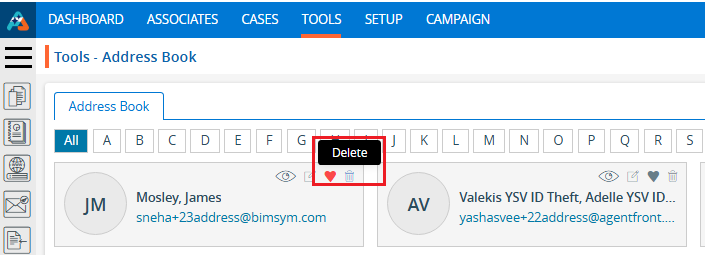
18. Click the ‘Delete’ icon to remove the contact details.

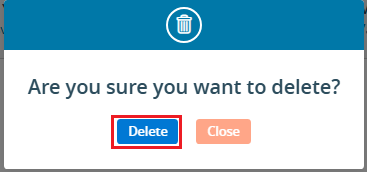
19. A confirmation pop-up will appear, asking if you want to delete the contact. Click the ‘Delete’ button to confirm.

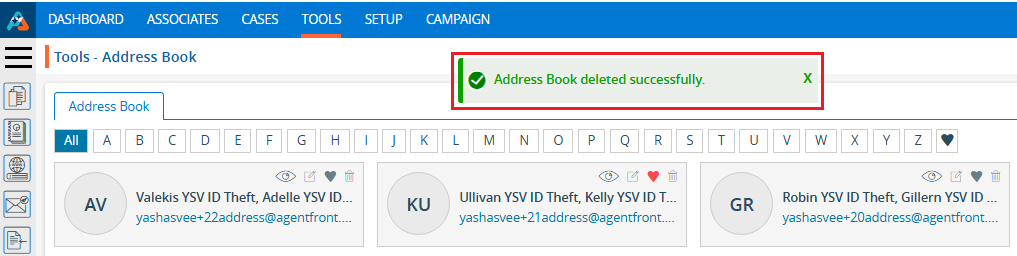
20. A confirmation message will appear indicating that the contact has been deleted.

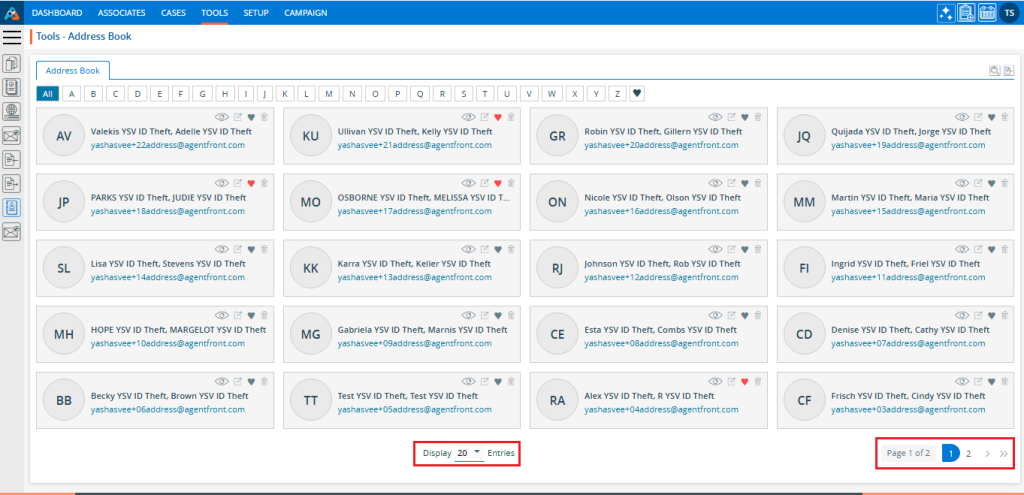
21. Select an option from the Display Settings to change the number of contacts shown per page, based on the total number of contacts available. After selecting a Display option, the system will show contacts and pagination according to the chosen setting. For example, if you select 20 contacts per page, the system will display 20 contacts per page and paginate the data accordingly.

22. Click the ‘Quick Search’ icon to find a contact in the list.

23. Type the name or email of the contact you need to search for.
For example, search for contacts with ‘Robin’ in their name or email address.

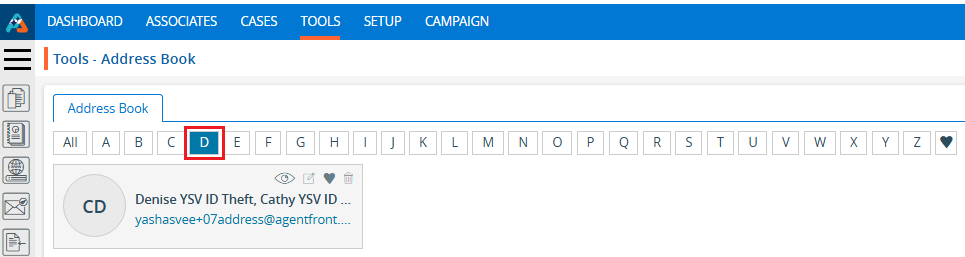
24. Click on a letter to find contacts whose names start with that letter.

25. Click on ‘D’ and contacts with names that start with ‘D’ will be displayed.

26. Click the favorite icon to view the contacts in your Favorites list.

0
0
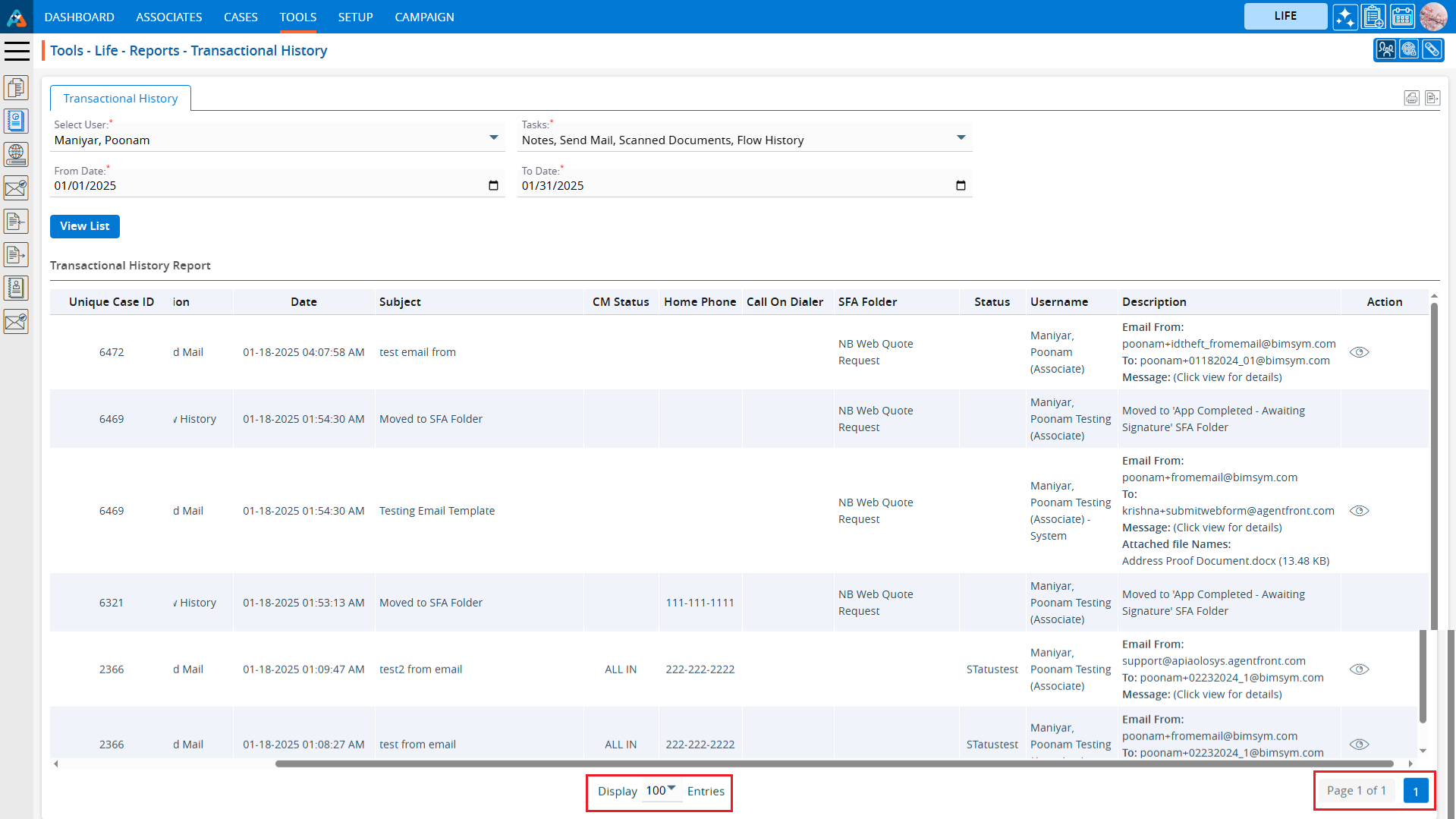
Reports > Transactional History

Transactional History is a list of users’ tasks filtered by date and task type.

The following are the steps to generate the report for Transactional History:

1. Navigate to the ‘TOOLS’ tab..

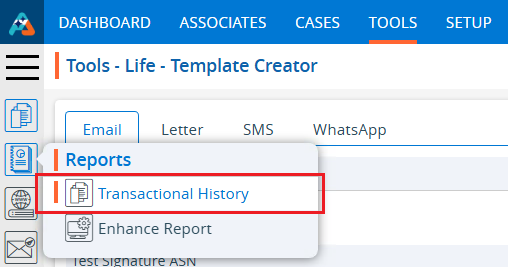
2. Click on ‘Reports’ in the left-side menu, then select the ‘Transactional History’ option from the list of reports.

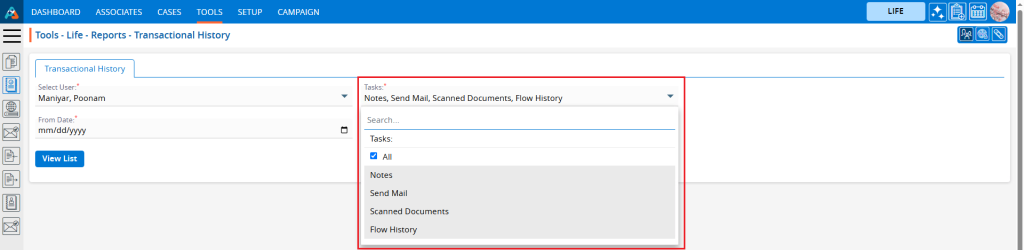
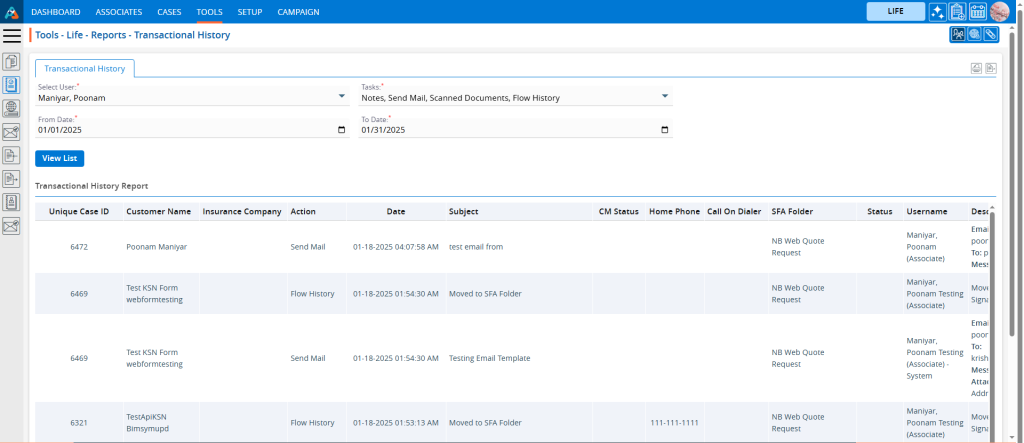
3. By clicking on Transactional History a new page titled ‘Tools – Life – Reports – Transactional History’ will open. This page will provide dropdown menus to select users and tasks by date.

4. Select a user from the dropdown menu to generate and view their ‘Transactional History’ details.

5. The ‘Tasks’ dropdown includes options such as Notes, Send Mail, Scanned Documents, and Flow History. Select the desired option from the dropdown menu. Users can choose either a single option to view or select ‘All’ to view the history for all categories together. For example, the ‘All’ option is selected from the dropdown menu.

6. Select the desired date range for the data to be listed, and then click on ‘View List’ to proceed.

7. It will display the transactional history details for the selected task(s) within the specified date range for the chosen user.

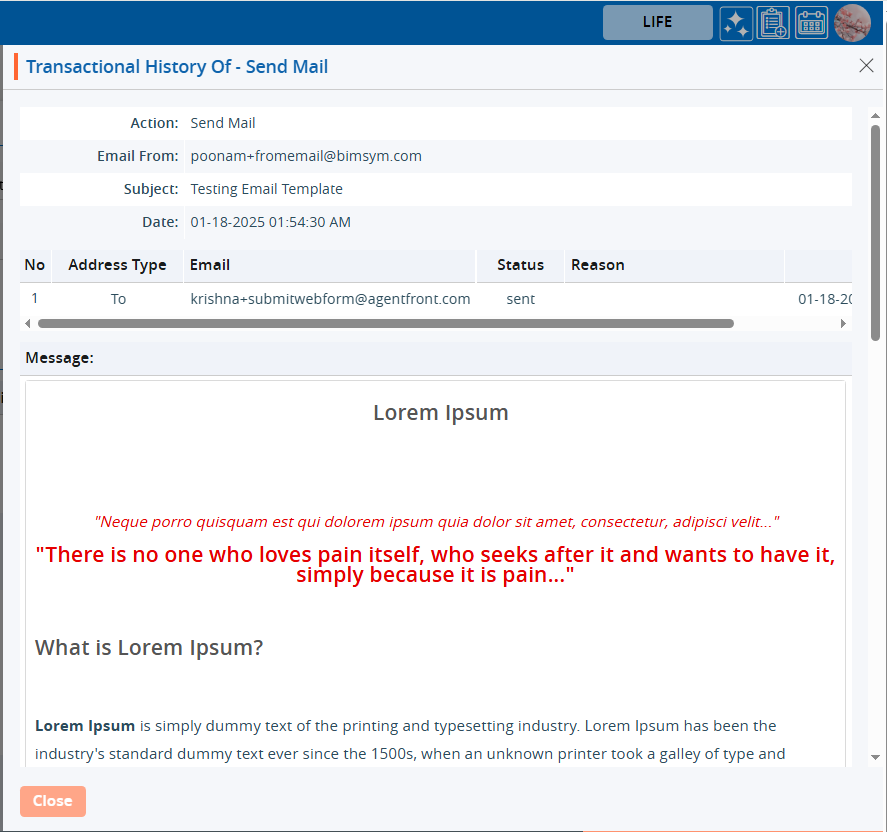
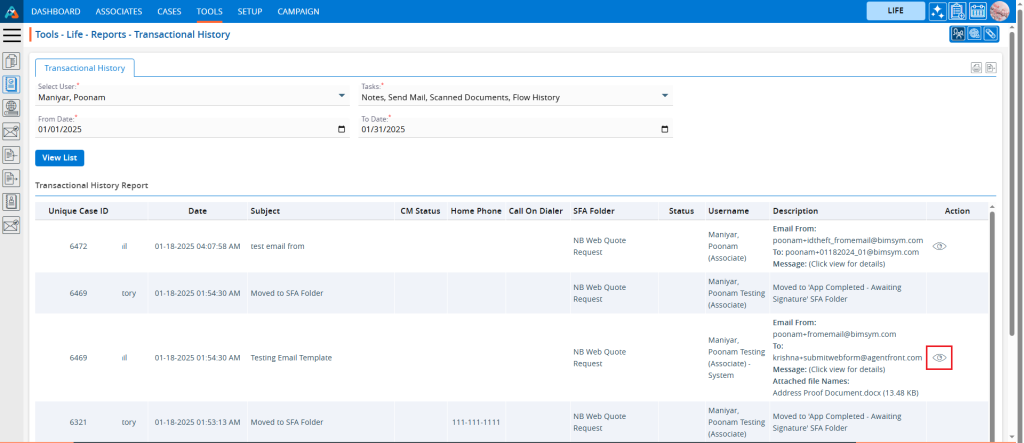
8. Click on the ‘View’ option next to the task for which the user wants to see details.

9. A new pop-up window will open to display the details of that selected transactional history. Click the ‘Close’ button to exit.

10. Choose an option from the display settings at the bottom to specify the number of records to show per page, based on the total number of available records. After selecting the Display option, the system will present the records and pagination based on the chosen setting. For example, if the user selects 50 cases per page, the system will display 50 web resources per page, with the data distributed accordingly.

0
0

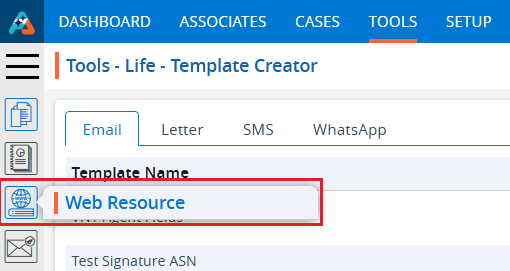
Web Resource

The Web Resource feature allows users to create a comprehensive list of web resources and save important URLs in the system.

The following are the steps to manage Web Resources:

1. Navigate to the ‘Tools’ tab.

2. Click on ‘Web Resource’ in the left-side menu.

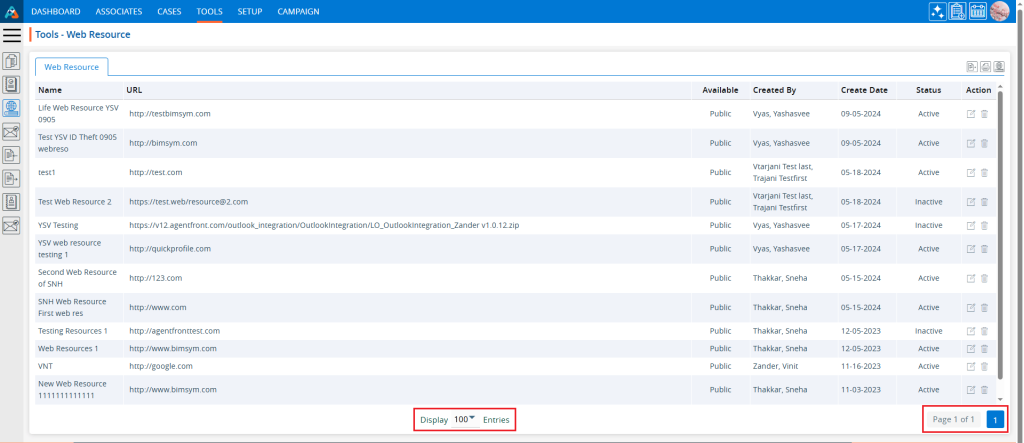
3. The ‘Tools – Web Resource’ page will open, displaying existing web resources with details such as Name, URL, Available, Created By, Create Date, Status and Action.

4. Click the ‘Add Web Resource’ icon to add a new web resource.

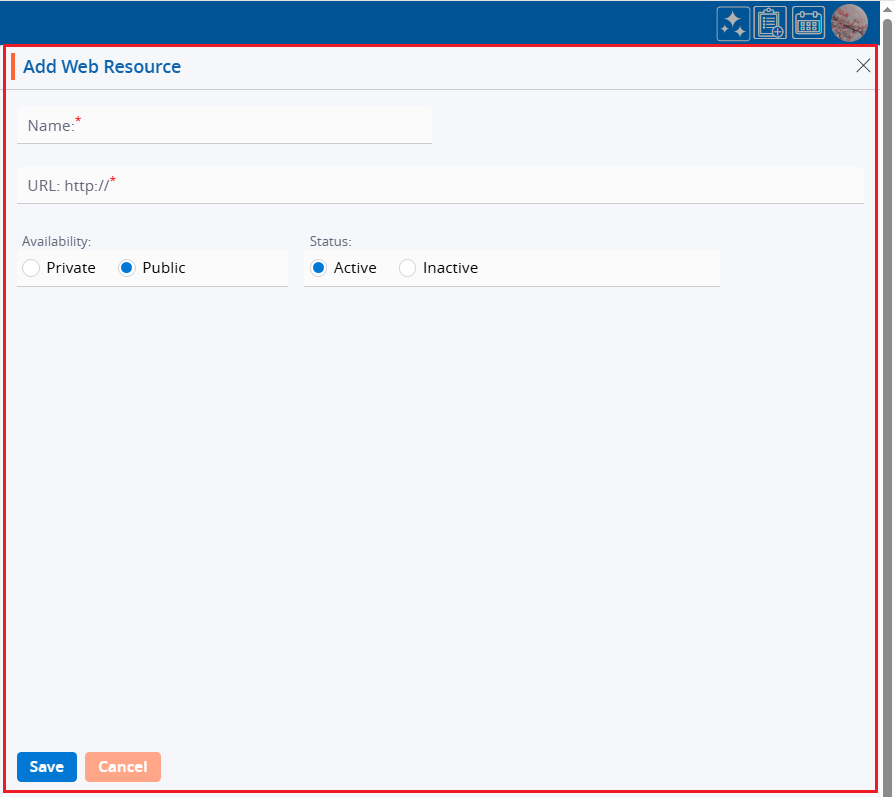
5. After clicking on the ‘Add Web Resource’ icon, a pop-up window ‘Add Web Resource’ will open.

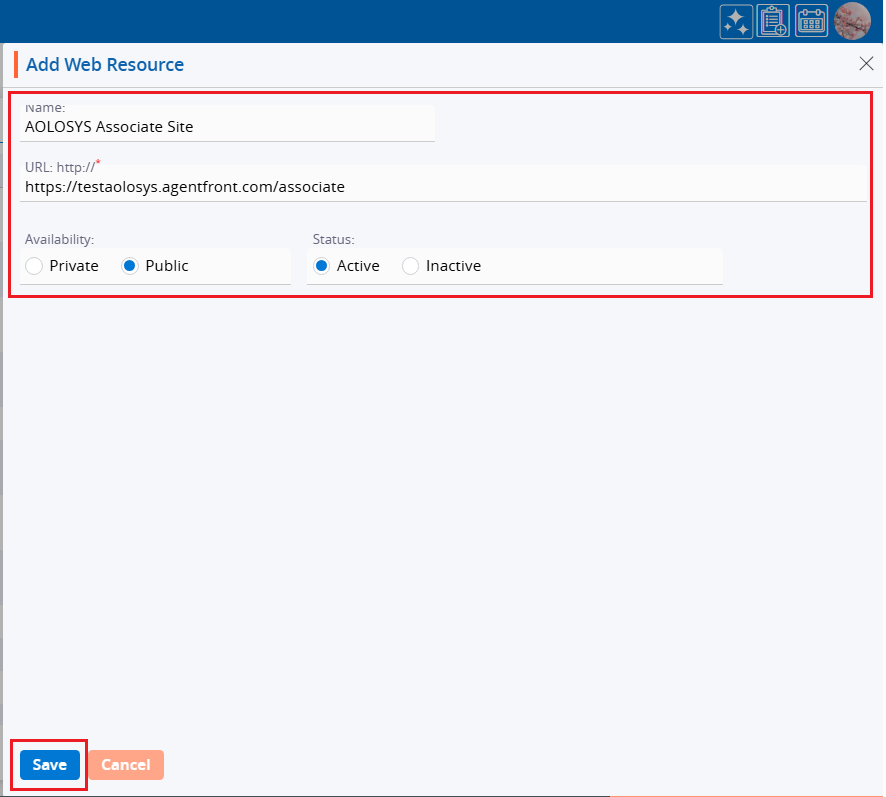
6. Fill in the details for the Web Resource, including Name, URL, Availability and Status, then click the ‘Save’ button.

7. A confirmation message will be generated, and a new web resource will appear in the list.

8. Click on the URL of the newly created web resource to check if it is working properly. For example, click on the URL for the ‘AOLOSYS Associate Site’.

9. After clicking on the URL, the system will redirect the user to the URL of the selected web resource.

10. Navigate to the ‘Tools’ tab again and click on the ‘Web Resource’ option to go back to the web resources page.

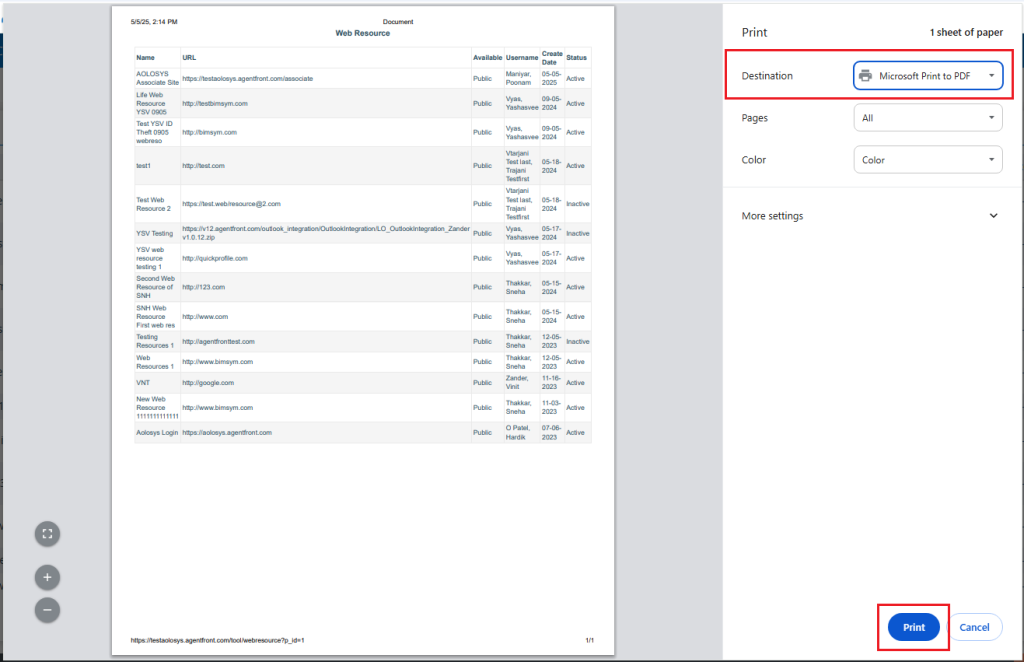
11. Click on the ‘Print’ icon to print the web resources.

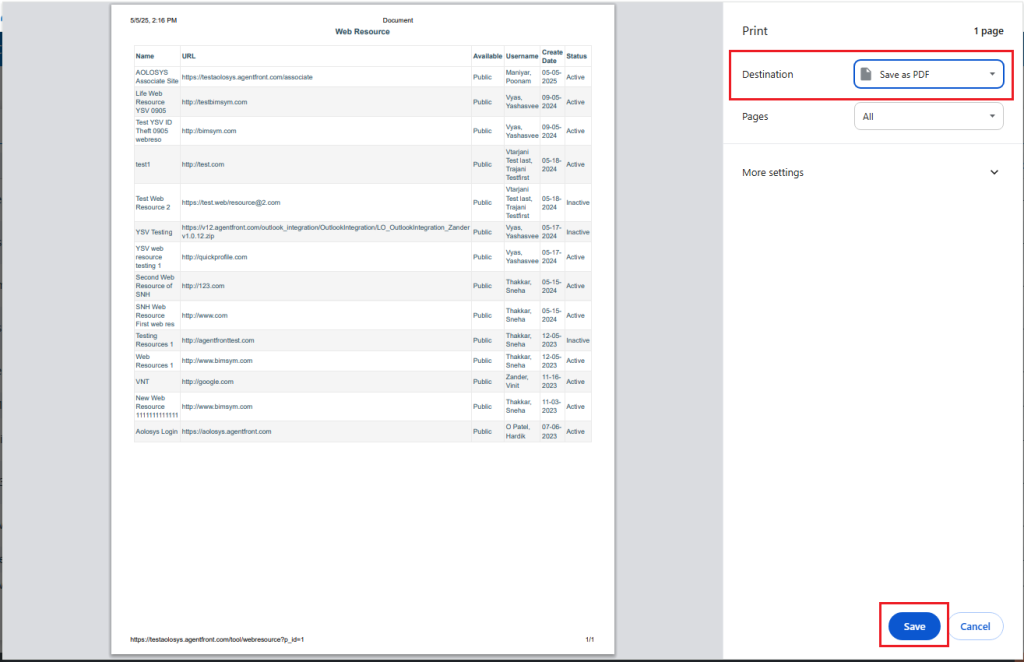
12. After clicking on Print, a popup page will open displaying the current page data and various print options.
a. Select the print option from the ‘Destination’ field and click on the ‘Print’ button.

b. Select the ‘Save as PDF’ option from the ‘Destination’ field and click on the ‘Save’ button to save the file to the required location. The file will be saved at a temporary location.

13. Click on the ‘Export’ icon to export web resources.

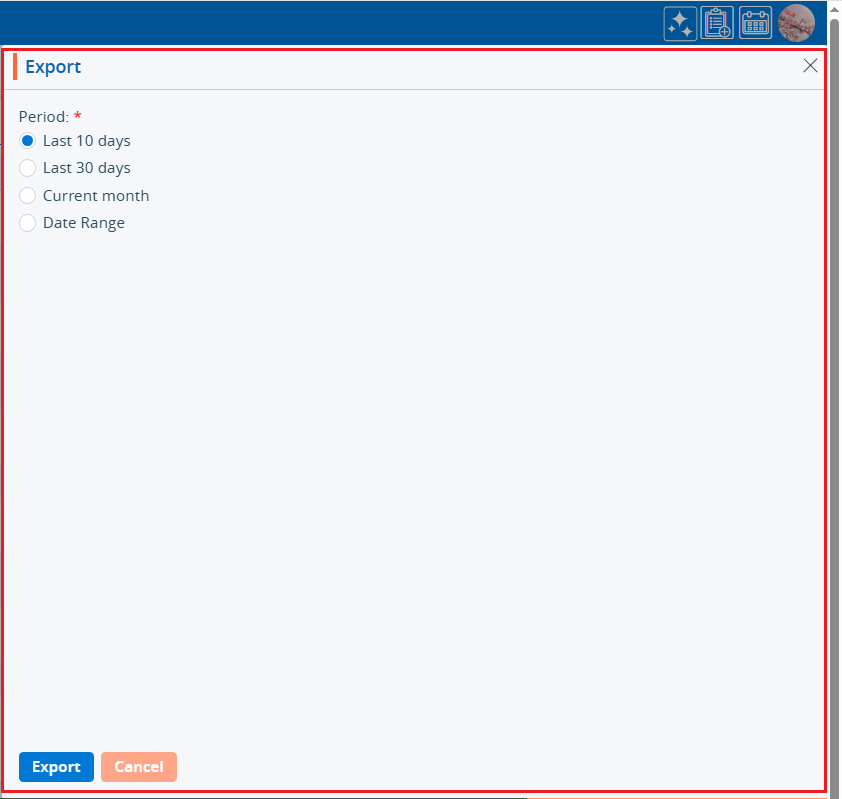
14. Upon licking Export, export’s pop-up window will open, and you can select the ‘Period’ to export data from.
There are four options available:
a. Last 10 days – This option is used to export data from the last 10 days.
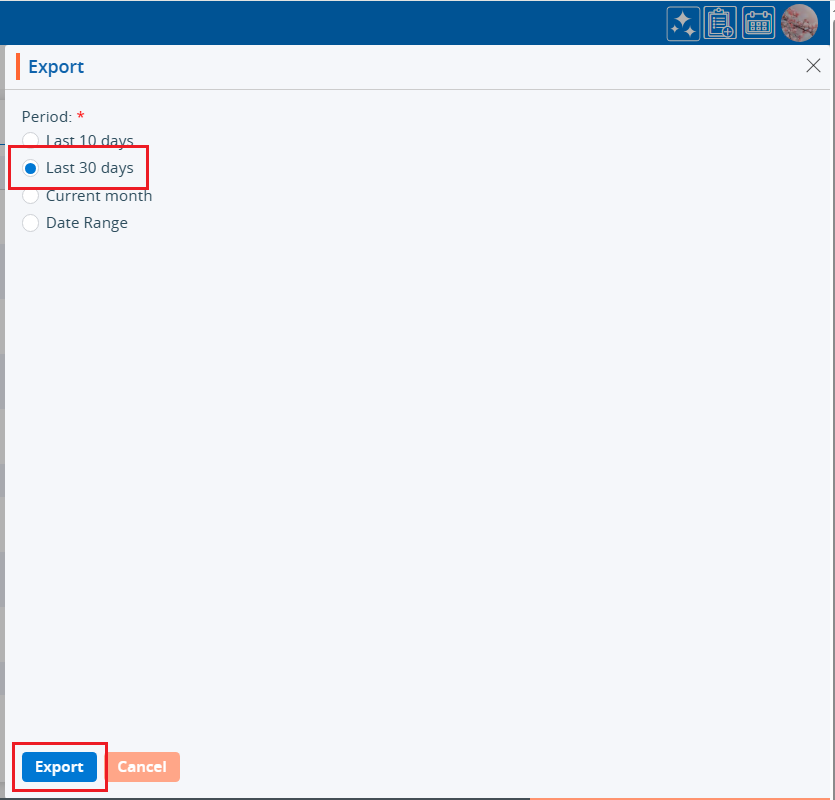
b. Last 30 days – This option is used to export records from the past 30 days.
c. Current month – This option is used to export records for the Current Month.
d. Date Range – This option is used to export records for the selected date range within 90 days.

15. Select a period as per the requirement and click on ‘Export’ button.

16. Records will be exported according to the selected option, and the CSV file will be saved in the designated location.

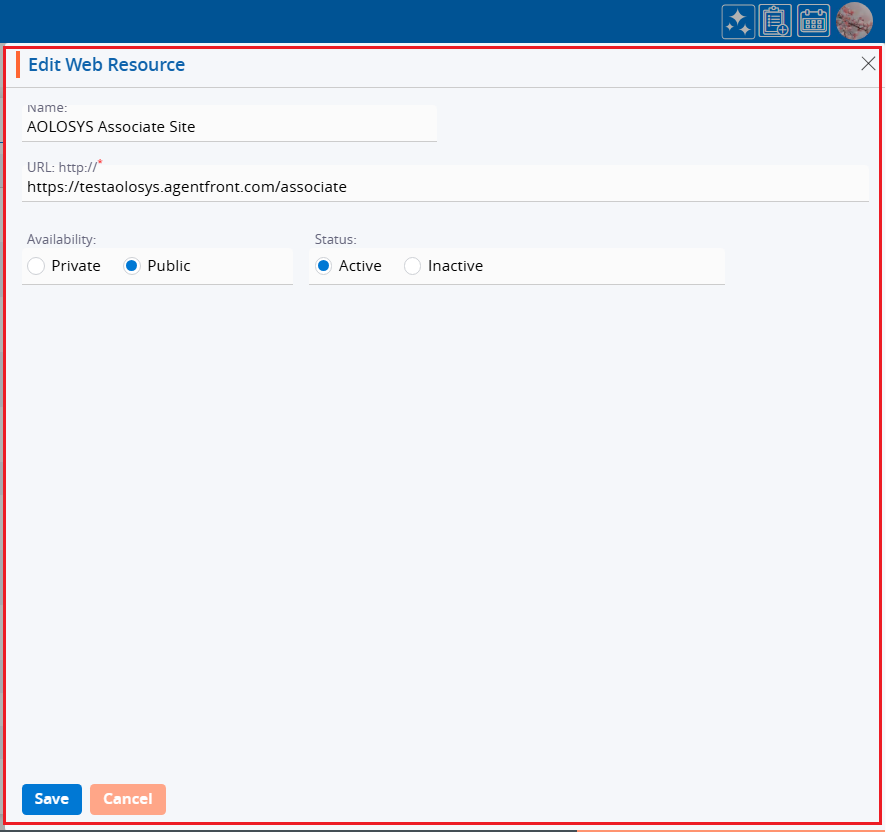
17. To update the details of the web resources, click on the ‘Edit’ icon.

18. ‘Edit Web Resource’ pop-up window will open. Make the changes and click on the save button.

19. A confirmation message will appear indicating ‘Web Resource updated successfully.’

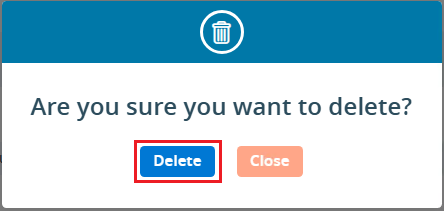
20. By using the ‘Delete’ icon, the user can remove the web resource. Select the ‘Delete’ button to remove them.

21. Select the ‘Delete’ option from the confirmation message asking to delete the web resources.

22. A confirmation message will appear confirming that the web resource has been deleted successfully, and it will be removed from the list.

23. Select the option from the Display settings to specify the number of records per page based on the total number of records available. After selecting the Display option, the system will present web resources and pagination based on the chosen setting. For example, if the user selects 10 web resources per page, the system will display 10 web resources per page, with the data distributed accordingly.

0
0

Enhance Report

An enhanced report in CRM for its own data refers to a report generated using the data stored within the CRM system, which is enriched with advanced features like custom filters, segmentation, and data visualizations. This type of report provides deeper insights into customer interactions, sales trends, and other CRM-specific metrics, helping businesses make informed decisions and optimize customer relationship strategies.

Create Enhance Report:

  1. Sign in to AgentFront CRM.
  2. From the top menu, choose Tools.
  3. Tools > Template Creator > Email setup page will open by default.
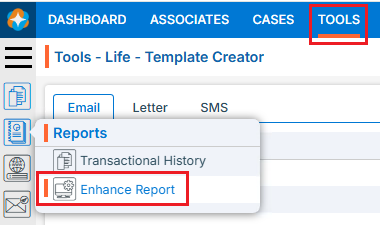
  4. In the left-side panel, select Reports > Enhance Report.
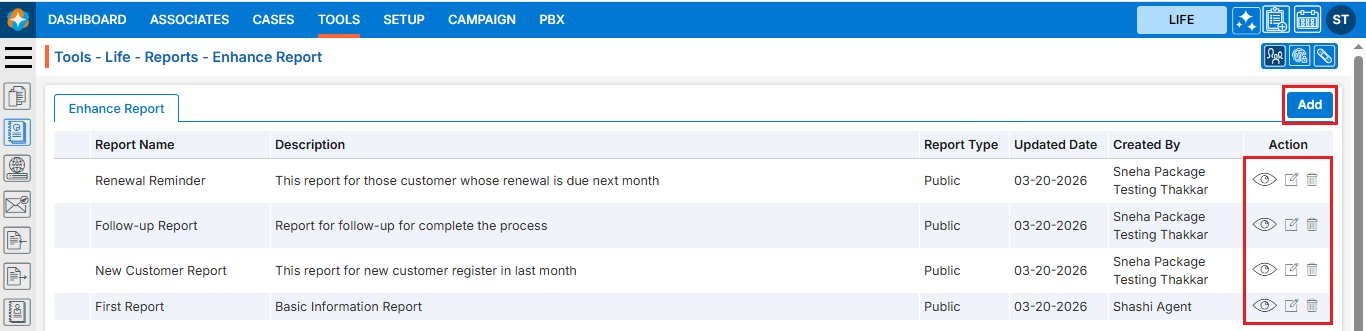
  5. The Enhance Report page opens with a list of existing Reports.
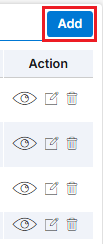
  6. There is an Add button above the Action Column on the top right side of the page to add new report.
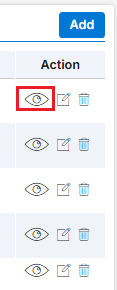
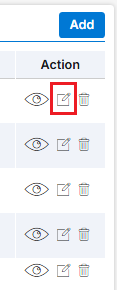
  7. There are options to View (), Edit () and Delete () the existing Report under the Action column.

Add New Report

  1. Click on Add button to create new Report.
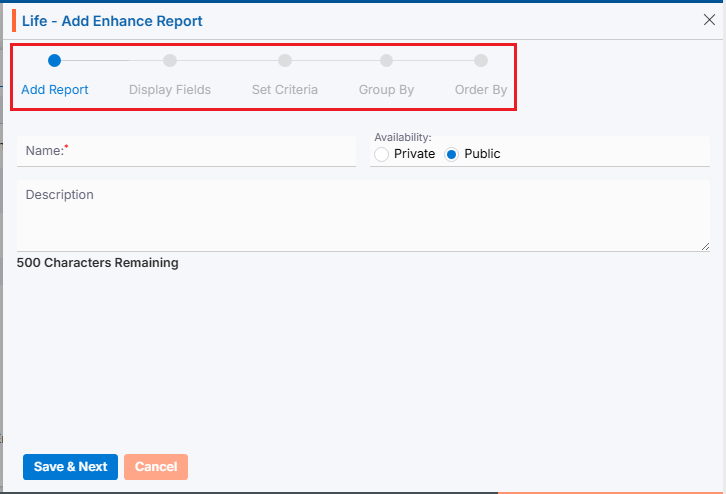
  2. A new page titled ‘Life – Add Enhance Report‘ will open, featuring the ‘Enhance Report’ tab with five steps to complete the process for creating report.
    • Add Report
    • Display Fields
    • Set Criteria
    • Group By
    • Order By
    • Add Report
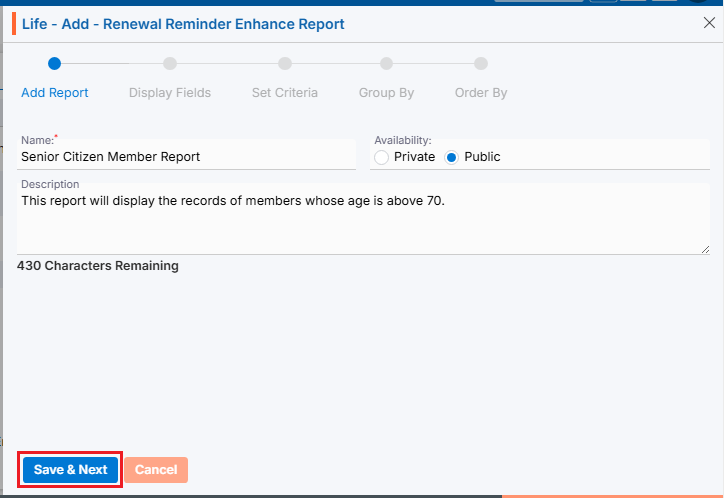
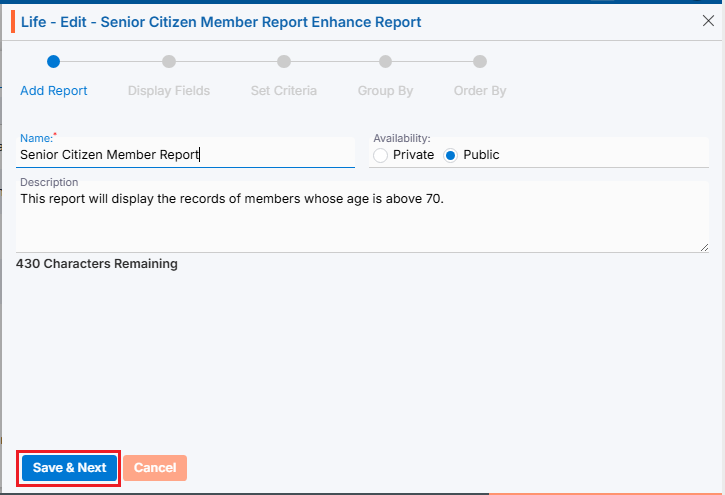
      1. To add Report, enter the following details:
        • Name: Enter the clear, descriptive name. This is what users can identify the purpose of the report.
        • Availability: Choose option Private/Public. When choosing ‘Private’, only the logged-in user can access this report, while selecting ‘Public’ allows all users of the application to access it.
        • Description: Optional explanation of the report’s purpose.
        • Once all the details have been filled in and the selection is complete, click ‘Save & Next’ to proceed to the next step: Display Fields.
    • Display Fields
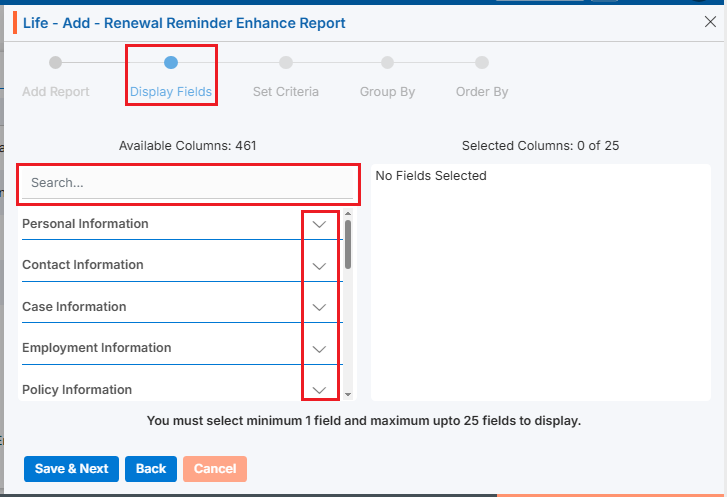
      1. On the same page next step is for Display Fields.
      2. There will be 2 sections on this page:
        • Available Columns: The fields will be listed in this section as available in the application, with counts considered as columns.
        • Selected Columns: The selected fields will be listed in this section with counts, and these fields will be displayed as column header in the report. Maximum of 25 fields can be selected.
      3. Click on the down arrow to reveal the fields for selection.
      4. Additionally, the user can search for field names based on their requirements, and the system will display the corresponding results.
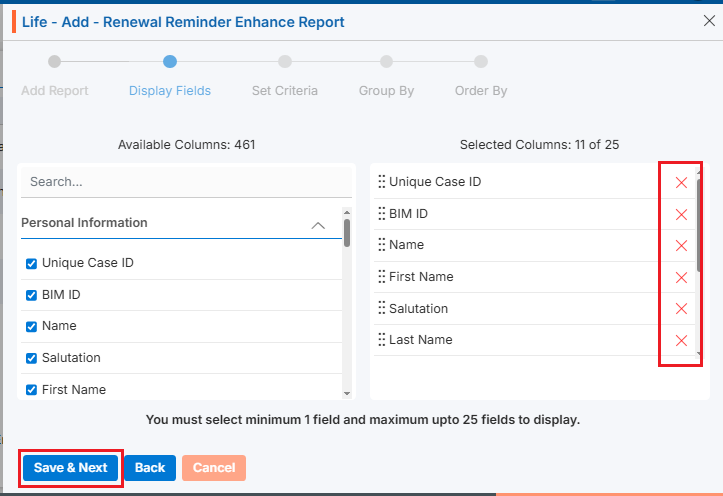
      5. Select the fields from the ‘Available Columns’ section, and the selected fields will be displayed under the ‘Selected Columns’ section.
      6. The sequence of the field list can be re-arranged using the six-dot () icon.

      7. Hover over the Re-arrange () icon at the beginning of a field name.
      8. Click and drag the Re-arrange () icon to move up or down the fields to the desired position, then drop it to save the new order.
      9. Fields can be removed by clicking on the cross (X) icon, if not required.
      10. Once the selection and arrangement of fields are complete, click on ‘Save & Next’ to proceed to the next step: Set Criteria.
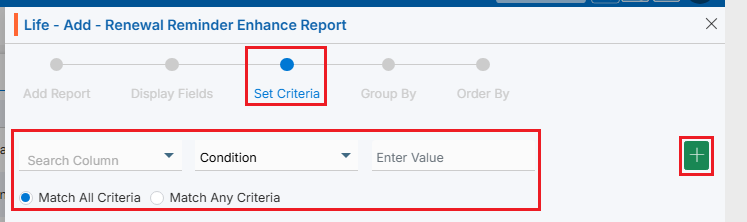
    • Set Criteria:
      1. On the same page next step is for Set Criteria.
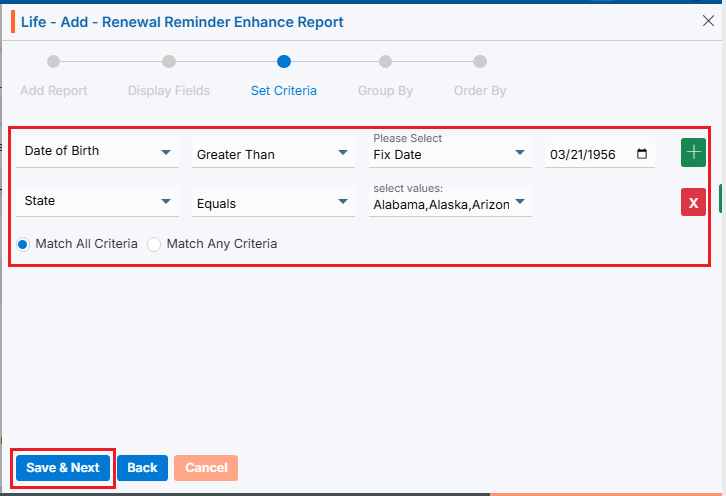
        • Set Criteria for Report: Set the condition by defining the specific criteria the data must meet using the following fields:
          • Search Column: Select the field for which the criteria need to be applied.
          • Condition: Set the appropriate condition for the selected column field.
          • Enter Value: Enter or select the value according to the selected column.
        • Using plus sign () users can set multiple criteria simultaneously for a single report.
      2. Match All Filter Rules or Match Any Filter Rule: Select any one of the given options.
      3. Criteria can be removed by clicking on the cross () icon, if not required.
      4. Once all criteria are set, click ‘Save & Next’ to proceed to the next step: Group By.
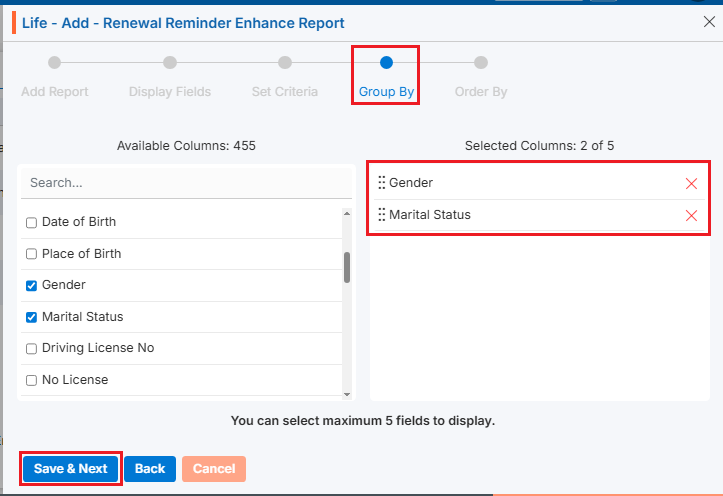
    • Group By:
      1. On the same page next step is for ‘Group By’.
      2. Again, there will be 2 sections on this page:
        • Available Columns: The fields will be listed in this section as available in the application, with counts considered as columns.
        • Selected Columns: The selected fields will be listed in this section with counts, and the report will segregate the records based on the selected fields. A maximum of 5 fields can be selected to divide into groups.
      3. Click on the down arrow to reveal the fields for selection.
      4. Additionally, the user can search for field names based on their requirements, and the system will display the corresponding results.
      5. Select the fields from the ‘Available Columns’ section, and the selected fields will be displayed under the ‘Selected Columns’ section.
      6. The sequence of the field list can be re-arranged using the six-dot () icon.
      7. Hover over the Re-arrange () icon at the beginning of a field name.
      8. Click and drag the Re-arrange () icon to move up or down the fields to the desired position, then drop it to save the new order.
      9. Fields can be removed by clicking on the cross (X) icon, if not required.
      10. Once the selection and arrangement of fields are complete, click on ‘Save & Next’ to proceed to the next step: Order By.
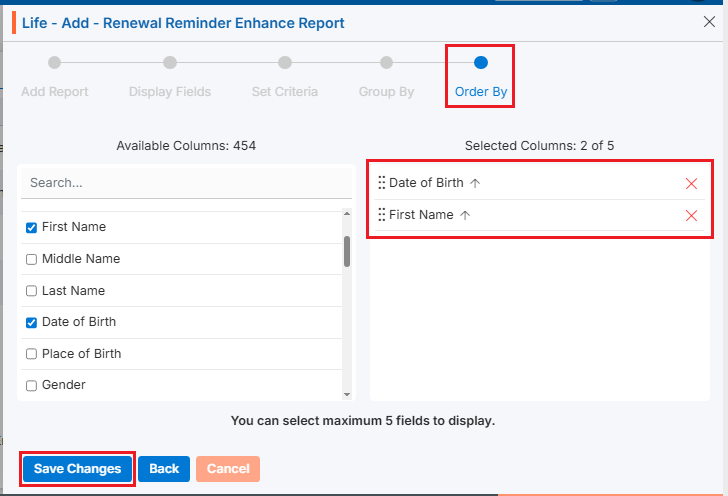
    • Order By
      1. On the same page next step is for ‘Order By’.
      2. Again, there will be 2 sections on this page:
        • Available Columns: The fields will be listed in this section as available in the application, with counts considered as columns.
        • Selected Columns: The selected fields will be listed in this section with counts, and the records in the report will be sorted in ascending order based on the selected fields. A maximum of 5 fields can be selected for sorting.
      3. Click on the down arrow to reveal the fields for selection.
      4. Additionally, the user can search for field names based on their requirements, and the system will display the corresponding results.
      5. Select the fields from the ‘Available Columns’ section, and the selected fields will be displayed under the ‘Selected Columns’ section.
      6. The sequence of the field list can be re-arranged using the six-dot () icon.
      7. Hover over the Re-arrange () icon at the beginning of a field name.
      8. Click and drag the Re-arrange () icon to move up or down the fields to the desired position, then drop it to save the new order.
      9. Fields can be removed by clicking on the cross (X) icon, if not required.
      10. Sorting will be applied according to the sequence set in the ‘Selected Columns‘ section.
      11. Once the selection and arrangement of fields for the sorting process are complete, click on ‘Save Changes’.
      12. Created report will now be listed and can be viewed according to the set criteria.

View Report

  1. Click on View () icon from the Action Column for the report you want to view.
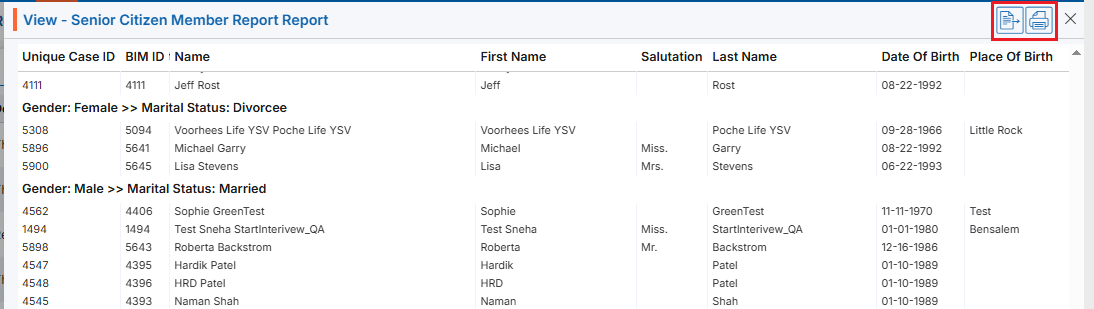
  2. Clicking on View () icon, new page will open and will display the records according to the set criteria.
    • Notes:
      1. When you view the report, you will see only the first 500 records. However, when you export the report, you will see all the records in the CSV file.
      2. Once you export, the field(s) selected in the ‘Group by’ will be displayed as a new column at the end of the file.
  3. Additionally, there will be a print () and export () feature available to print or download the report’s data.

Update Report Criteria

  1. To update the existing report criteria from the available list, click on Edit () icon from the Action Column for the report you want to edit/change.
  2. The report window will open with the existing criteria, allowing the user to modify the report criteria and options.
  3. The user can make changes at any step as needed.

Delete Report

  1. To delete the existing report from the available list, click on Delete () icon from the Action Column for the report you want to delete.
  2. It will ask for confirmation popup, click on Deleted button to delete report otherwise click on Close button.

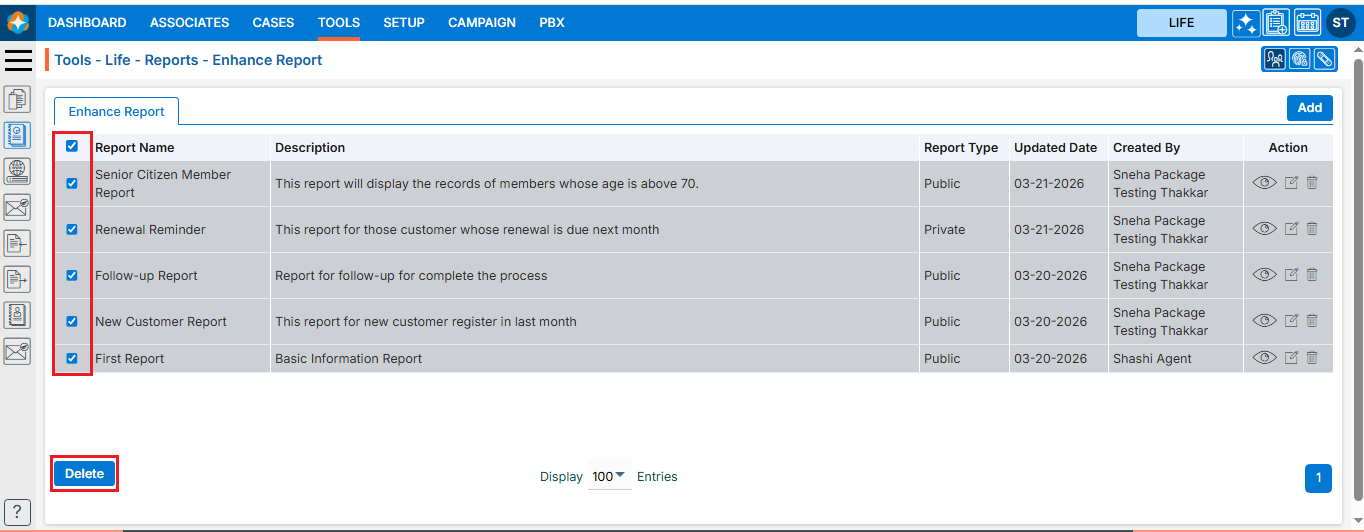
  3. Multiple reports can be deleted simultaneously.
  4. Select the reports by checking the checkboxes before the report names, and then click the ‘Delete’ button at the bottom of the page.
    Note: The delete button will be enabled only after selecting at least one report using the checkbox.
0
0

Manage Subscriptions > WhatsApp

The ‘Manage Subscription for WhatsApp’ option allows users to control their WhatsApp message preferences, including subscribing or unsubscribing from notifications. This functionality is primarily used to manage phone numbers on the unsubscribe list, ensuring that users no longer receive unwanted WhatsApp messages.

The following are the steps to manage WhatsApp Subscriptions:

1. Navigate to the ‘TOOLS’ tab. Click on Manage Subscriptions from the left side panel.

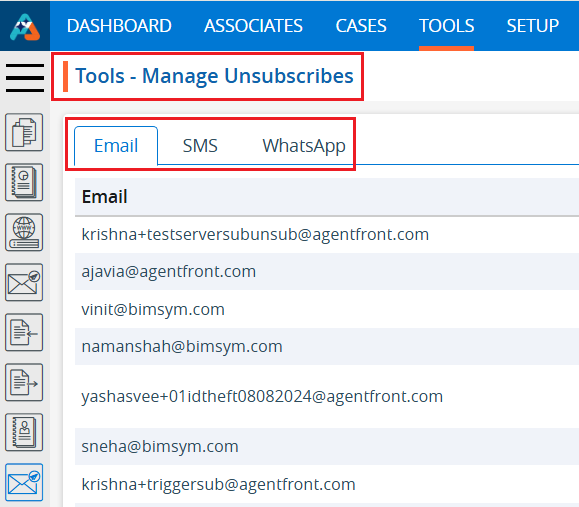
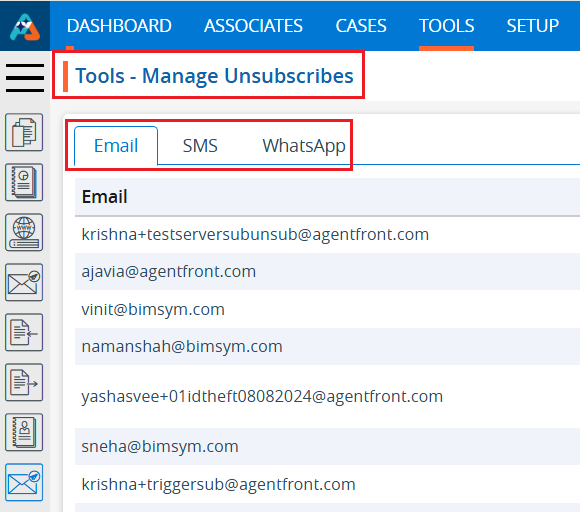
2. The user will be directed to the ‘Manage Subscription’ page, which includes three tabs: Email, SMS, and WhatsApp.

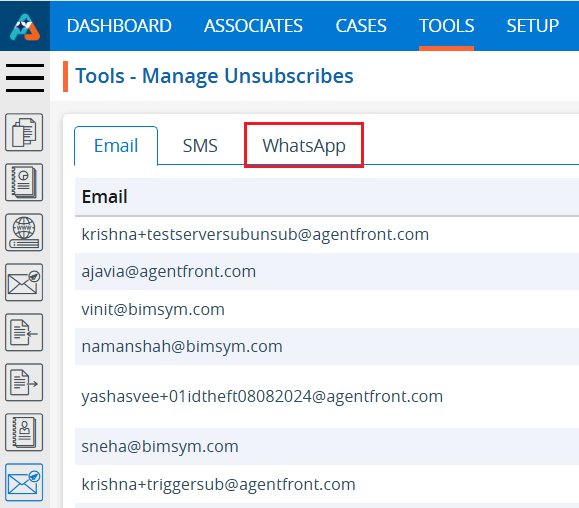
3. Click on the ‘WhatsApp’ tab.

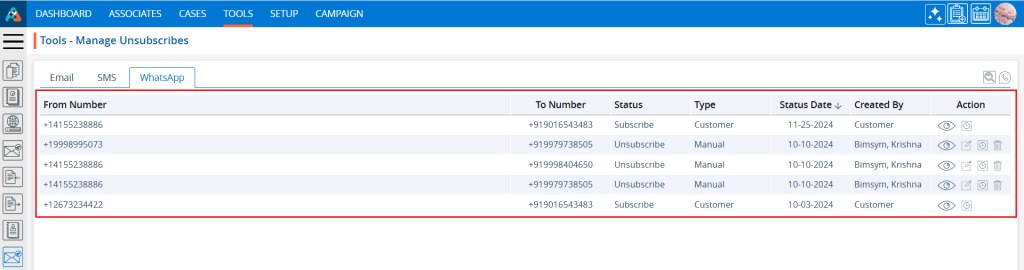
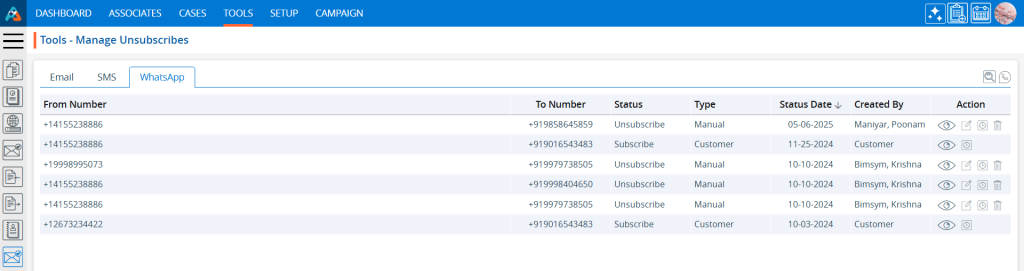
4. The WhatsApp – Manage Subscription page will open, displaying a list of existing WhatsApp Subscriptions, including the From Number, To Number, Status, Type, Status Date, Created By, and Action fields.
5. There are four options for each subscription:
a. View
b. Edit
c. History
d. Delete

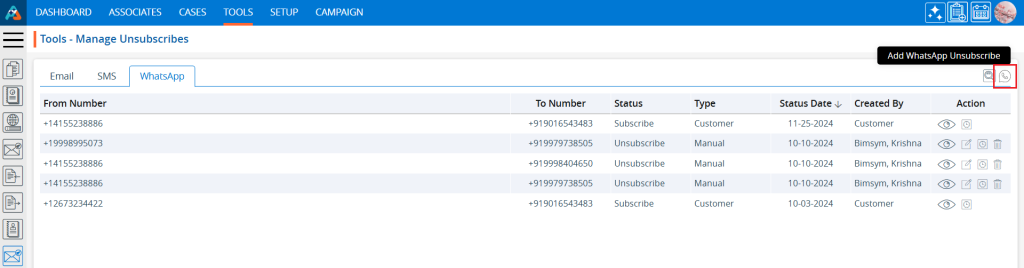
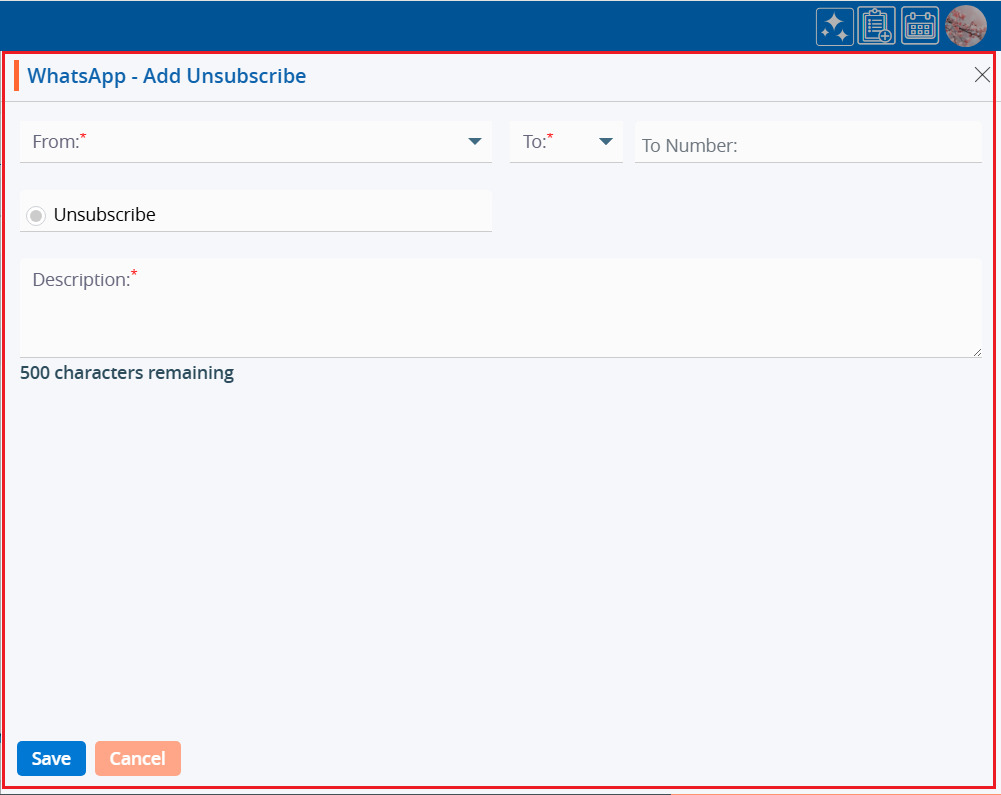
6. Click on the ‘Add WhatsApp unsubscribe’ icon in the top-right corner to add a new phone number to the WhatsApp unsubscribe list.

7. A pop-up window will open with fields for From, To, To Number, Unsubscribe and Description and Save and Cancel buttons at the bottom.
8. Fields marked with an asterisk (*) are mandatory.
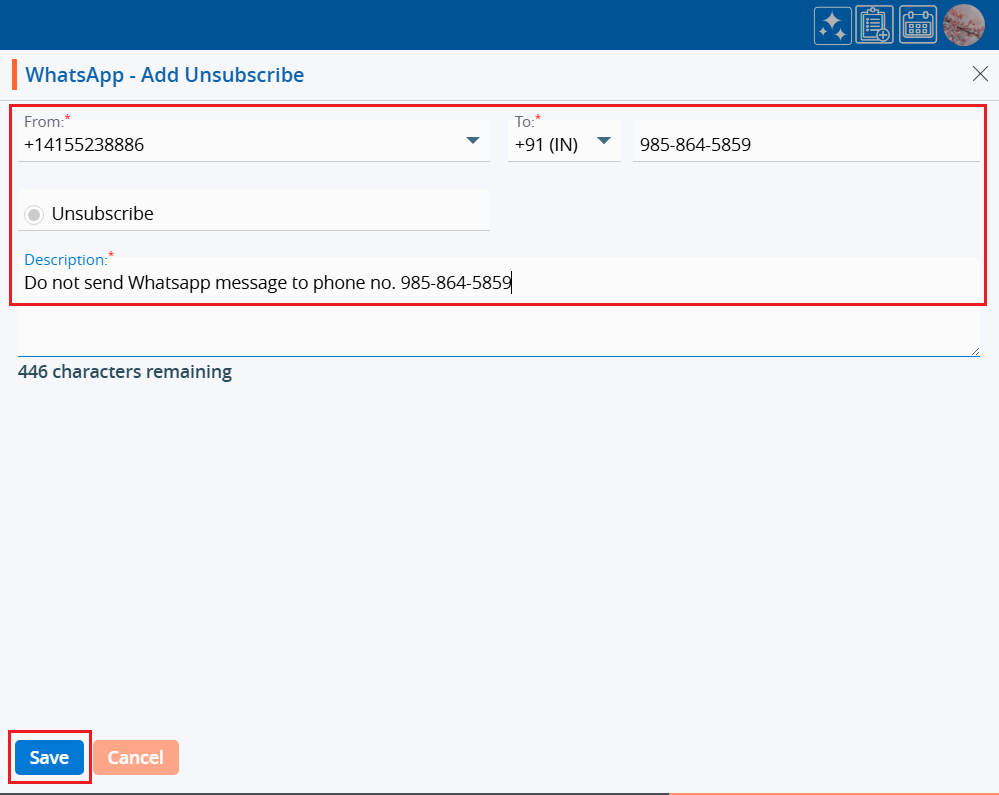
9. The user can enter up to 500 characters in the Description field.

10. Fill in the fields and click on the ‘Save’ button to add the phone number to the WhatsApp subscriptions list.

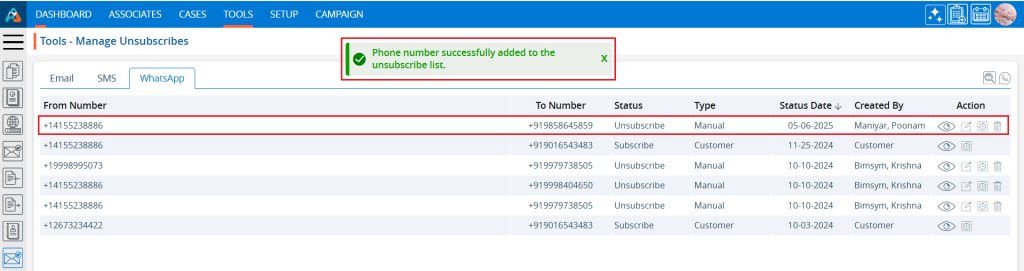
11. A confirmation message will appear and the user will see the phone number and its details in the list.

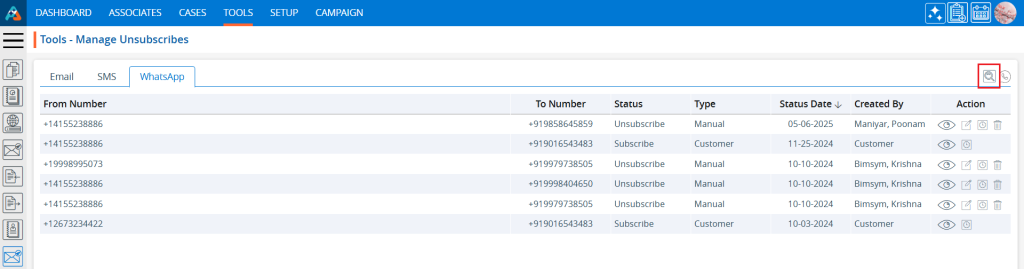
12. To find specific subscription details, use the ‘Search’ functionality. Click on the second-to-last icon in the top-right corner.

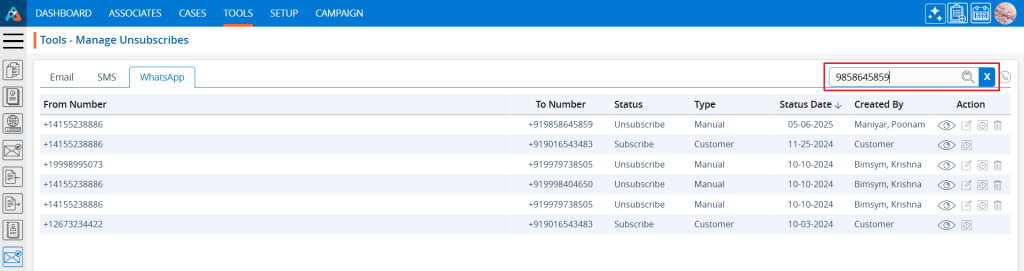
13. By clicking on the search icon, it will expand. Enter the keyword and click on the search icon again. For example, search for ‘9858645859,’ which is a phone number.

  • The User can use From Number, To Number, Status, and Type as keywords.
  • A minimum of 3 characters are needed to search.

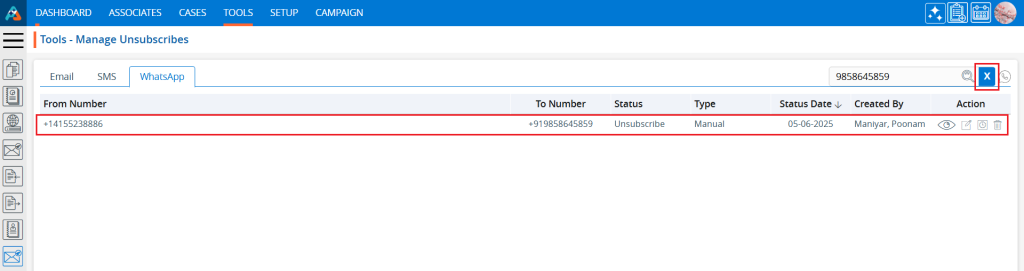
14. The search result will display. To restore the page to its original view, click the ‘Cancel’ button.

15. The page will return to its default state.

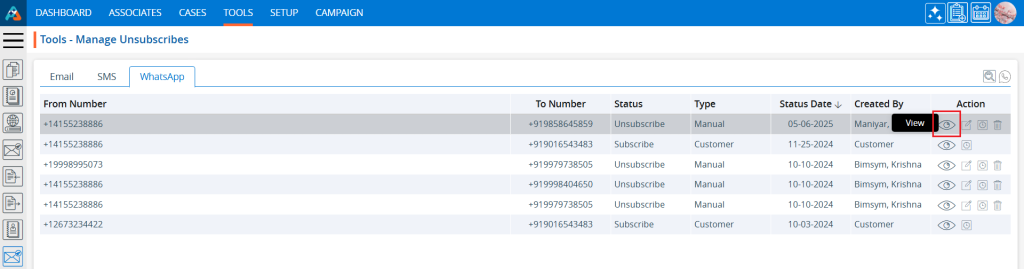
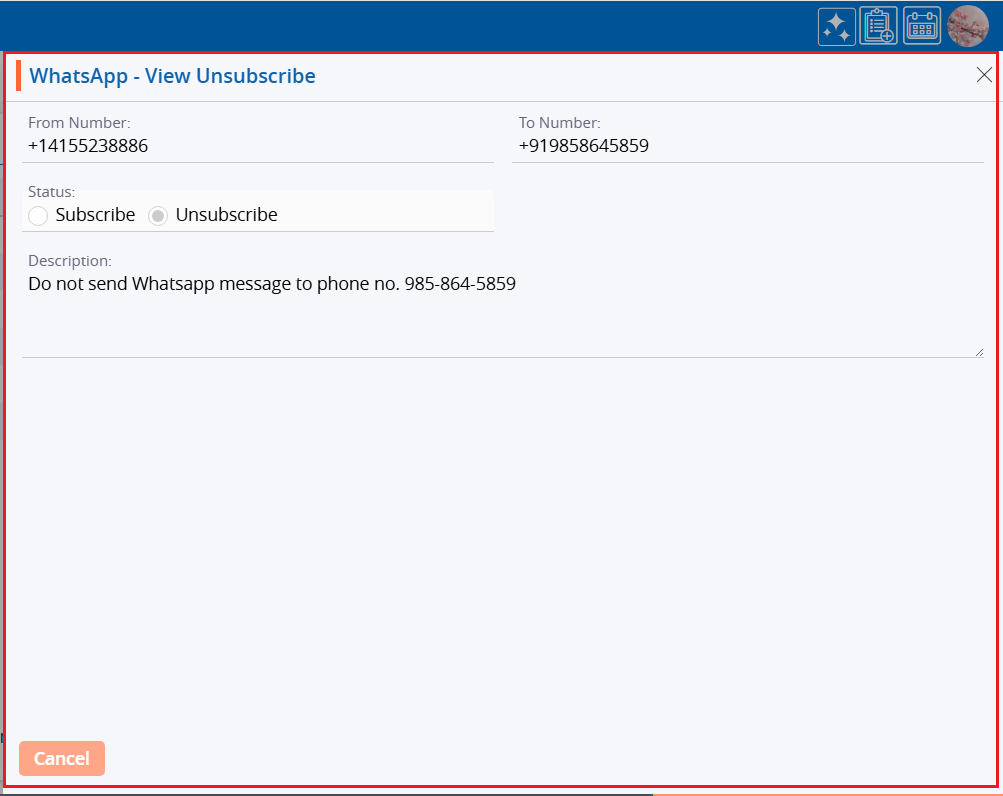
16. Click on the ‘View’ icon, the first option in the Action column on the right side of the Subscription List, highlighted by a red box, to view the details of unsubscribed phone number in the WhatsApp subscription list.

17. A pop-up window will open where all the fields are read-only, and the user can view them without making any changes. After viewing the details, click the ‘Cancel’ button to close the pop-up.

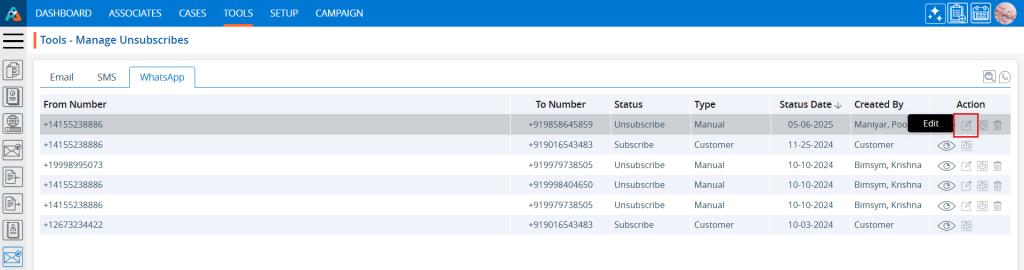
18. Click on the ‘Edit’ icon, the second option in the Action column on the right side of the Subscription List, highlighted by a red box, to modify the details of the unsubscribed WhatsApp phone number.

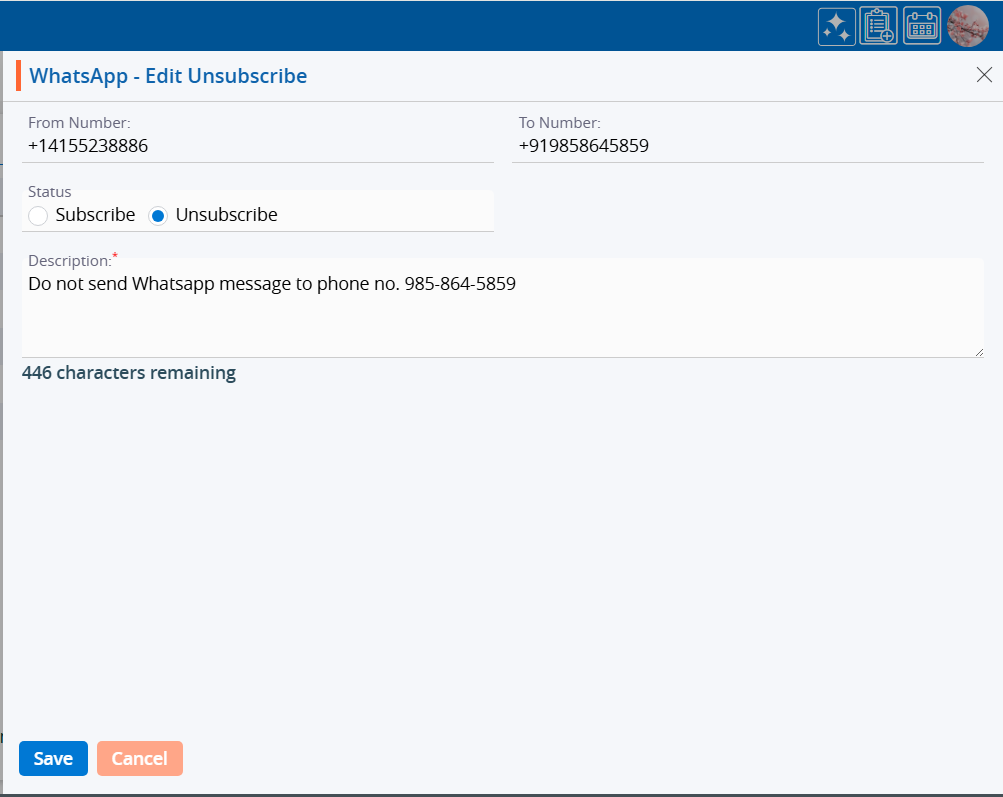
19. A pop-up window will open, allowing the user to update the status or Description of the unsubscribed WhatsApp.

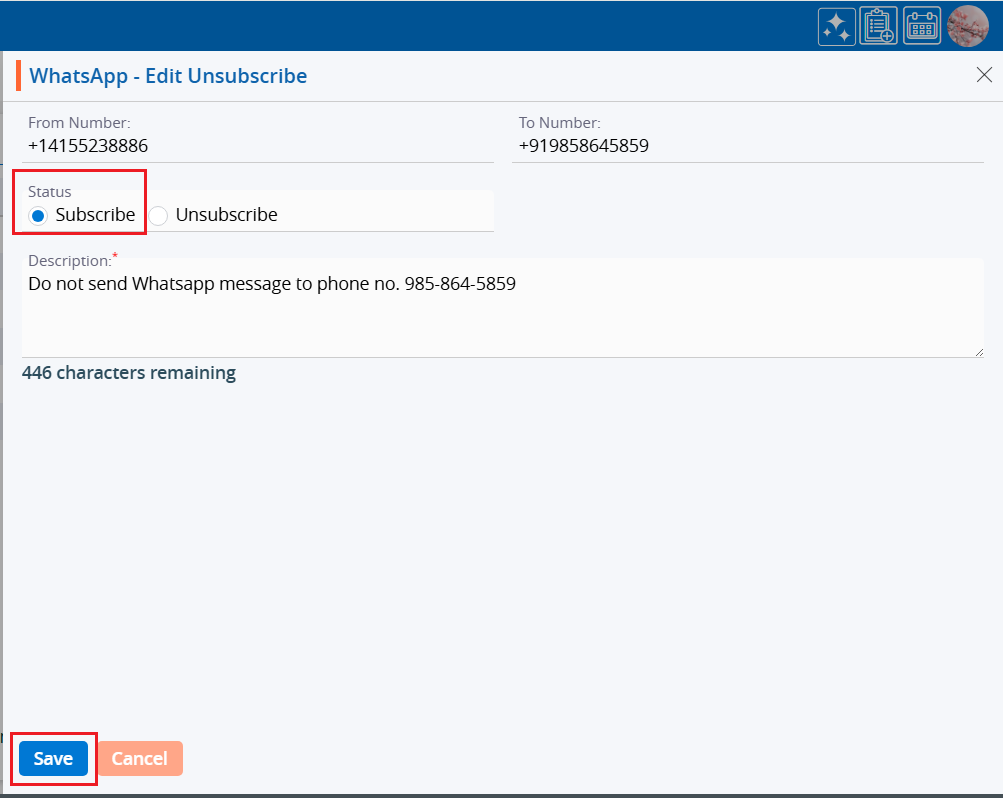
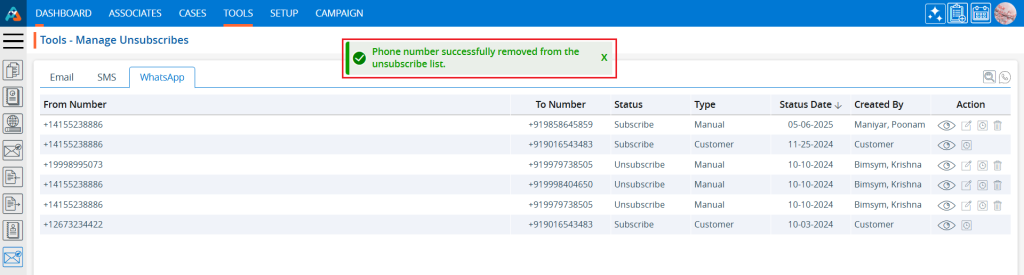
20. Update the details to modify the subscription. For example, we updated the status from ‘Unsubscribe’ to ‘Subscribe’. After making the changes, click on the ‘Save’ button.

21. A confirmation message will appear indicating that the subscription has been updated, and the phone no. has been removed from the unsubscribed list.

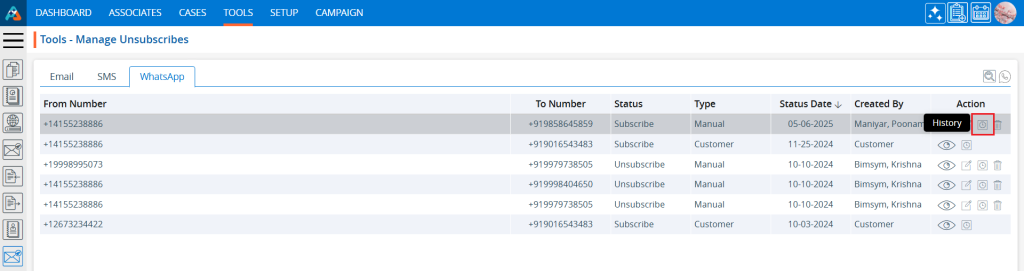
22. Click on the ‘History’ icon, the third option in the Action column on the right side of the Subscription List, highlighted by a red box, to view the history of the subscription.

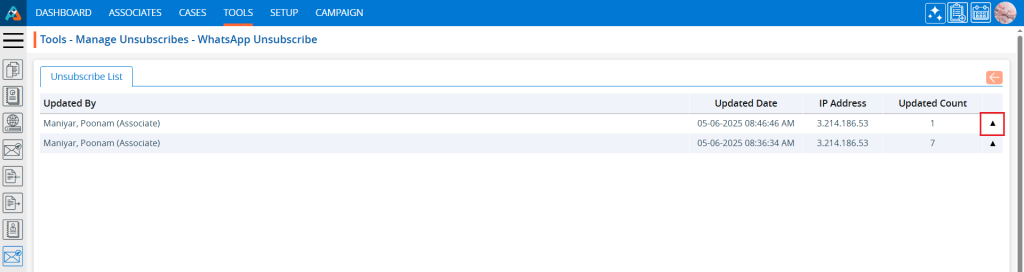
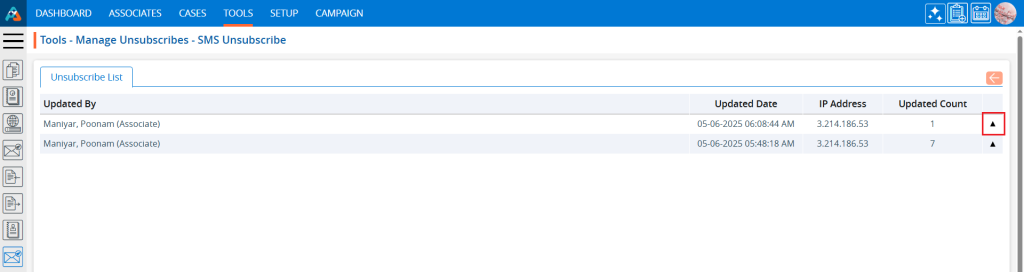
23. A new page will open displaying the history of the Unsubscribe List.  Click the drop-down on the right side of the Unsubscribe List, highlighted by a red box, to view the detailed history.

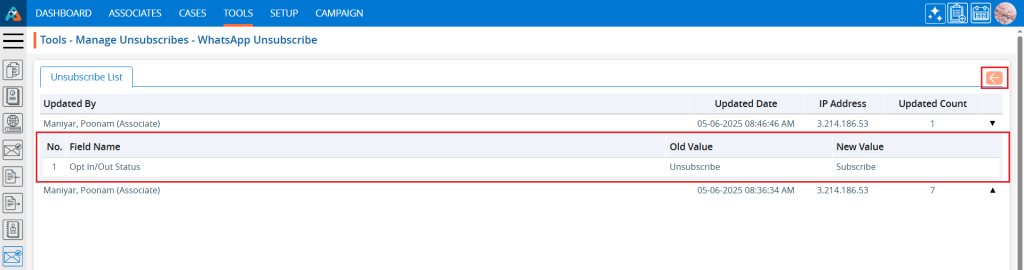
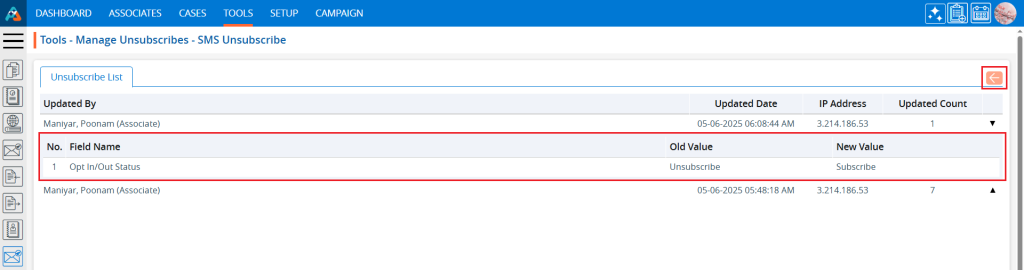
24. The detailed history will be displayed. Click the back button on the right side at the top, highlighted by a red box, to return to the Manage Subscription page.

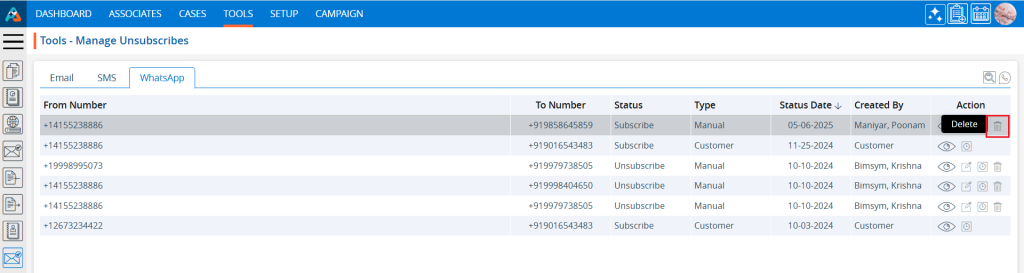
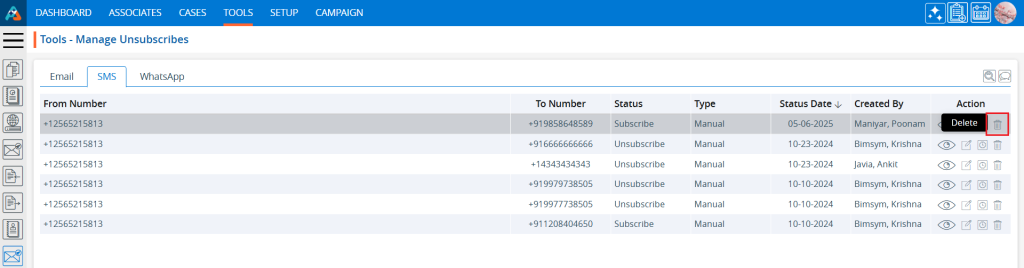
25. Click the ‘Delete’ icon, the last option in the Action column on the right side of the Subscription List, highlighted by a red box, to remove the subscription from the list if it is no longer needed.

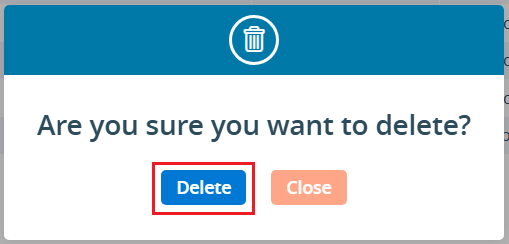
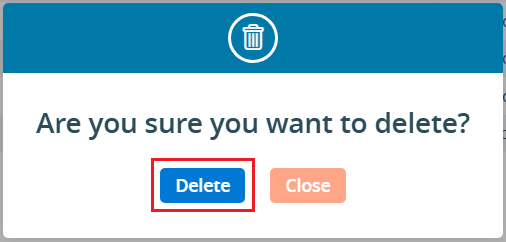
26. Click the ‘Delete’ option in the confirmation message to proceed with removing the subscription from the list.

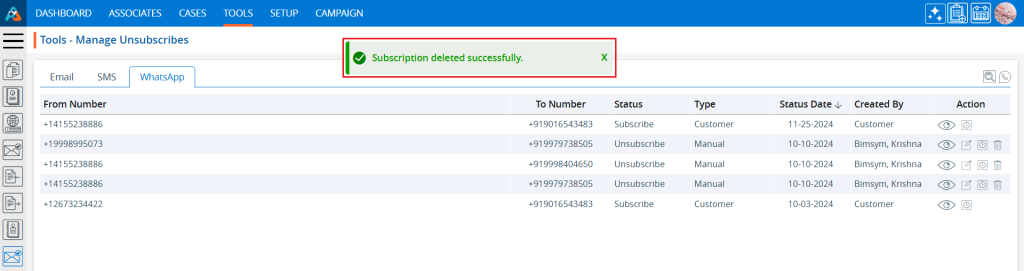
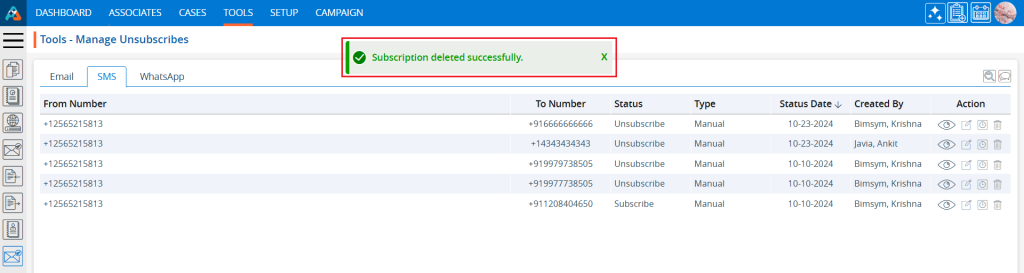
27. A confirmation message will appear, indicating that the subscription has been deleted and is no longer available on the list.

0
0

Manage Subscriptions > SMS

The ‘Manage Subscription for SMS’ option allows users to control their SMS preferences, including subscribing or unsubscribing from SMS notifications. This functionality is primarily used to manage phone numbers on the unsubscribe list, ensuring that users no longer receive unwanted SMS messages.

The following are the steps to manage the SMS Subscriptions:
1. Navigate to the ‘TOOLS’ tab. Click on ‘Manage Subscriptions’ from the left side panel.

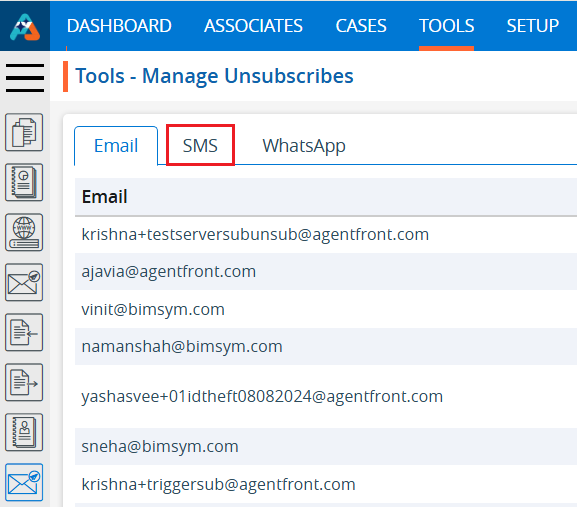
2. The user will be directed to the ‘Tools – Manage Subscription’ page, which includes three tabs: Email, SMS, and WhatsApp.

3. Click on the ‘SMS’ tab.

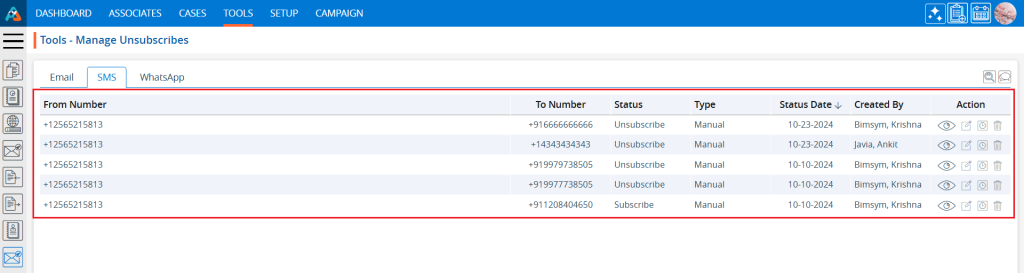
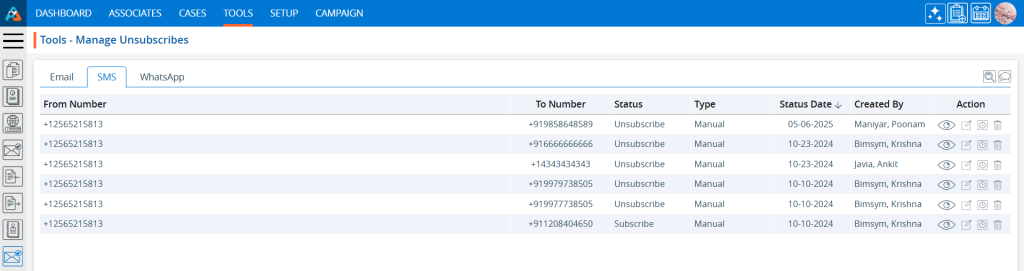
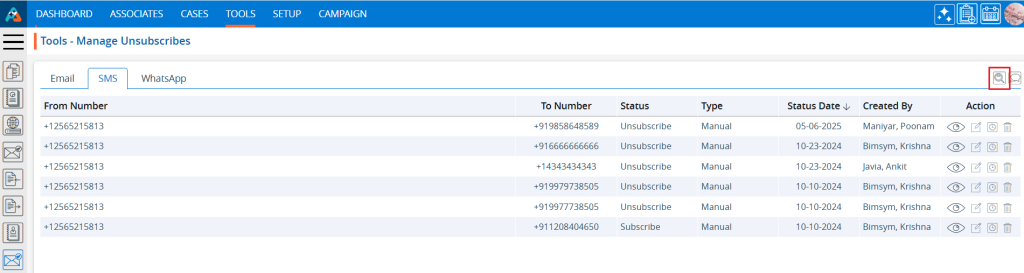
4. The ‘SMS – Manage Subscription’ page will open, displaying a list of existing SMS Subscriptions. The list includes the following fields: From Number, To Number, Status, Type, Status Date, Created By, and Action.
5. There are four options for each subscription:
a. View
b. Edit
c. History
d. Delete

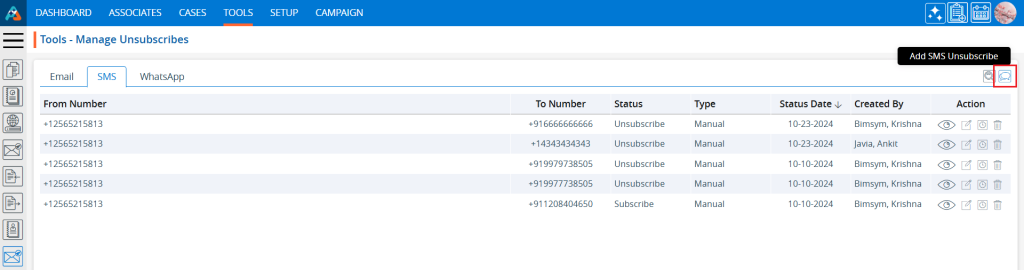
6. Click on the ‘Add SMS Unsubscribe’ icon in the top-right corner to add a new phone number to the SMS unsubscribe list.

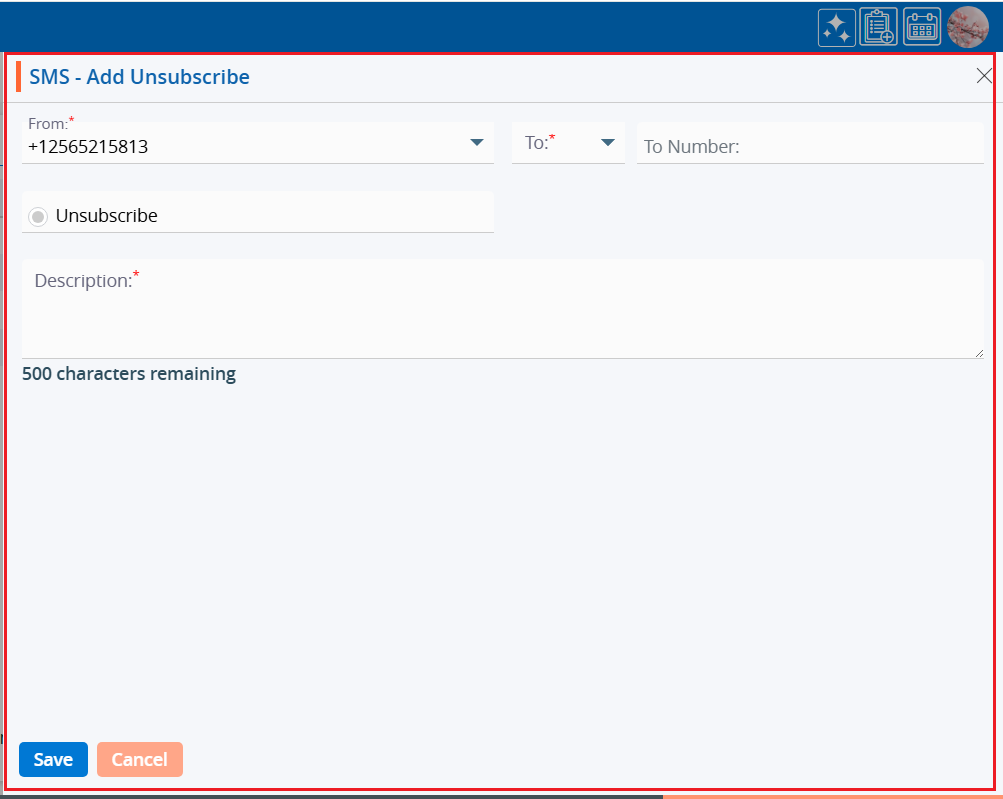
7. A pop-up window will open with fields for From, To, To Number, Unsubscribe and Description and Save and Cancel buttons at the bottom.
8. Fields marked with an asterisk (*) are mandatory.
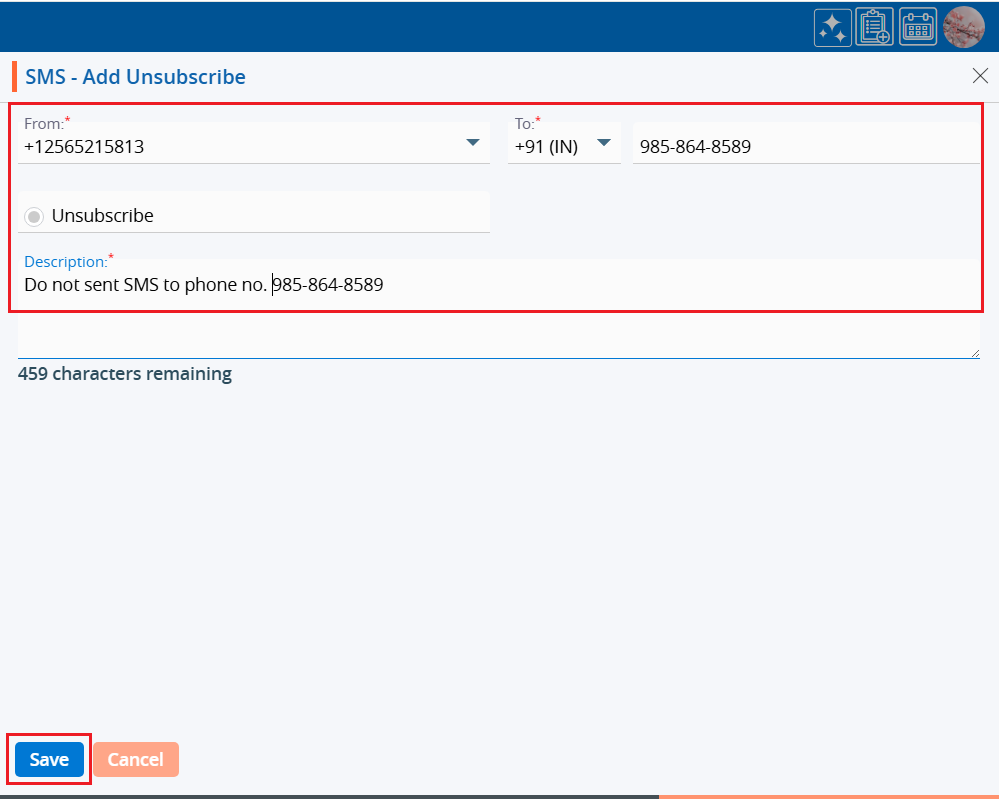
9. The user can enter up to 500 characters in the Description field.

10. Fill in the fields and click on the ‘Save’ button to add the phone number to the SMS unsubscribe list.

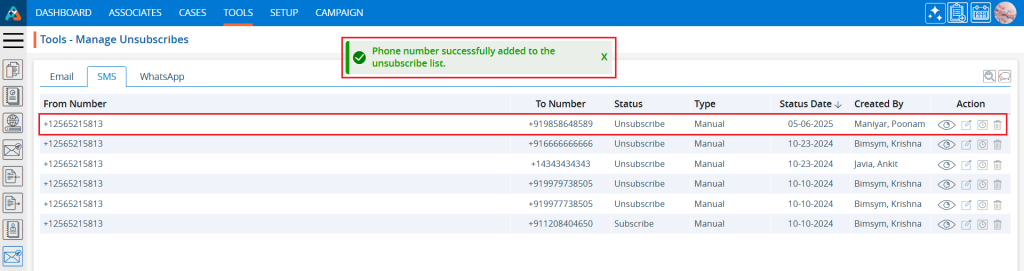
11. A confirmation message will appear once the phone number is successfully added to the SMS unsubscribe list, and the user will see the phone number and its details in the list.

12. To find specific subscription details, use the ‘Search’ functionality. Click on the second-to-last icon in the top-right corner.

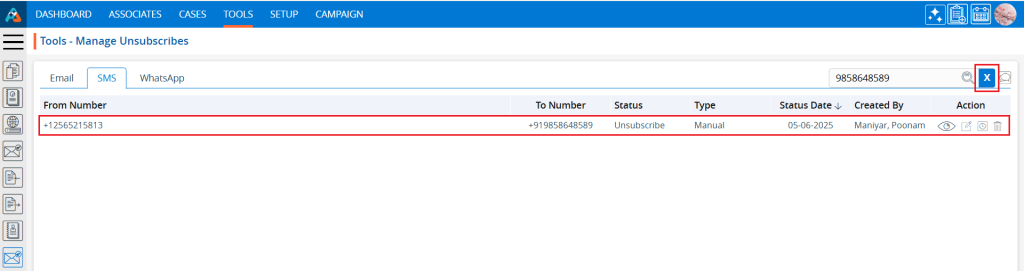
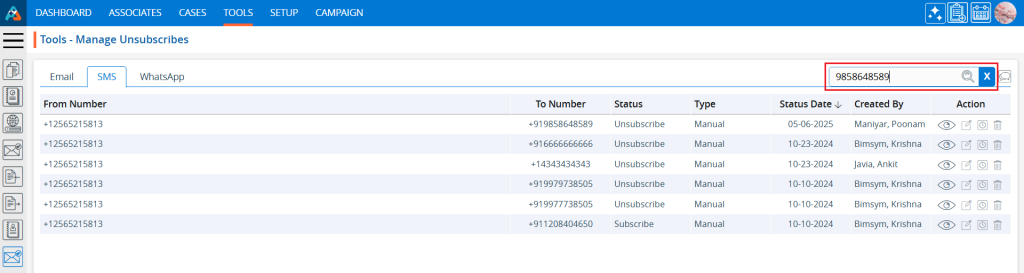
13. Click the search icon to expand the search field. Enter the keyword and click the search icon again. For example, search for ‘9858645859,’ which is a phone number.
• The User can use From Number, To Number, Status and Type as keywords.
• A minimum of 3 characters are needed to search.

14. The search results will be displayed. To restore the page to its original view, click the ‘Cancel’ button.

15. The page will return to its default state.

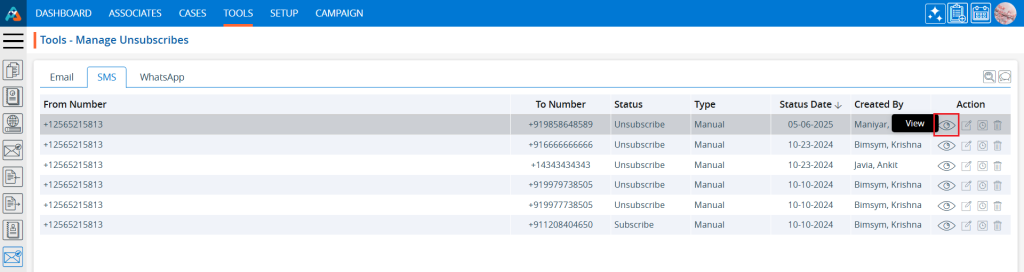
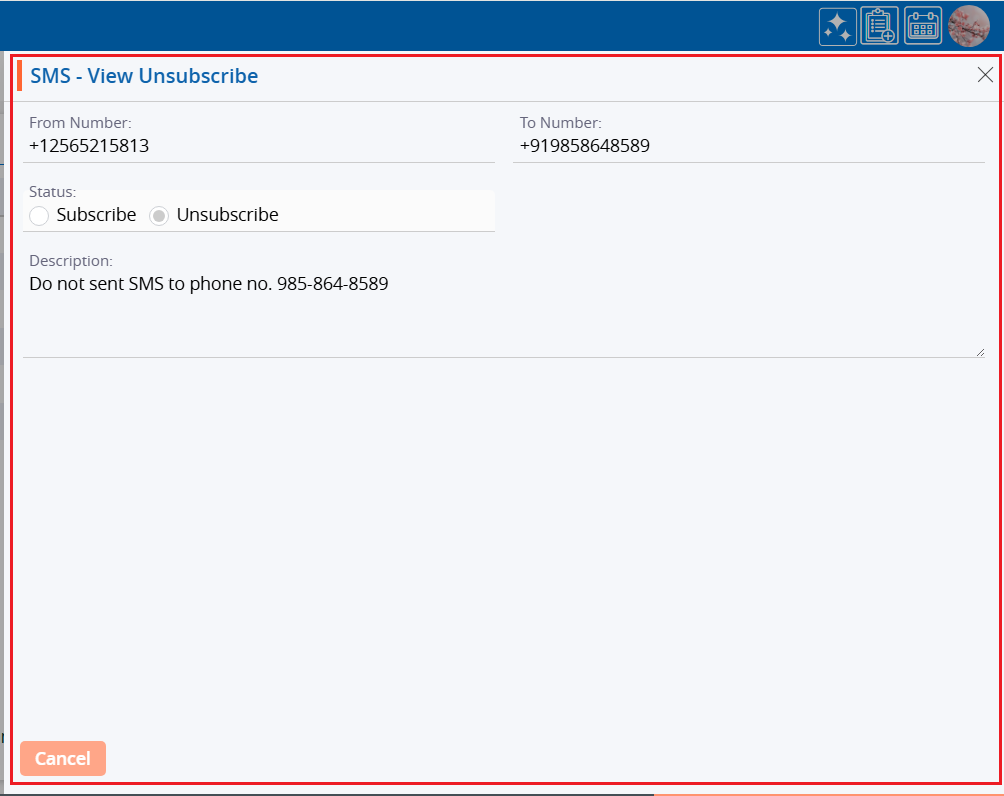
16. Click on the ‘View’ icon, the first option in the Action column on the right side of the Subscription List, highlighted by a red box, to view the details of the unsubscribed phone number in the SMS subscription list.

17. A pop-up window will open where the fields are read-only, and the user can not make any changes. After viewing the details, click the ‘Cancel’ button to close the pop-up.

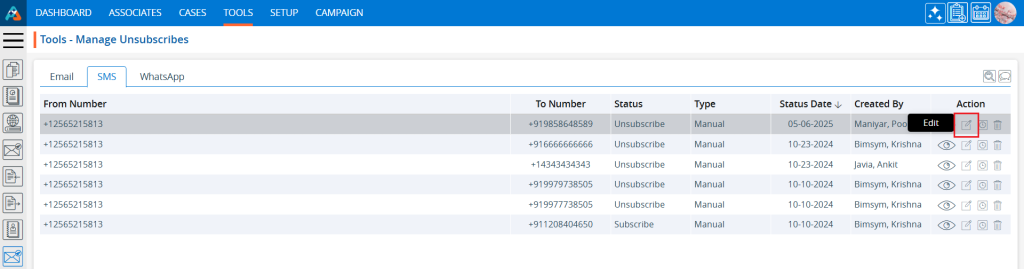
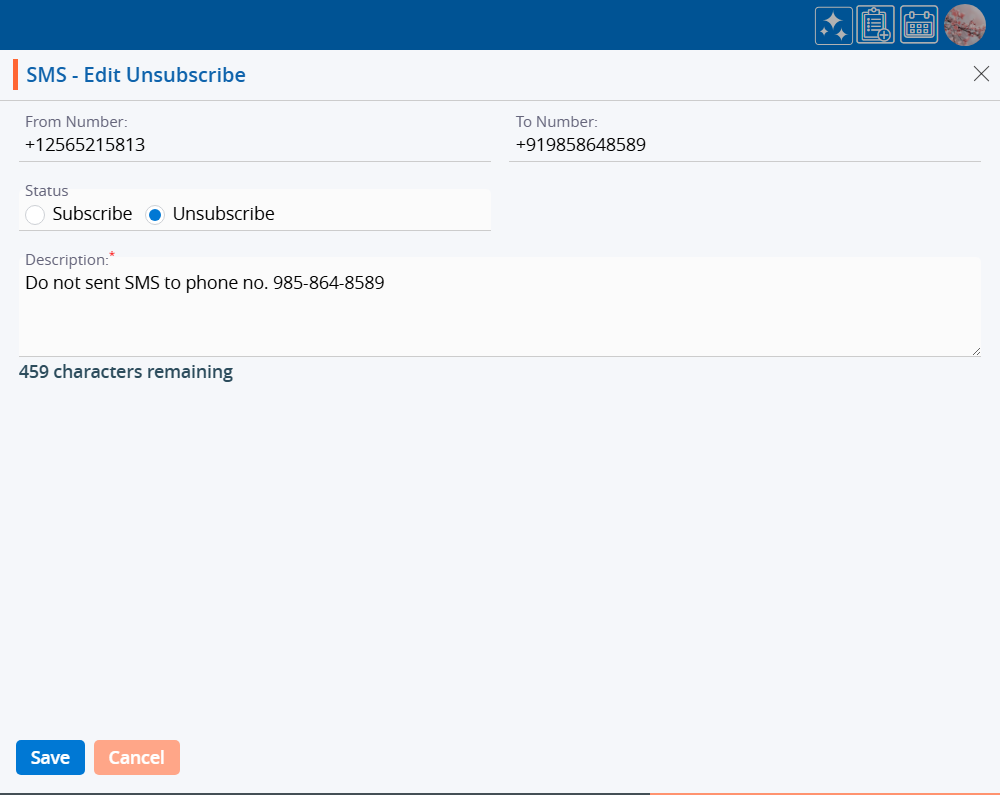
18. Click on the ‘Edit’ icon, the second option in the Action column on the right side of the Subscription List, highlighted by a red box, to modify the details of the unsubscribed phone number.

19. A pop-up window will open.

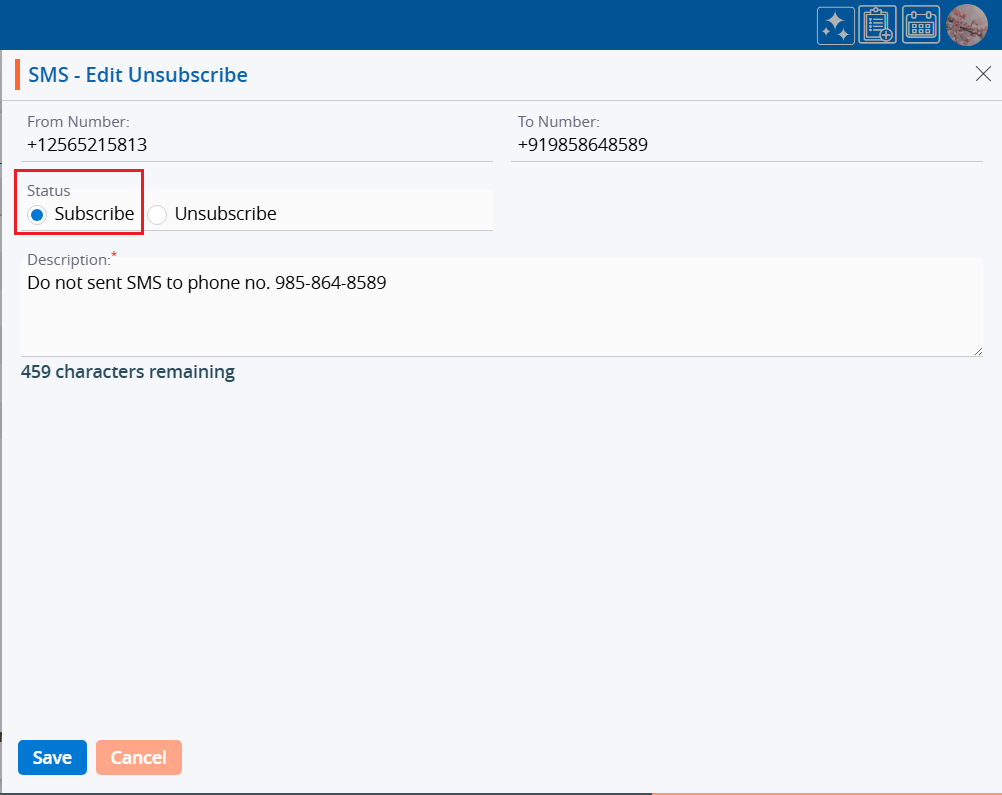
20. Update user is able to update the status or Description of the unsubscribed SMS. For example, we updated the status from ‘Unsubscribe’ to ‘Subscribe’. After making the changes, click the ‘Save’ button.

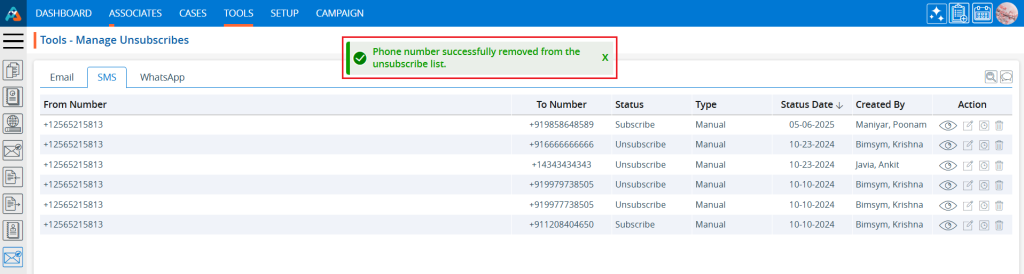
21. A confirmation message will appear and the phone number has been removed from the unsubscribed list.

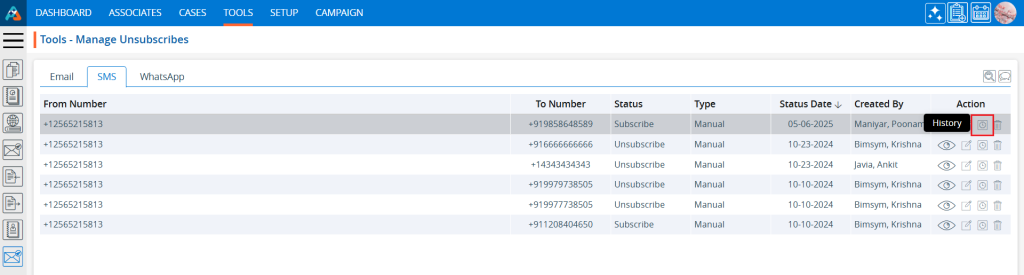
22. Click on the ‘History’ icon, the third option in the Action column on the right side of the Subscription List, highlighted by a red box, to view the subscription history.

23. A new page will open displaying the history of the Unsubscribe List. Click the drop-down on the right side of the Unsubscribe List, highlighted by a red box, to view detailed history.

24. The detailed history will display fields such as No., Field Name, Old Value, and New Value. Click the back button on the right side at the top, highlighted by a red box, to return to the Manage Subscription page.

25. Click the ‘Delete’ icon, the last option in the Action column on the right side of the Subscription List, highlighted by a red box, to remove the subscription from the list if it is no longer needed.

26. Click the ‘Delete’ option in the confirmation message to proceed with removing the subscription from the list.

27. A confirmation message will appear, and the subscription is no longer available on the list.

0
0

Manage Subscriptions > Email

The ‘Manage Subscription for Email’ option allows users to control their email preferences, including subscribing to or unsubscribing from email notifications. This functionality is primarily used to manage email addresses on the unsubscribe list, ensuring that users no longer receive unwanted emails from the selected categories.

The following are the steps to manage the Email Subscriptions:
1. Navigate to the ‘TOOLS’ tab. Click on ‘Manage Subscriptions’ from the left side panel.

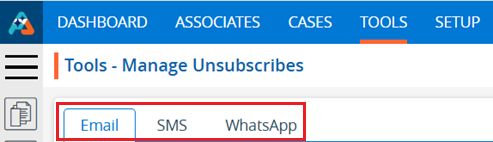
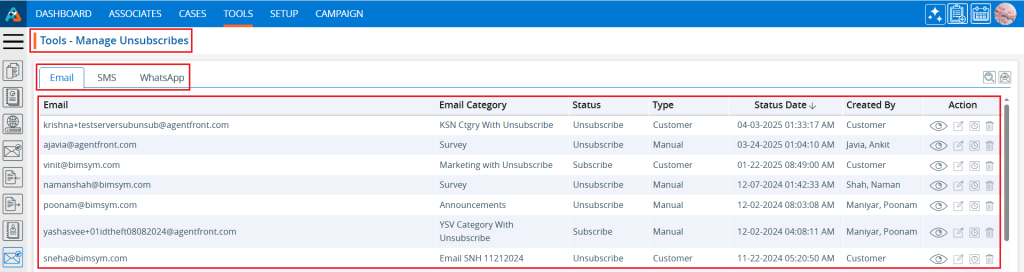
2. The user will be directed to the ‘Manage Subscriptions’ page, which includes three tabs: Email, SMS, and WhatsApp.

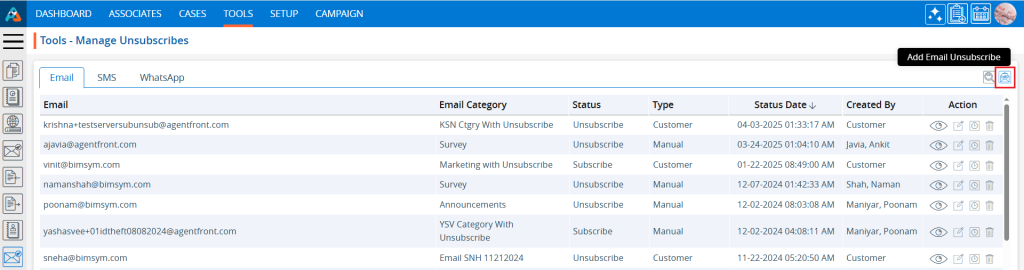
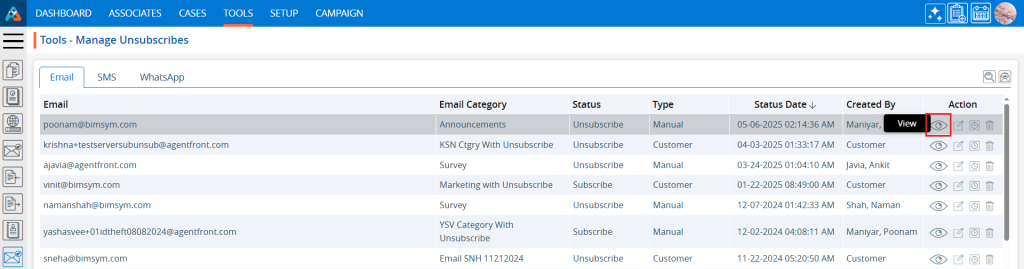
3. By default, the Manage Subscriptions page will open with the Email tab selected, displaying a list of existing Email Subscriptions, along with columns: Email, Email Category, Status, Type, Status Date, Created By, and Action.
4. There are four options in ‘Action’ for each subscription:
a. View
b. Edit
c. History
d. Delete

5. Click on the ‘Add Email Unsubscribe’ icon in the top-right corner to add a new email address to the subscription list.

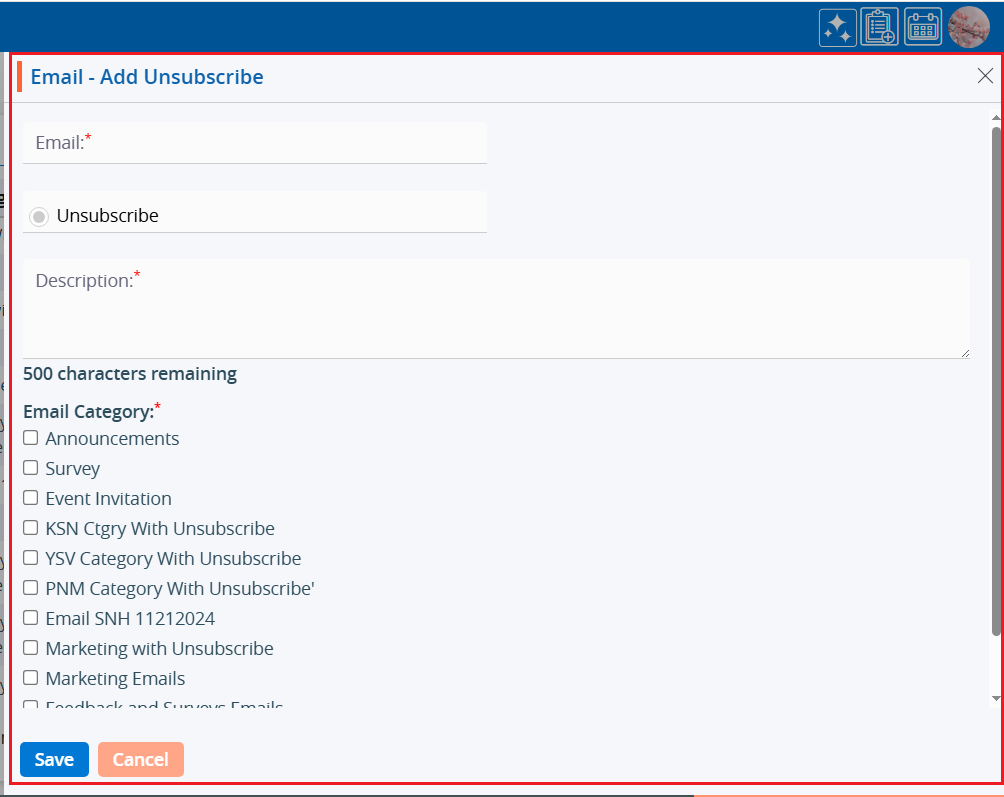
6. A pop-up window will open with fields for Email, Unsubscribe, Description, Email Category, and options Save and Cancel at the bottom.
7. Fields marked with an asterisk (*) are mandatory.
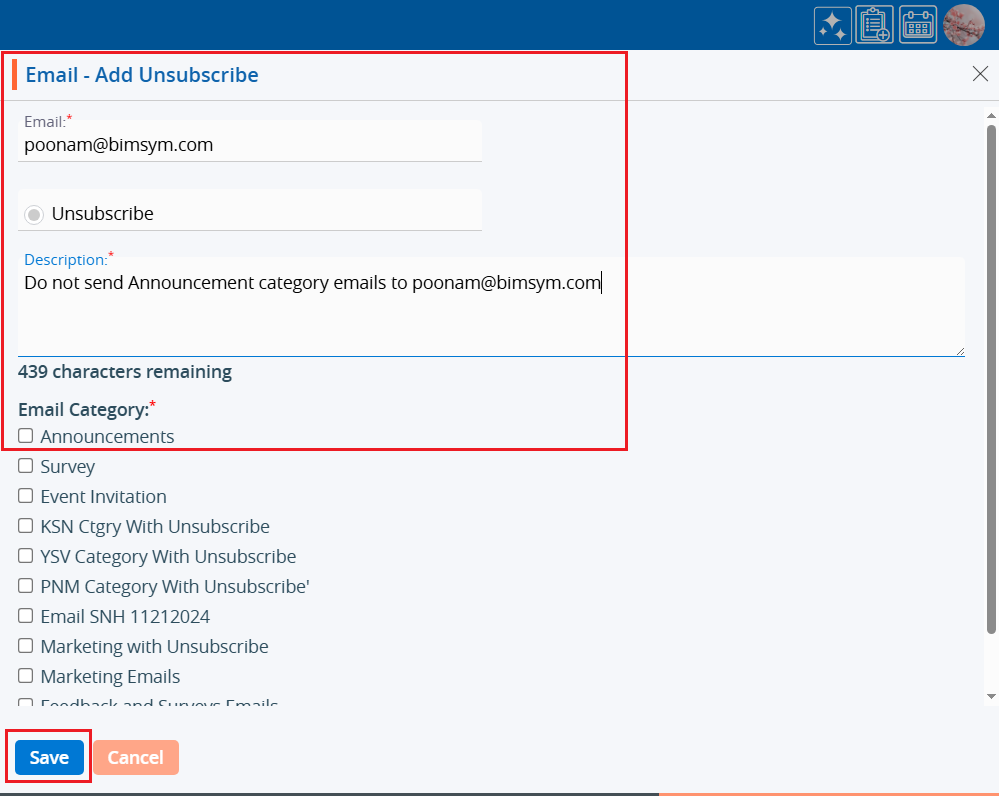
8. The user can enter up to 500 characters in the Description field.

9. Fill in the fields and click the ‘Save’ button to add the required email to the unsubscribe list.

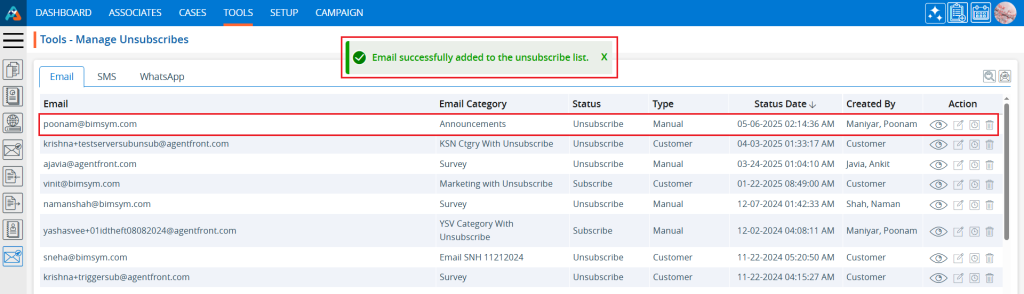
10. A confirmation message will appear and the newly added email address and its details will appear in the list.

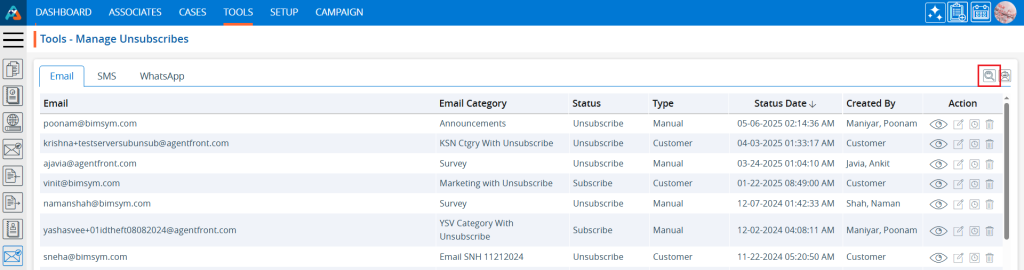
11. The user can find the subscription using the search functionality. Click on the second-to-last icon in the top-right corner.

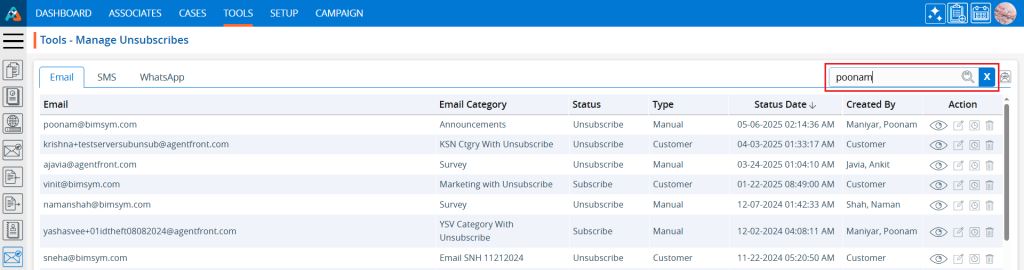
12. Click the search icon to expand the search field. Enter the keyword and click the search icon again. For example, we are searching for the word ‘poonam’, which is in the email address.
• The user can use Email Address, Email Category, Status, and Type as keywords.
• A minimum of 3 characters is required to perform a search.

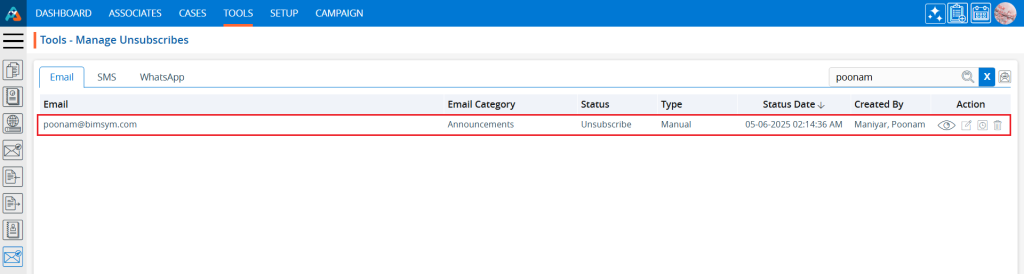
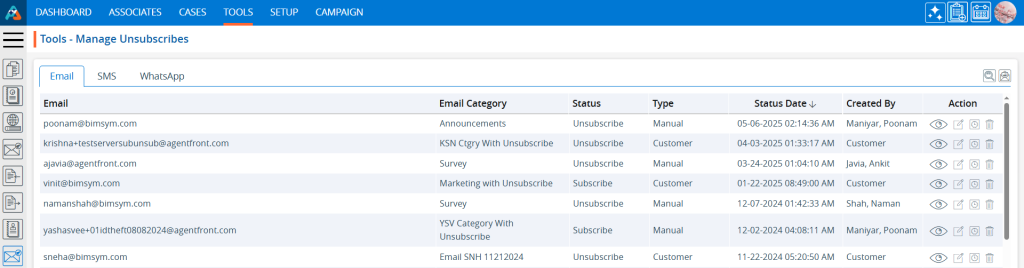
13. The search results will be displayed. Click the ‘Cancel’ button to restore the page to its original view.

14. The page will return to its default state.

15. Click on the ‘View’ icon, in the first option in the Action column on the right side of the Subscription List, highlighted by a red box, to view the details of the unsubscribed email addresses.

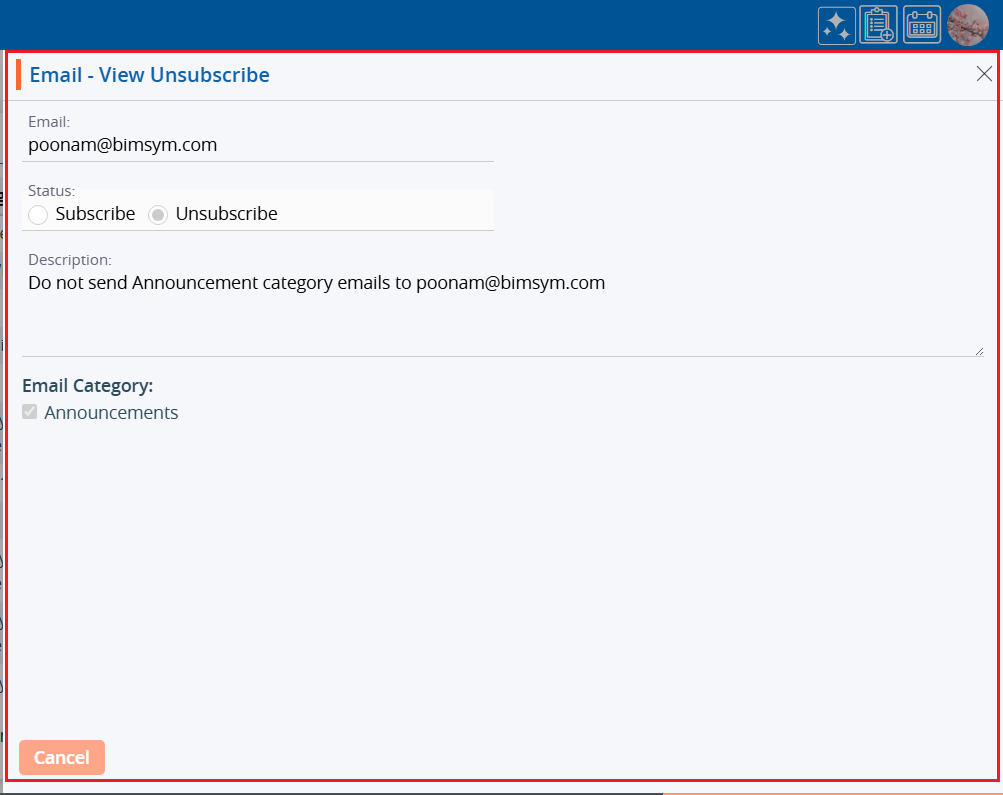
16. A pop-up window will appear where all the fields are read-only, and the user can view them without making any changes. After viewing the details, click the ‘Cancel’ button to close the pop-up.

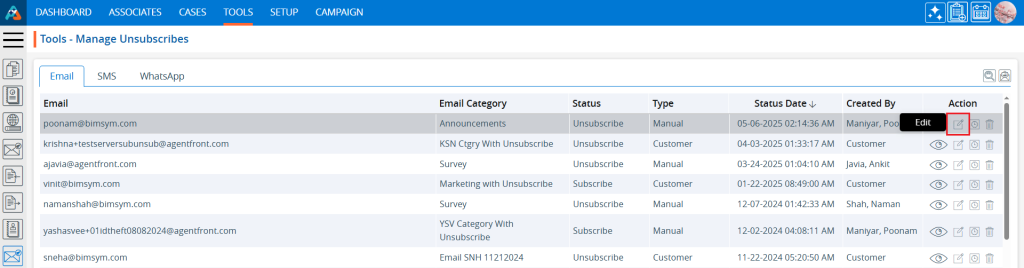
17. Click on the ‘Edit’ icon, the second option in the Action column on the right side of the Subscription List, highlighted by a red box, to modify the unsubscribed details.

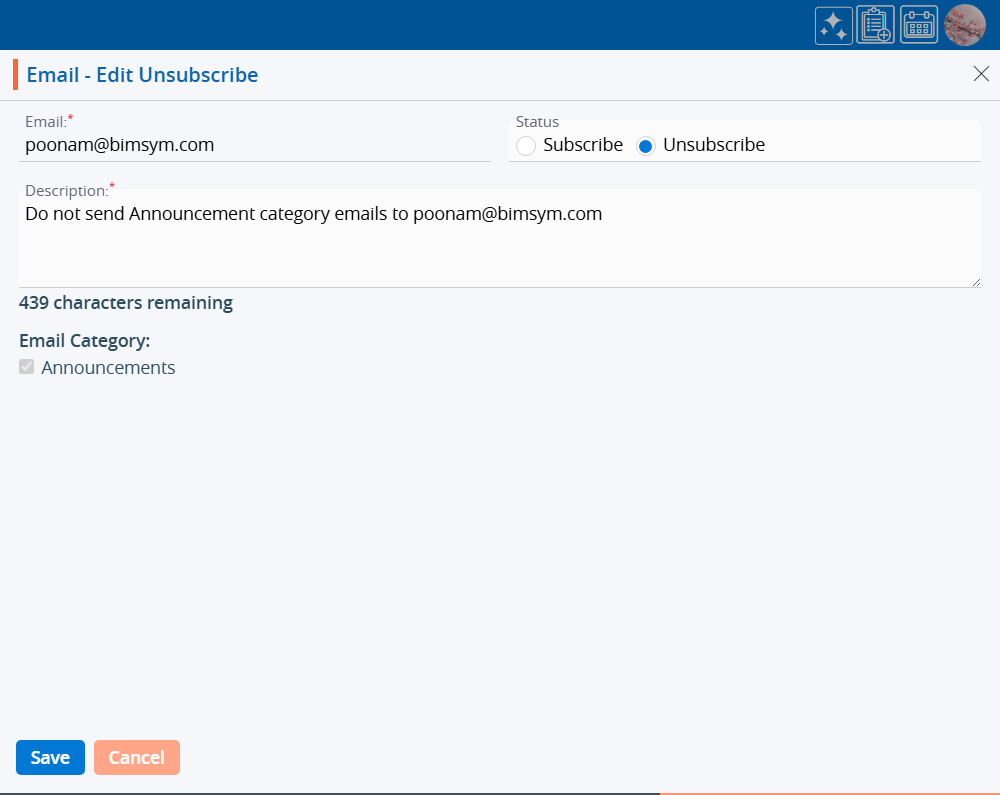
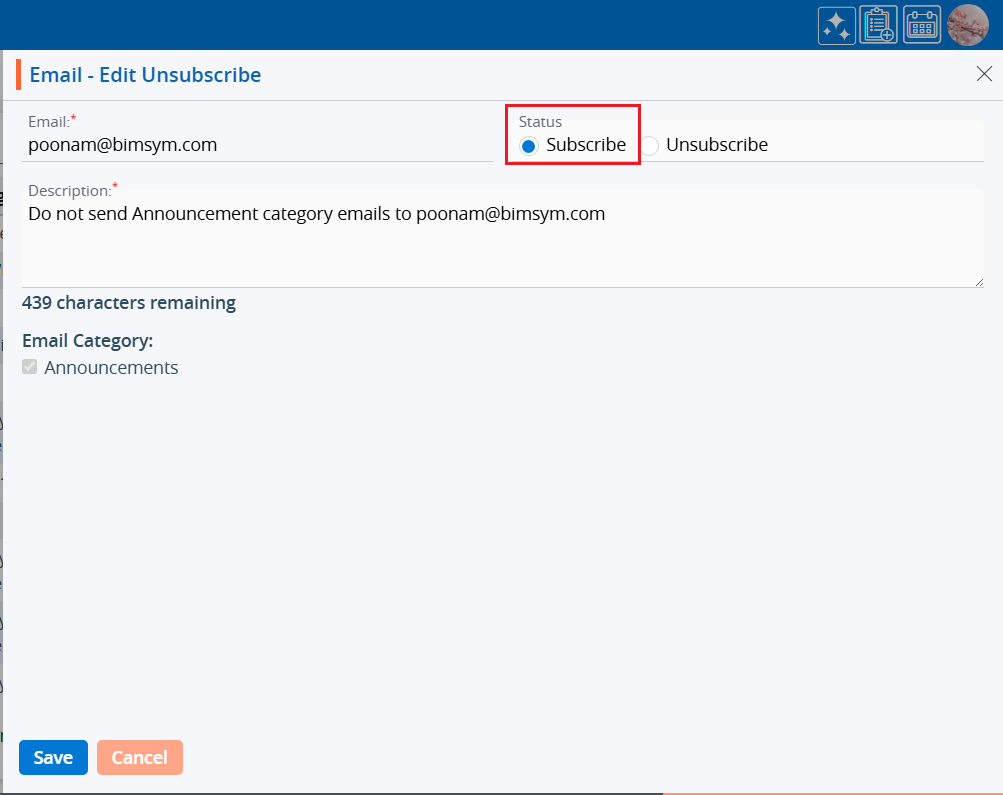
18. A pop-up window will open, allowing the user to update the status or Description of the unsubscribed email.

19. Update the details as needed. For example, we updated the status from ‘Unsubscribe’ to ‘Subscribe’. After making the changes, click the ‘Save’ button.

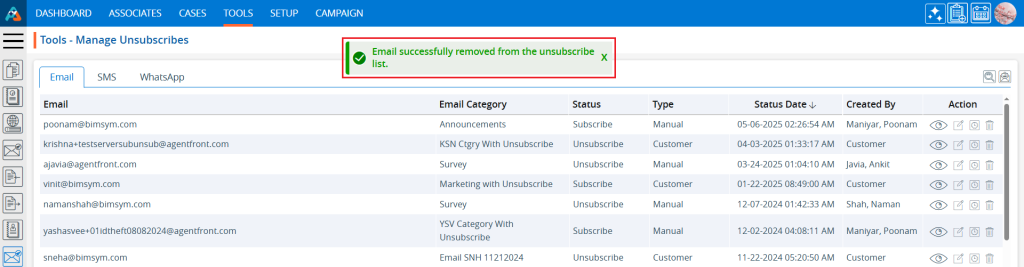
20. A confirmation message will appear and the email has been removed from the unsubscribed list.

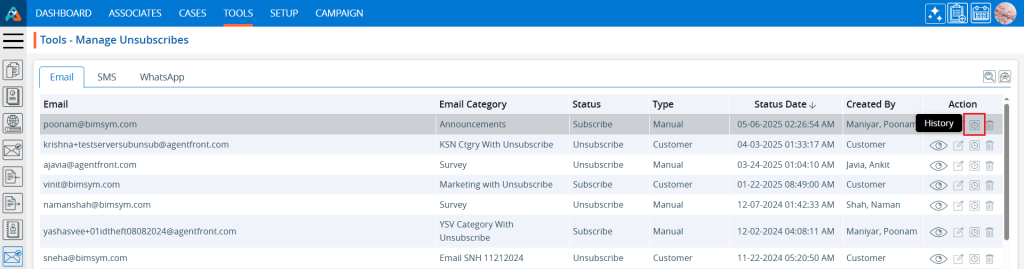
21. Click on the ‘History’ icon, the third option in the Action column on the right side of the Subscription List, highlighted by a red box, to view the history of the subscription.

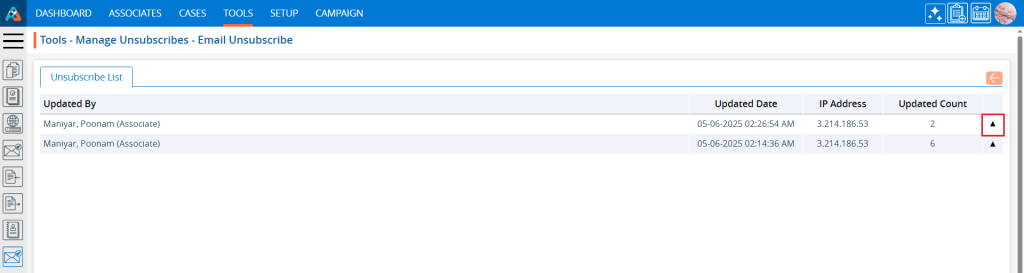
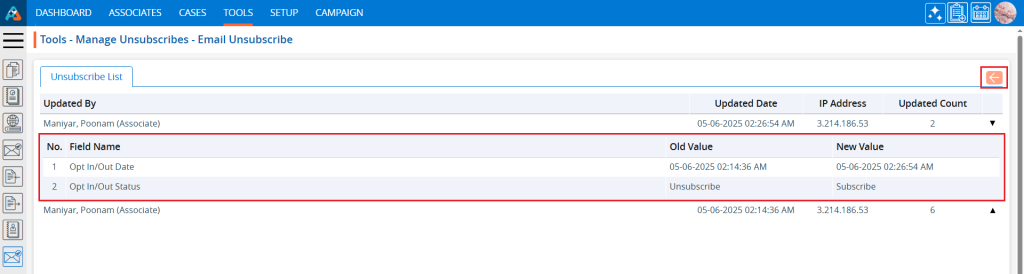
22. A new page will open with the history of the Unsubscribe List, showing the Updated By, Updated Date, IP Address, and Updated Count. Click the drop-down on the right side of the Unsubscribe List, highlighted by a red box, to view the detailed history.

23. The detailed history will display fields such as No., Field Name, Old Value, and New Value. Click the back button on the right side at the top, highlighted by a red box, to return to the Manage Subscription page.

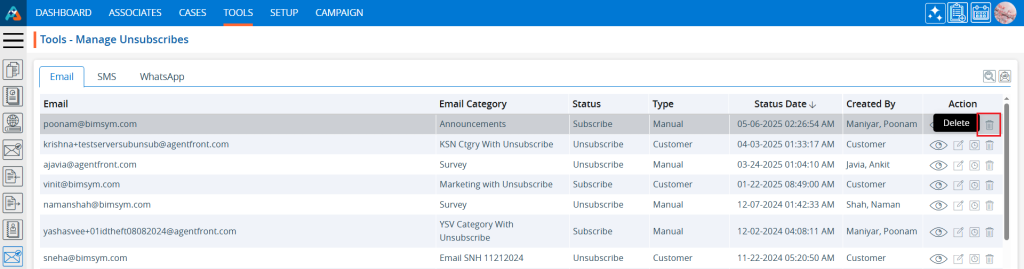
24. Click the ‘Delete’ icon, the last option in the Action column on the right side of the Subscription List, highlighted by a red box, to remove the subscription from the list if it is no longer needed.

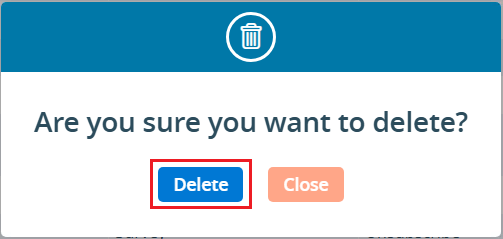
25. Click the ‘Delete’ option in the confirmation message to proceed with removing the subscription from the list.

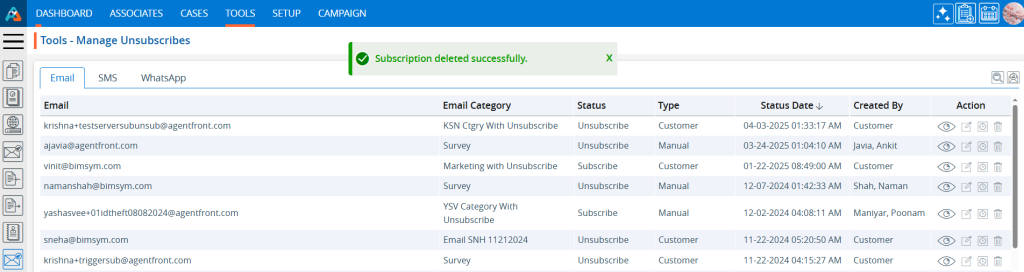
26. A confirmation message will appear and the subscription is no longer available on the list.

0
0

Template Creator > WhatsApp

WhatsApp – The WhatsApp template creator streamlines and accelerates the process of sending WhatsApp messages using pre-designed templates. These templates can be easily accessed to send WhatsApp messages through the system.


The following are the steps for managing WhatsApp message template:

1. Navigate to the ‘TOOLS’ tab.

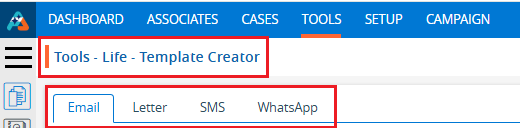
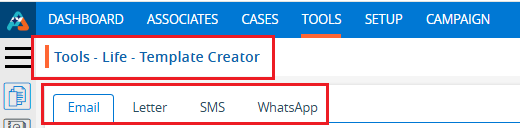
2. The Tools tab will open, displaying the ‘Tools – Life – Template Creator’ with four tabs: Email, Letter, SMS, and WhatsApp.

3. Click on the ‘WhatsApp’ tab, which will display a list of existing WhatsApp templates along with details such as Template Name, Category, Template ID, Language, Template Type, Approval Status, Usage, Created By, Create Date and Action.

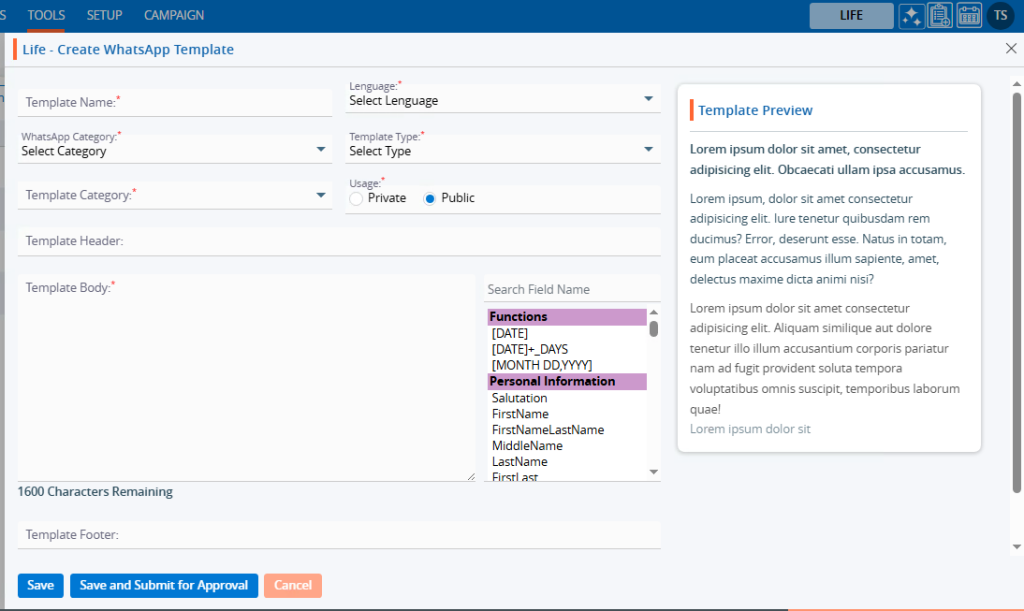
4. Click on the ‘Create WhatsApp Template’ icon to begin creating a new WhatsApp template.

5. A pop-up window will appear with fields for Template Name, Language, WhatsApp Category, Template Type, Template Category, Usage (defaulted to ‘Public’), Template Header, Template Body and Template Footer. At the bottom, there will be options to Save, Save And Submit for Approval, and Cancel.
6. Fields marked with an asterisk (*) are mandatory.
7. The length of the Template Body is 1600 characters.

8. Fill in the fields.
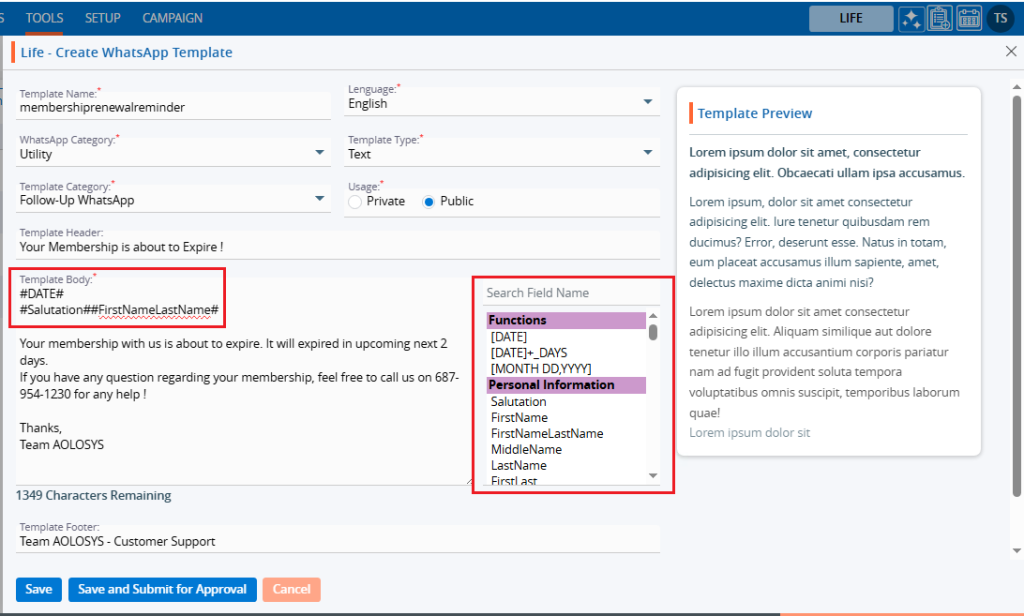
9. On the right-hand side, there is a list of fields that will fetch details for the selected user.
10. Users can click on fields or search from the list to use in the template.
11. Double-clicking on the selected field will add them to the content area.
For example, users can include fields such as Date, Salutation, and FirstNameLastName.

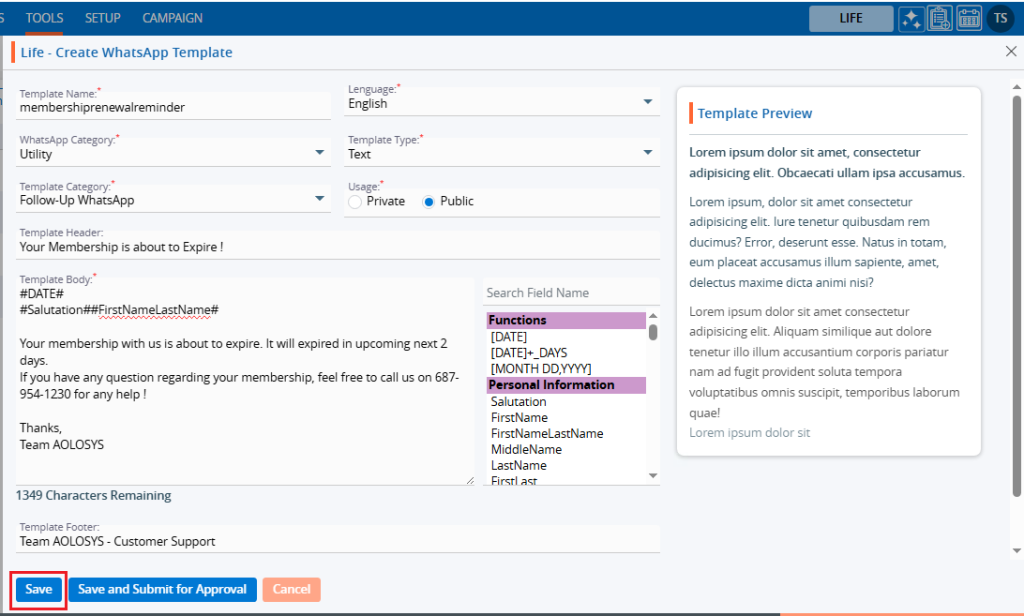
12. Click the ‘Save’ button to save the template.

13. A confirmation message will appear once the template is created, and the user will find the newly created template and its details in the list.

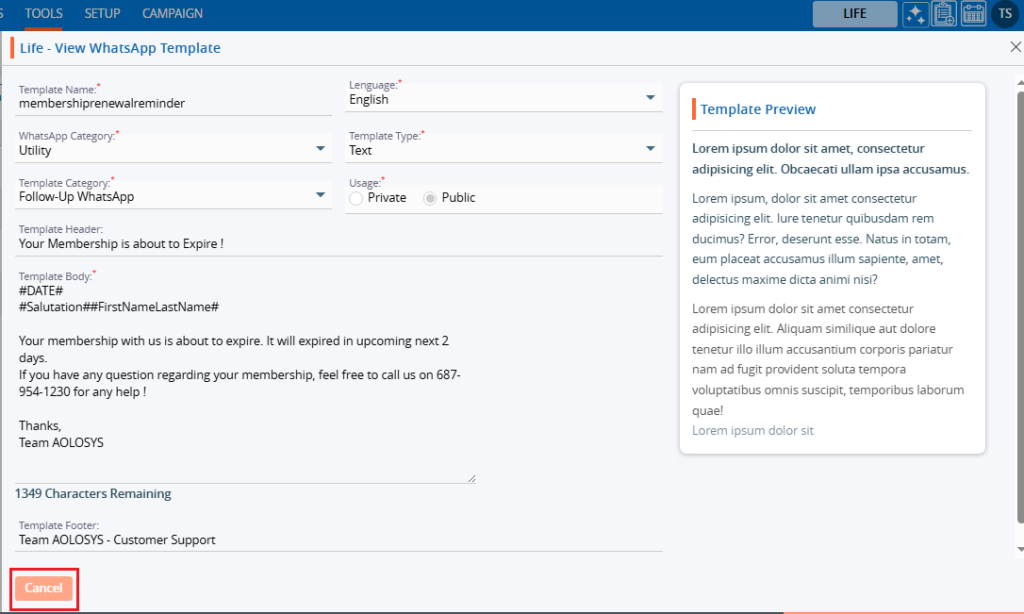
14. Click on the ‘View’ icon to view the existing Template.

15. A pop-up window will open, where the user can view the details of the template in read-only.

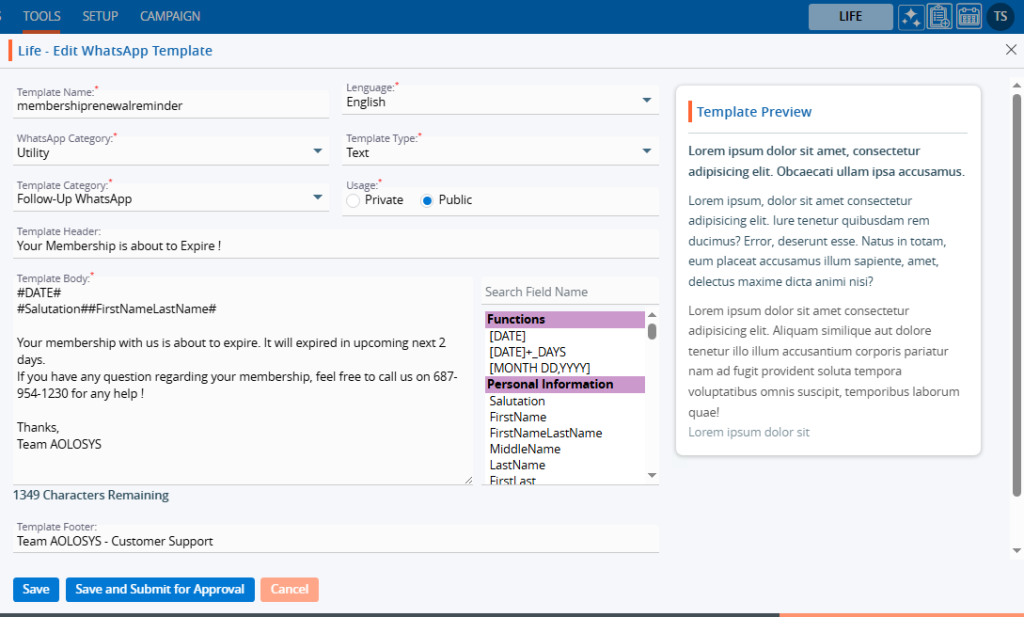
16. Click on the ‘Edit’ option to modify the template.

17. A pop-up window will appear, allowing the user to update details of the template.

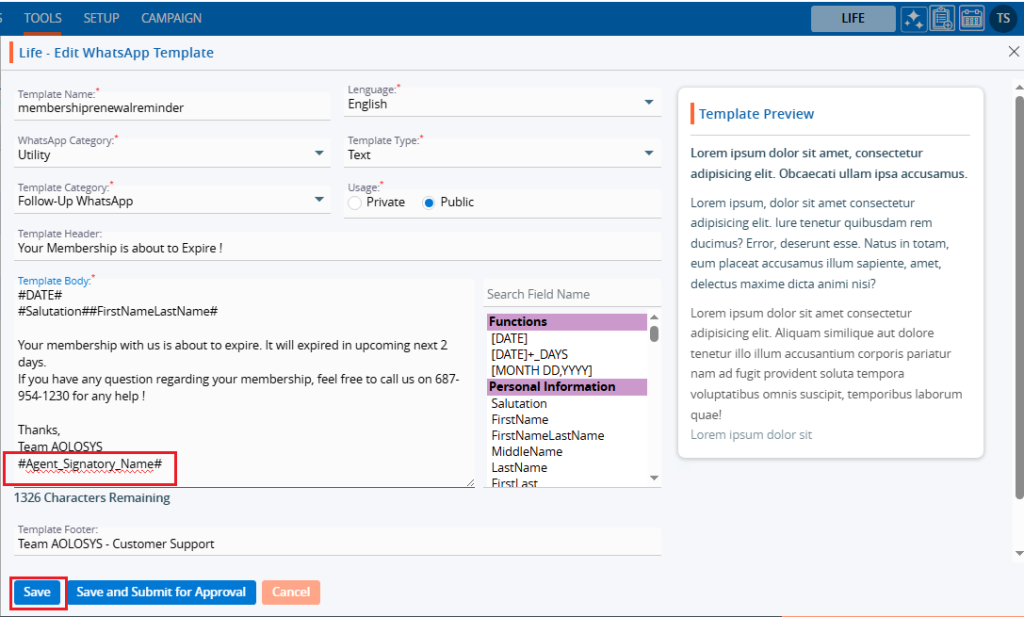
18. After making the changes, click the ‘Save’ button.

19. A confirmation message will appear indicating that the template has been updated.

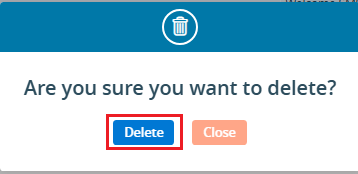
20. Select the ‘Delete’ option to remove the template from the list if it is no longer needed.

21. Click the ‘Delete’ option in the confirmation message to proceed with removing the template from the list

22. A confirmation message will appear, indicating that the template has been deleted and is no longer available.

0
0

Template Creator > SMS

SMS – SMS templates is used to simplify and speed up the process of sending messages. These templates can be utilized for any SMS sent through the system.

The following are the steps for creating SMS templates:

1. Navigate to the ‘TOOLS’ tab.

2. The Tools tab will open, displaying the ‘Tools – Life – Template Creator’ with four tabs: Email, Letter, SMS, and WhatsApp.

3. Click on the ‘SMS’ tab. A list of existing SMS templates will display details including Template Name, Category, Usage, Created By, Create Date and Action.

4. Click on the ‘Create SMS Template’ icon to begin creating a new SMS template.

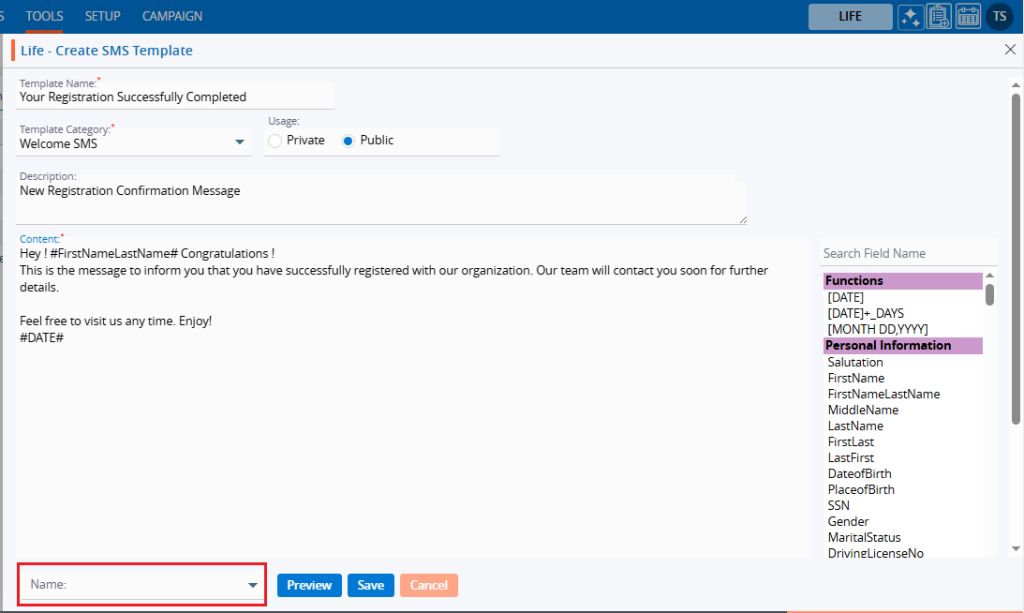
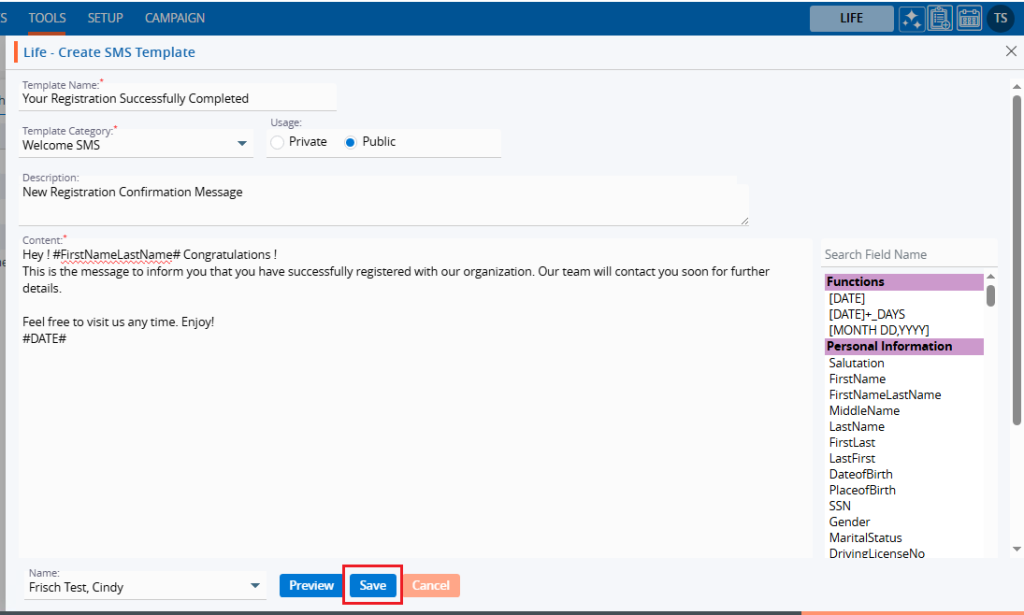
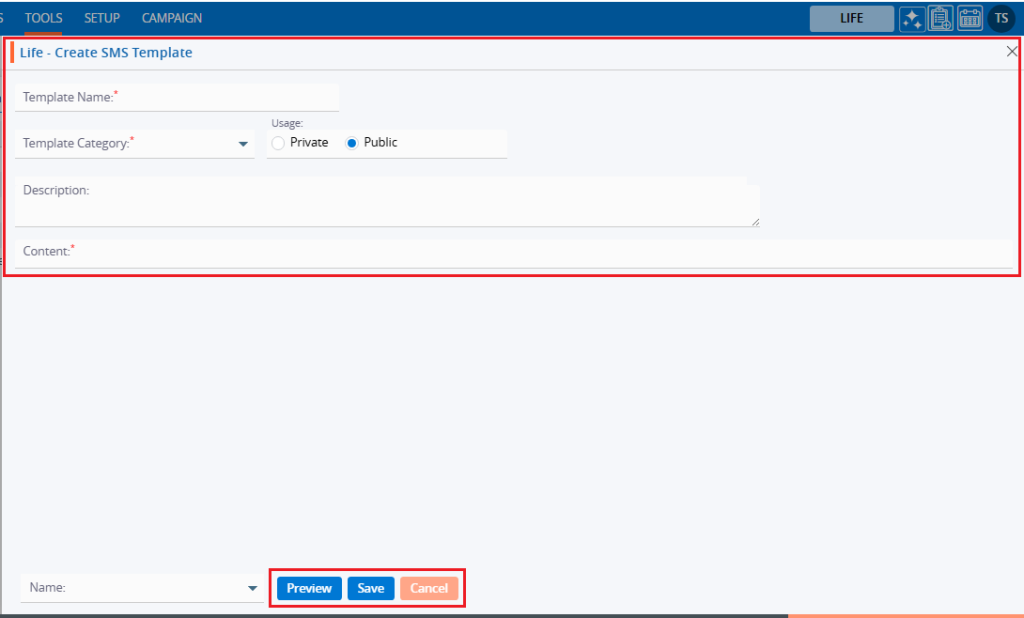
5. A pop-up window will open with fields for Template Name, Template Category, Usage (defaulted to ‘Public’), Description, and Content. At the bottom, there is an Associate Dropdown and Preview, Save, and Cancel options.
Fields marked with an asterisk (*) are mandatory.

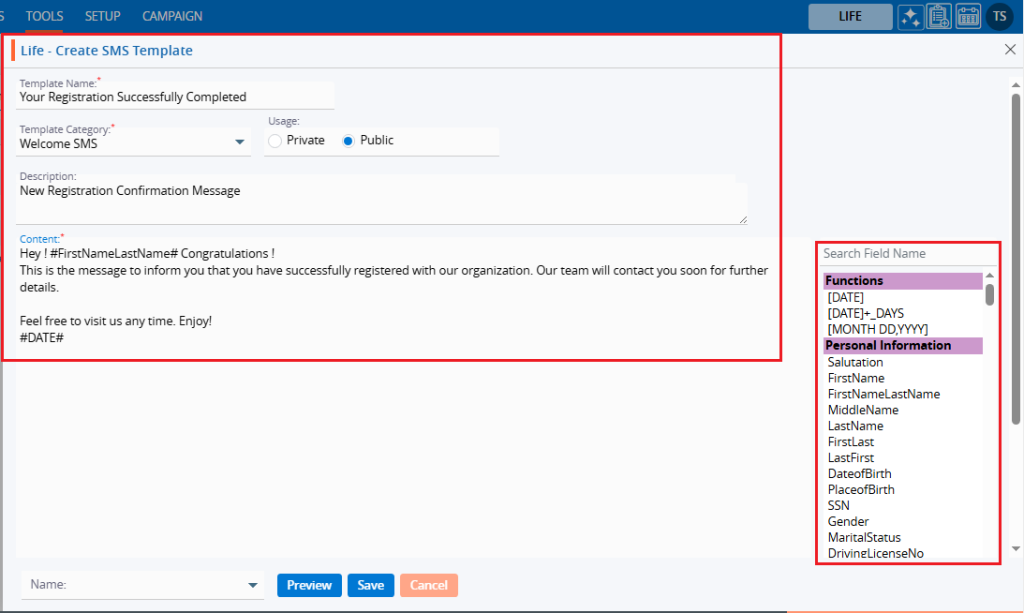
6. Fill in the fields to create an SMS message template. Also, on the right-hand side, there is a list of fields that will fetch details for the message. Search for field names to use in the templates. Double-clicking on the field will add it to the content area. For example, users can include fields such as FirstNameLastName and Date.

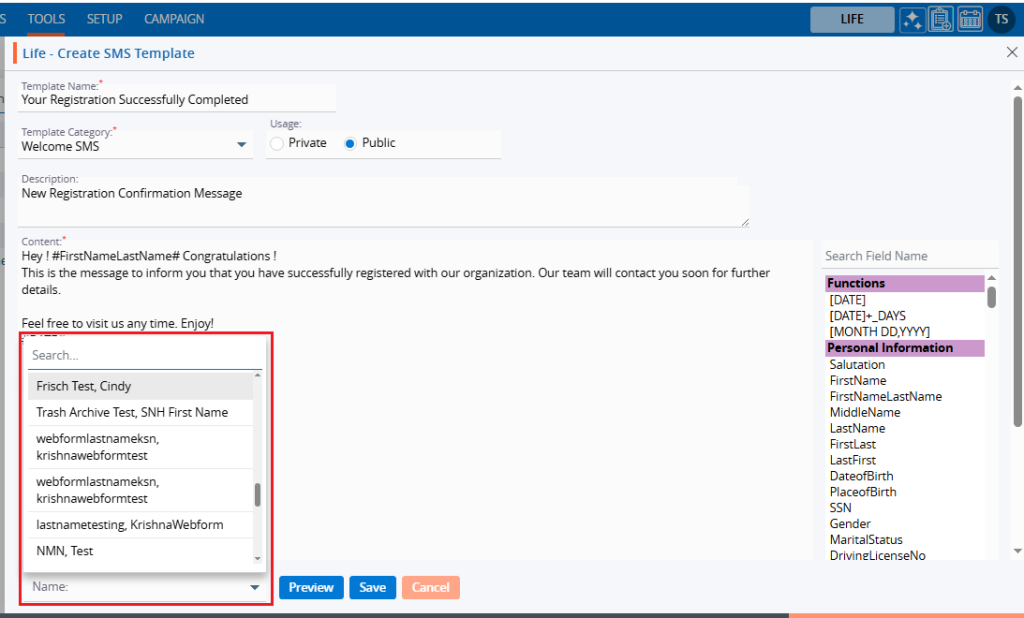
7. At the bottom, there is a dropdown. Click on the dropdown to open it.

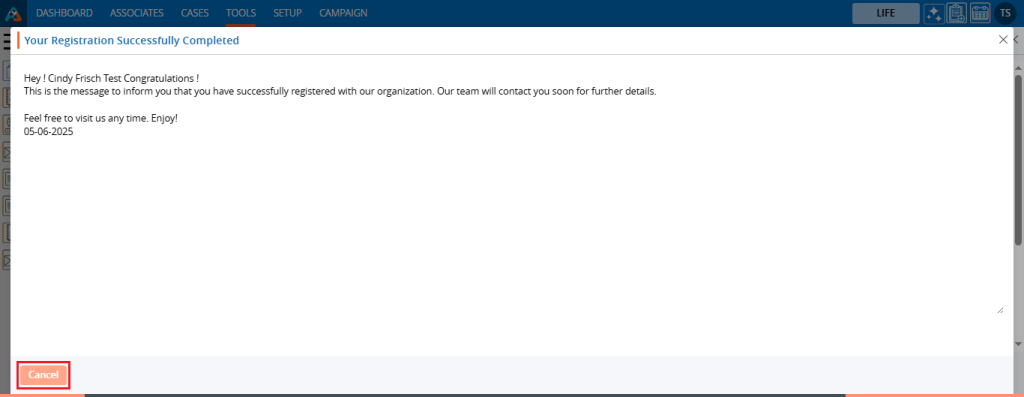
8. Select the associate from the list of associates from the dropdown and click the ‘Preview’ button to view a preview of the template.

9. A pop-up window will appear, showing the template details in preview mode. Click the ‘Cancel’ button to close the window.

10. Click the ‘Save’ button to save the template.

11. A confirmation message will appear and the template is created.  The user will find the newly created template and its details in the list.

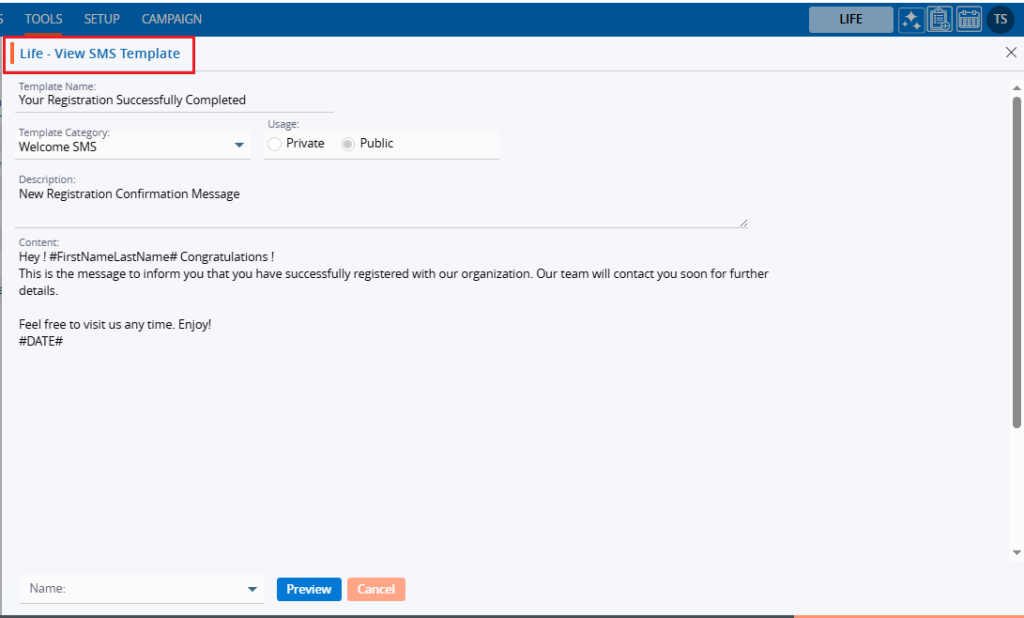
12. Click on the ‘View’ icon to view the existing Template.

13. A pop-up window will open, where the user can view the details of the template in read-only.

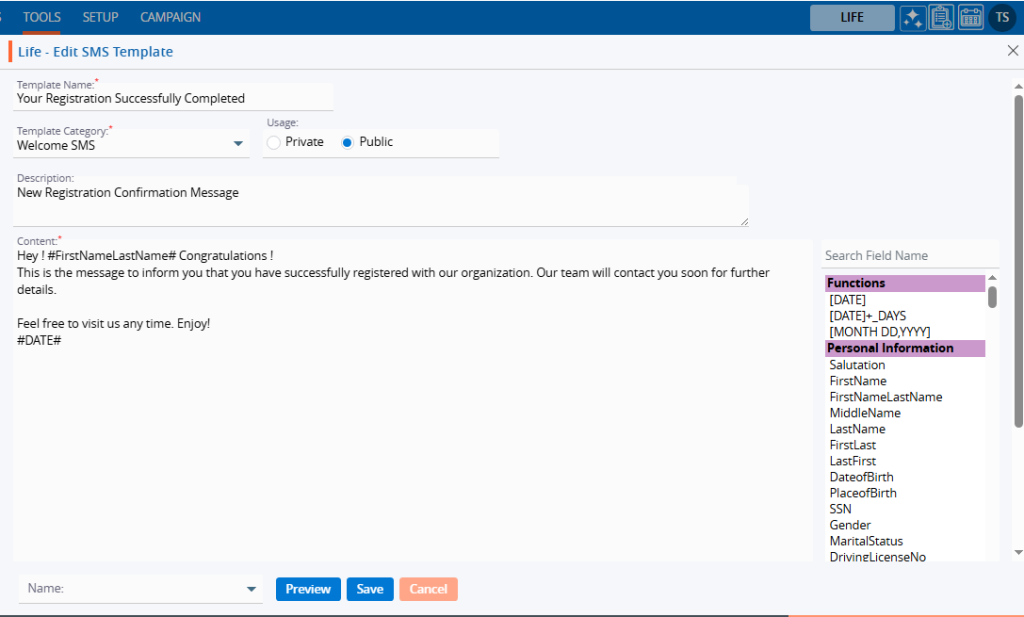
14. Click on the ‘Edit’ option to modify the template.

15. A pop-up window will open, allowing the user to update any details related to the template.

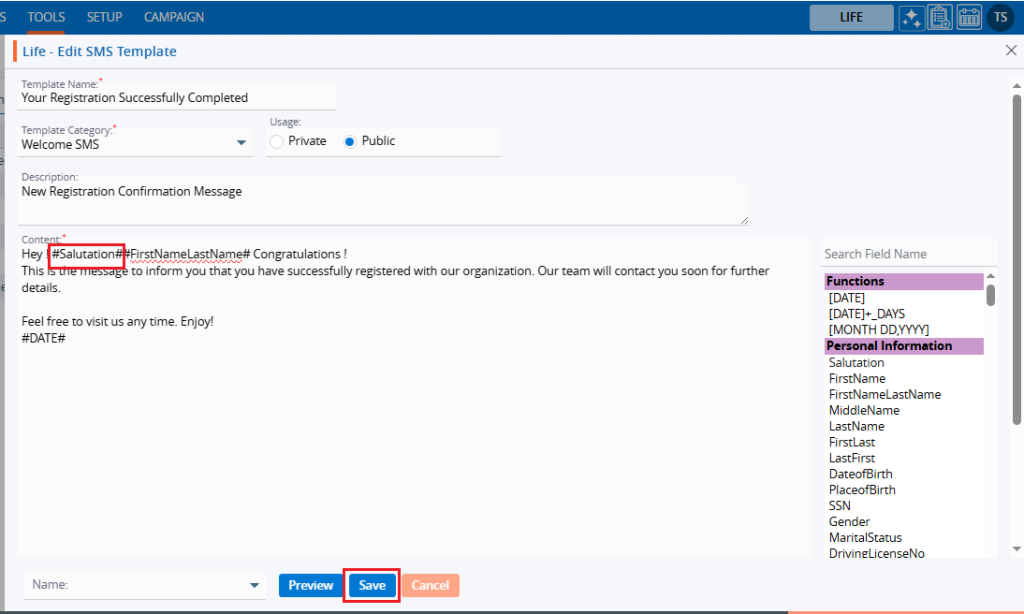
16. Update the details to modify the template. For example, add the ‘Salutation’ field. After making changes, click the ‘Save’ button.

17. A confirmation message will appear indicating that the template has been updated.

18. Select the ‘Delete’ option to remove the template from the list if it is no longer needed.

19. Click the ‘Delete’ option in the confirmation message to proceed with removing the template from the list.

20. A confirmation message will appear, indicating that the template has been deleted and is no longer available in the list.

0
0